Imagine if nearly everyone who lived in a city lived in the same city. That's what this measure captures: how much of a country's urban population is concentrated in its single largest city, rather than spread across a network of regional centres. A high score means one city dominates everything — jobs, government, culture, money. A low score means a country has built several major hubs instead of relying on one.
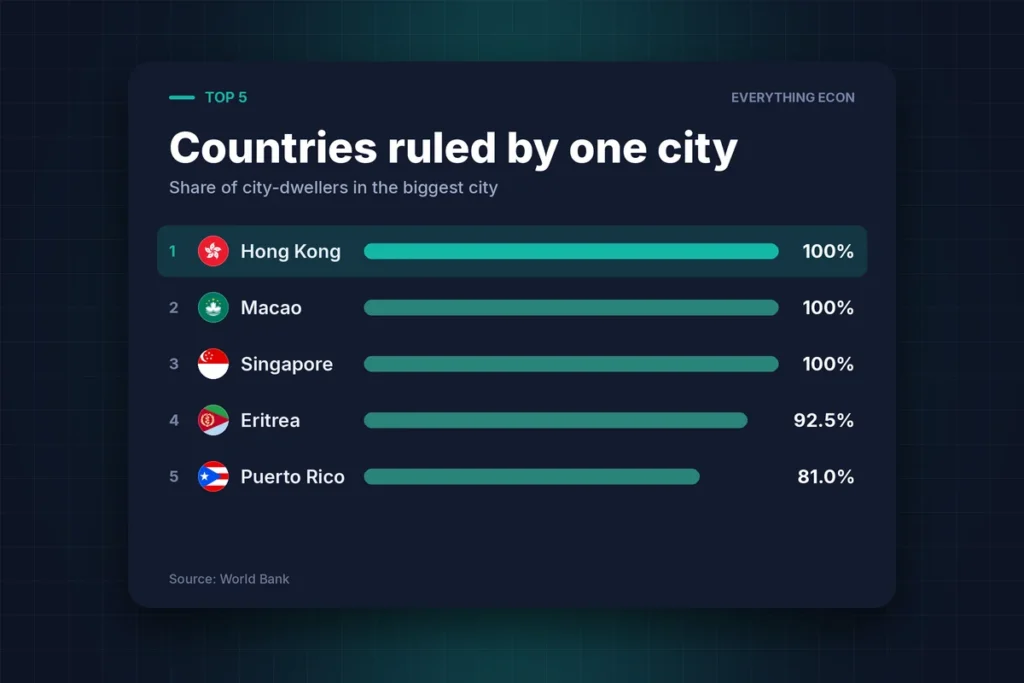
At a glance · Top 5
Share of city-dwellers in the biggest city
- 1Hong Kong100%
- 2Macao100%
- 3Singapore100%
- 4Eritrea92.5%
- 5Puerto Rico81.0%
Source: World Bank
When One City Is the Whole Country
The very top of the ranking is dominated by places that are barely "countries" in the traditional sense at all. Hong Kong, Macao and Singapore all sit at exactly 100%, because they are city-states — there is no other city to share the population with, since the city is the country.
Once you move past the city-states, the picture gets more interesting. Eritrea leads the pack of proper nations at 92.5%, a legacy of Italian colonial planners who built up Asmara as the country's administrative and economic showpiece in the 1930s — a role it never relinquished. Paraguay tells a similar story at 73.5%: decades of centralised government and industry poured investment into Asunción, leaving little room for a rival city to grow. Puerto Rico (81.0%) and Trinidad and Tobago (74.0%) round out the top ten, both standing out as striking exceptions in a region that, as we'll see, is usually far more balanced.
Why Some Countries Spread the Load
At the other end of the table are countries that did the opposite — deliberately or otherwise — and grew several big cities instead of one dominant capital. China sits at just 3.3%, the lowest score in the entire ranking, a direct result of urban-planning laws introduced in 1990 that put a lid on how large any single megacity could grow. Germany is close behind at 5.2%, having developed a genuinely polycentric layout with Berlin, Hamburg, Munich and Frankfurt all pulling economic weight rather than one city hoovering it all up.
India (6.6%) and Indonesia (6.9%) land near the bottom for a related but distinct reason: not planning restrictions, but sheer scale. Both countries have enormous populations spread across dozens of cities that have each grown past the million mark, so no single metropolis can claim a dominant share. The Netherlands sits right alongside Indonesia at 6.9%, and the United States, at 7.0%, shows the same pattern — its urban weight is split between New York, Los Angeles, Chicago and a long list of others.
Regionally, this produces an interesting twist: North America actually posts the world's highest average concentration, at 37.7%, entirely because of outliers like Puerto Rico and Trinidad and Tobago dragging the average up, even as the region's biggest economy, the United States, sits near the bottom of the individual rankings.
The Numbers Behind the Story
Beyond the city-states, the countries that top this ranking share a common thread: history concentrated power, people and investment in one place, and nothing since has pulled it back apart. Kuwait (70.0%), Panama (67.9%) and Mongolia (67.9%) all follow this pattern, with a single capital acting as the undisputed centre of national life.
Ultimately, this ranking is less about the size of a country's biggest city and more about balance — whether a nation has built alternatives to it. Countries with the lowest scores, from China to Germany to India, have each arrived at that balance through very different routes: legal caps, historical polycentrism, or simply too much population to funnel into one place.
Source: World Bank.
Get a new data story like this every week — join the newsletter.
Browse every visualisation on the visualisations page.