Governments face constant trade-offs when deciding where to put public money, and education is one of the biggest line items on any national budget. This ranking looks at how much each country spends on public education as a share of its entire economy (its GDP) — a measure that shows how much of a nation's wealth is being ploughed into schools and universities, regardless of how rich or poor that nation is. The gap between the top and bottom of the table is enormous: some countries put more than one in every eight pounds of national income into education, while one country reports spending nothing on it at all.
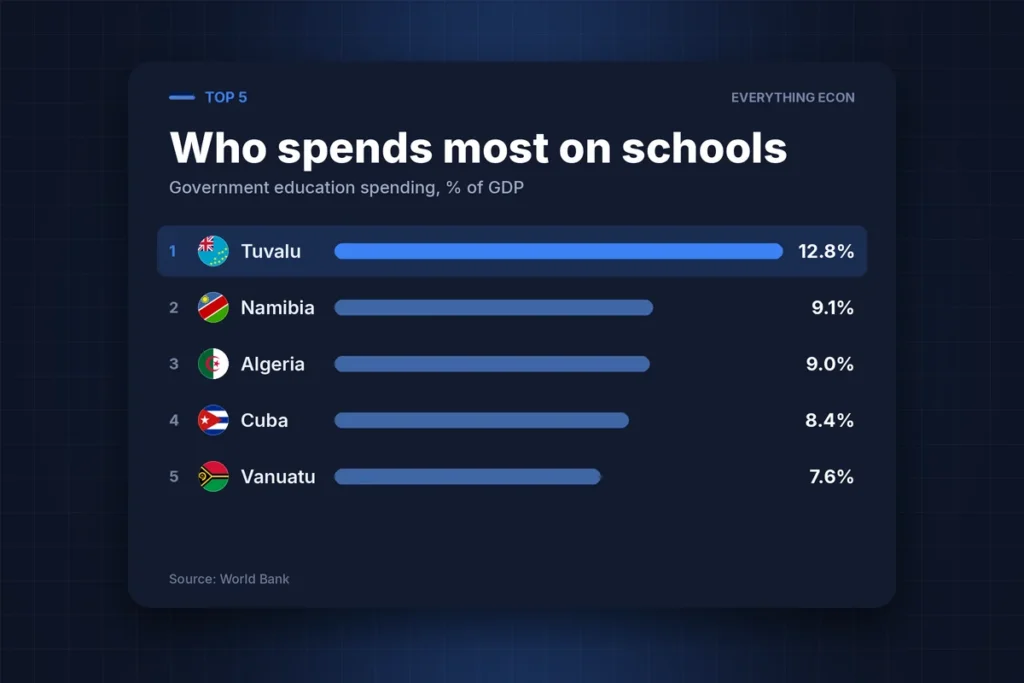
At a glance · Top 5
Government education spending, % of GDP
- 1Tuvalu12.8%
- 2Namibia9.1%
- 3Algeria9.0%
- 4Cuba8.4%
- 5Vanuatu7.6%
Source: World Bank
The high spenders: small states and old ideals
Several of the countries at the top are small, and that matters. In a small economy, a relatively modest school budget can still represent a large slice of GDP, which helps explain why Pacific island nations like Vanuatu (7.6%) sit so high on the list. But size isn't the whole story. Sweden (7.3%) and Iceland (7.3%) are wealthy, well-established economies that have long treated heavy public investment in education as a cornerstone of their welfare model, not a temporary push.
Then there's Cuba, in fourth place at 8.4%. That figure is actually a decline — Cuba spent 9.4% of GDP on education in 2021 and peaked at 14.1% back in 2008. Education has historically been a flagship of Cuban state policy, so even its reduced spending today still ranks among the highest in the world.
Oil money tells a different story further down the top ten. Algeria spends 9.0% of GDP on education, third overall, funded largely by revenue from its oil exports. Its neighbour Mauritania spends 7.6%, well above what most countries in the region manage, showing that resource wealth can be redirected into classrooms rather than just infrastructure or subsidies.
Where the big economies actually land
None of the world's largest economies come close to the top of this ranking, which says something about how spending shares work: bigger GDPs mean even large absolute education budgets look smaller as a percentage. The United States spends 5.4% of GDP on education, narrowly ahead of Germany at 5.2% and the United Kingdom at 5.0%. Japan, despite being one of the richest countries in the world, spends just 3.3%, among the lowest in the OECD. China and India, two economies at very different stages of development, spend almost identical shares — 3.9% and 4.1% respectively — a reminder that spending share doesn't track a country's stage of economic development in any simple way.
The bottom of the table, and the surprise at the top
The lowest-ranked countries share a common thread of strained public finances. Nigeria spends just 0.3% of GDP on education, and its 2025 budget allocation for education actually fell by 18% compared with the year before. Zimbabwe (0.4%), Papua New Guinea (0.8%) and Haiti (1.0%) all report spending under 1%, reflecting economies where government budgets are stretched thin across many competing needs. At the very bottom, Somalia reports spending 0.0% of GDP on education — the lowest figure recorded anywhere, a stark illustration of what happens when a state has almost no capacity to fund public services at all.
At the very top of the ranking, ahead of every country in the world, is Tuvalu, spending 12.8% of its GDP on public education. Tuvalu is one of the smallest nations on Earth, both in population and economic size, and that scale is part of the explanation: a small number of schools and students can still add up to a very large share of a tiny economy. But the figure also reflects a genuine national priority, placing Tuvalu well clear of the next-highest spenders, Namibia (9.1%) and Algeria (9.0%).
Source: World Bank.
Get a new data story like this every week — join the newsletter.
Browse every visualisation on the visualisations page.