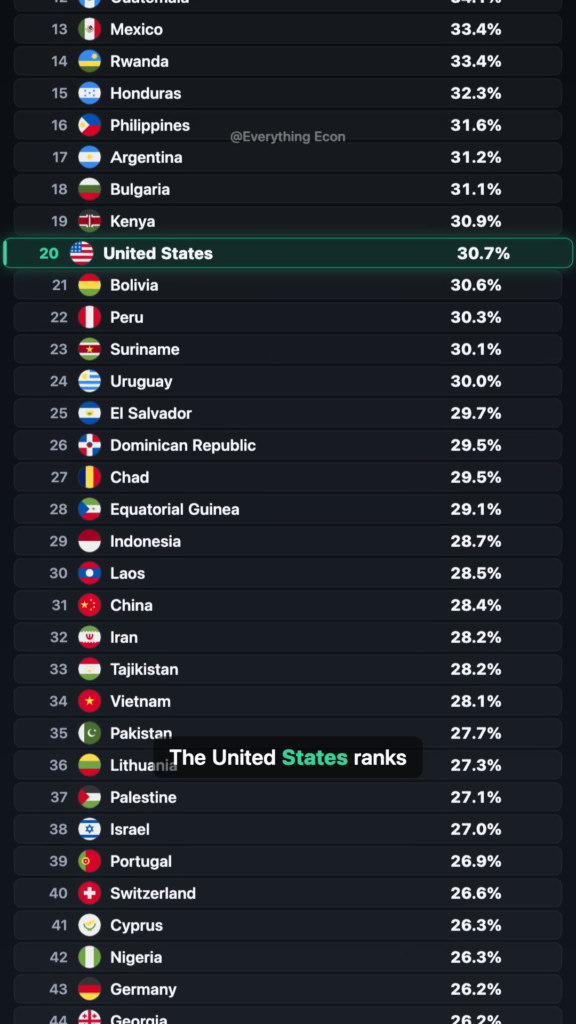
Inequality can be measured many ways, but one of the simplest is this: what share of a country's total income goes to the richest 10% of its people? The World Bank tracks exactly this across 83 countries, and the results split the world into two clear camps. In some places, the top tenth of earners take well over a third of everything earned. In others, they take barely a fifth. That gap — more than 20 percentage points between the most and least concentrated economies — says a lot about how income is actually distributed once you look past the average.
Latin America's Persistent Pattern
Look down the top of the ranking and one region dominates. Colombia leads at 42.7%, but Brazil (39.3%), Panama (37.6%), Ecuador (35.1%), Paraguay (35.0%), Chile and Costa Rica (both 34.3%), Guatemala (34.1%), Mexico (33.4%) and Honduras (32.3%) all crowd into the top 15. It's not a coincidence: South America's regional average is 33.9%, the highest of any region in the world and almost 10 percentage points above Europe's typical level. This pattern has deep roots in land ownership, education access and labour markets that have historically concentrated opportunity among a small elite, and it has proven strikingly persistent across decades of economic growth.
Africa makes its presence felt too, with South Africa in second place at 42.1% and Mozambique third at 40.8%. South Africa's case is worth a pause: even the World Bank's 42.1% is likely an understatement. Other researchers using pretax income data (which captures earnings before taxes and benefits reshuffle them) put South Africa's true top-10% share closer to 70%, which would make it the most unequal major economy on record by that measure.
The Most Equal Corner of the World
At the opposite end, Central and Eastern Europe stands out for the opposite reason. Slovakia sits last among all 83 countries at just 18.8%, with Slovenia (20.6%) and Czechia (21.5%) close behind. These are former communist countries, and decades on, their income structures still bear that legacy: strong wage compression, extensive public services, and a much smaller gap between typical and top earners than in most of the world. Norway, at 21.6%, shows the same pattern can emerge from a very different starting point — a small, high-income economy with strong redistribution through taxes and social spending.
It's worth noting that where you draw the income line changes the picture. The United States doesn't appear in the World Bank's top 15 at all, but alternative estimates that count income before government redistribution put its richest 10% at 46.8% of national income — a reminder that "inequality" numbers can shift a lot depending on methodology, even before comparing across countries becomes tricky.
The Number One: Colombia
Colombia tops the ranking outright, with its richest 10% capturing 42.7% of national income — more than double the share seen in Slovakia. This isn't a recent shift either: high inequality has been a long-running feature of Colombia's economy, tied to concentrated landownership, an informal labour market that leaves many workers without stable wages, and regional divides between wealthier cities and poorer rural areas. It's a useful case study in how a fast-growing, middle-income economy can still see the gains cluster heavily at the top.
What's striking across the whole ranking is how consistent the regional stories are — geography and history seem to matter as much as current growth rates in shaping who captures the gains from an economy.
Source: World Bank.
Get a new data story like this every week — join the newsletter.
Browse every visualisation on the visualisations page.