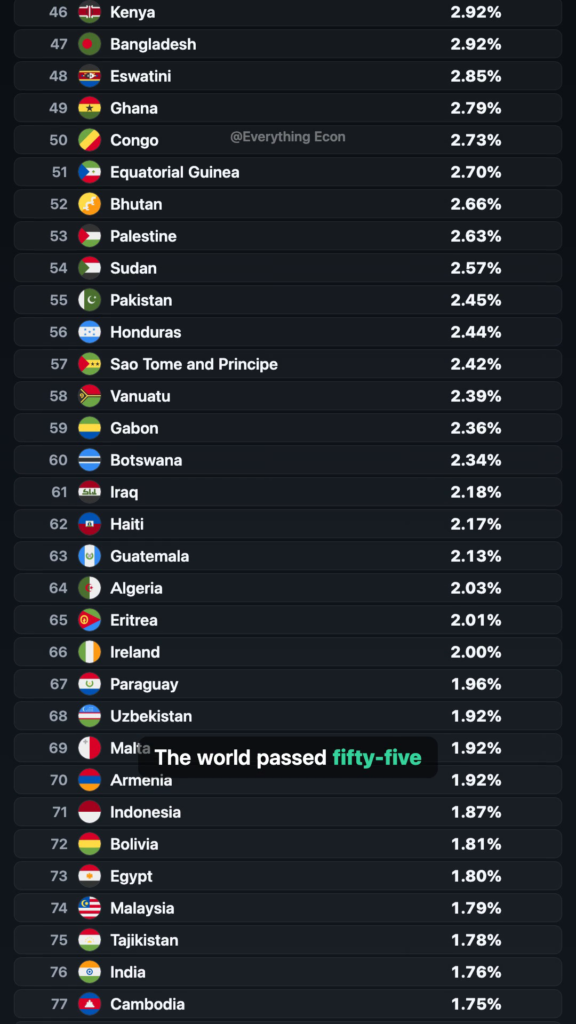
Every year, the World Bank tracks how fast the urban population of each country is growing — that is, how quickly people are moving into or being born in cities relative to the year before. A country near the top isn't necessarily getting richer or bigger overall; it just means its cities are swelling fast, whether from births, migration from the countryside, or people fleeing conflict. A country at the bottom is seeing its urban population shrink. The range this year runs from Burundi at a blistering 5.80% growth down to Moldova, which is actually losing population, at -1.26%. That gap says a lot about which parts of the world are under pressure to build housing, schools and roads — and which are quietly emptying out.
The Sahel and East Africa are filling up fast
The top of the list is dominated by a band of African countries: Burundi (5.80%), Chad (5.74%), Rwanda (5.55%), Niger (5.00%), Mozambique (4.95%), Tanzania (4.81%), Uganda (4.80%), Mali (4.80%), Ethiopia (4.59%), Malawi (4.43%), Central African Republic (4.34%), Somalia (4.29%) and Burkina Faso (4.26%). This isn't a story of glossy economic booms. In Burundi, conflict and pressure on farmland are pushing people into the capital, Bujumbura. Chad's cities, led by N'Djamena, are absorbing people displaced by Sahel conflict and worsening desertification. Niger shows the same pattern into its capital, Niamey, layered on top of one of the highest birth rates on Earth. Across this belt, cities are growing not because life there is easy, but because the alternative — staying on land that's becoming harder to farm, or in areas hit by violence — is worse.
The Gulf tells a completely different story
Sitting right alongside the Sahel countries are two Gulf states: the United Arab Emirates (4.85%) and Saudi Arabia (4.82%). Their fast growth comes from the opposite driver — money, not desperation. In the UAE, expatriate workers make up a staggering 89% of the population, and most of them live in cities like Dubai and Abu Dhabi. Saudi Arabia's growth is milder but still expat-fuelled, with foreign workers at 37% of its population feeding cities such as Riyadh. Dubai is the extreme case: from 1972 to 2011 it averaged roughly 10% annual growth, one of the fastest sustained city booms ever recorded anywhere. It's a reminder that the same growth rate can mean two very different things — one country's cities absorb people running from hardship, another's absorb people chasing high wages.
What sets the pace elsewhere, and who's shrinking
Beyond this top tier, the bigger population stories move more slowly. Nigeria's Lagos is expected to add about 77 new residents every hour through 2030, pushing it towards 30 million people by 2035 — huge in absolute terms, even if Nigeria itself doesn't crack the top 15. China's urban growth, which once ran at 7.29% per decade, has now peaked and is slowing sharply as its cities mature. India, by contrast, is still early in this process, urbanising at only about 2.7% per decade and remaining just 37% urban, compared with China's 66%.
At the very bottom, the picture flips entirely. Albania (-0.61%), Kuwait (-0.65%), Monaco (-0.75%) and Latvia (-0.77%) are all seeing their urban populations decline, largely through ageing and outward migration. Moldova is the extreme case, at -1.26%: the country has lost roughly a quarter of its population between 2020 and 2024, as people — especially the young — leave for work elsewhere in Europe.
So the fastest-growing cities in the world right now belong to Burundi. At 5.80% annual urban growth, it narrowly edges out Chad and Rwanda, and its story is really about scarcity: a small, land-locked country where conflict and shrinking farmland are pushing more people than ever into Bujumbura, faster than almost anywhere else on the planet.
Source: World Bank.
Get a new data story like this every week — join the newsletter.
Browse every visualisation on the visualisations page.