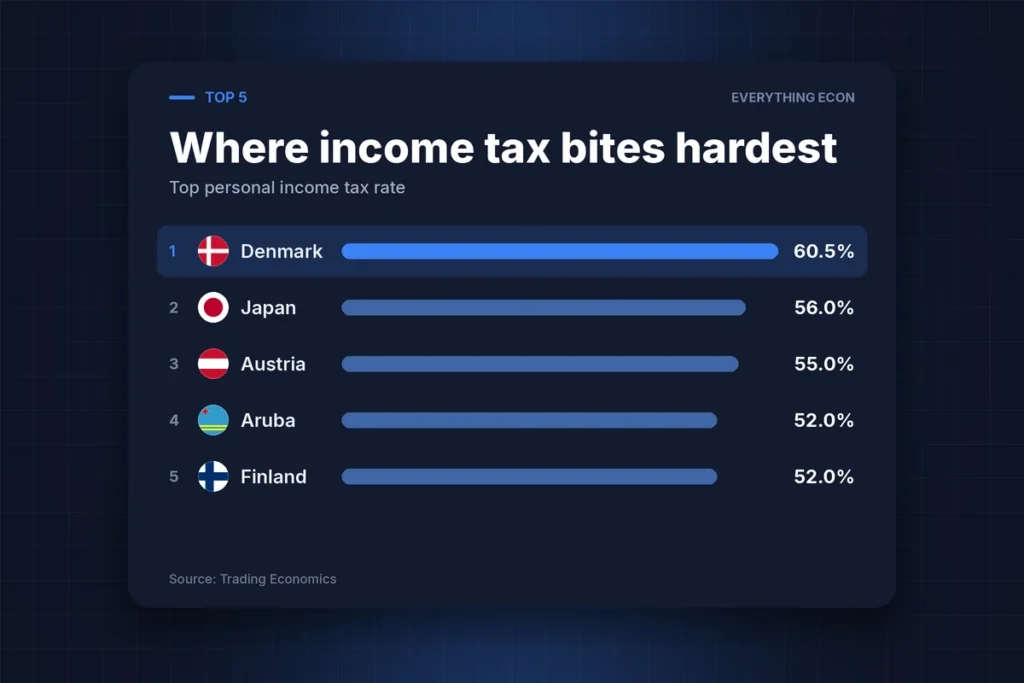
Every country decides, in its own way, how much of a high earner's income belongs to the state rather than the individual. The figures below track the top personal income tax rate — the percentage taken from the highest slice of a person's earnings once they cross into the top bracket, not their entire income or their entire pay packet from the first pound. It's one of the clearest signals of how a government funds itself, and the range is startling: from over 60% at one end to a flat zero at the other.
At a glance · Top 5
Top personal income tax rate
- 1Denmark60.5%
- 2Japan56.0%
- 3Austria55.0%
- 4Aruba52.0%
- 5Finland52.0%
Source: Trading Economics
Europe's high-tax club
Nine of the top ten spots belong to Europe, and the pattern is consistent: high top rates paired with heavily funded public services. Austria (55.0%), Belgium (50.0%), Slovenia (50.0%) and the Netherlands (49.5%) all sit comfortably above 45%, and Portugal (48.0%) and Spain (47.0%) aren't far behind. Iceland, a small economy, still charges 46.3%. The two Nordic countries in the list — Denmark and Sweden, both at or above 52% — are the clearest examples of a broader trade-off: steep taxes on high earners funding taxpayer-backed healthcare, free university education, generous parental leave and a strong social safety net. Sweden's 52.0% and Finland's 52.0% show this isn't a one-country quirk but a regional approach shared across the Nordics.
Outside Europe, the picture is more mixed. Israel (50.0%) matches the European top tier, while Japan (56.0%) actually outranks every European country bar Denmark. Japan's rate is a combination of a 45% national bracket plus a 2.1% surtax introduced after the 2011 earthquake to fund reconstruction — a temporary-sounding levy that is legislated to run all the way through 2037.
The middle and the outliers
China lands at 15th place with a 45% top rate — a figure that has not moved since at least 2003, one of the most static tax rates anywhere in the world. Yet China also carves out an exception: foreign professionals working in special economic zones such as Qianhai and Hainan can pay an effective rate of just 15%, a deliberate policy to attract international talent.
Two of the world's largest economies sit further down the pack than many would expect. The United States charges 37% for 2025 — lower than most of Western Europe and even below China. India comes in at 39% once cess and surcharge are added on top of the base rate; that figure has averaged around 35% since 2004 and peaked at 42.74% back in 2020.
At the very bottom of the ranking, five countries charge nothing at all: Brunei, Kuwait, Oman, Qatar and Saudi Arabia all list a 0.0% top income tax rate. These are overwhelmingly oil-funded economies. The UAE, which also charges 0% income tax, is sustained by roughly $100 billion in oil revenue generated in 2025, according to IMF estimates. But "zero tax" doesn't mean these governments raise no revenue at all — the UAE runs a 9% corporate tax, and most Gulf states apply a value-added tax of 5-15% on everyday purchases, effectively shifting the tax burden from income to consumption.
Denmark takes the top spot
Denmark leads the entire ranking at 60.5%, a rate reached through a 2026 reform that stacked a national rate, a municipal tax of roughly 25%, and an 8% labour market contribution into a single combined figure. It's worth noting this isn't a permanent high: Denmark's top rate has swung significantly over time, from a record 65.9% in 1997 down to a record-low 55.4% in 2010, before climbing back up to today's 60.5%. As with its Nordic neighbours, that tax bill comes bundled with free healthcare, tuition-free university and one of the world's more comprehensive welfare systems.
Source: Trading Economics, 2025-2026 data.
Get a new data story like this every week — join the newsletter.
Browse every visualisation on the visualisations page.
Take one home
Every country drawn to scale, as an instant printable download or a museum-quality matte poster printed to order.