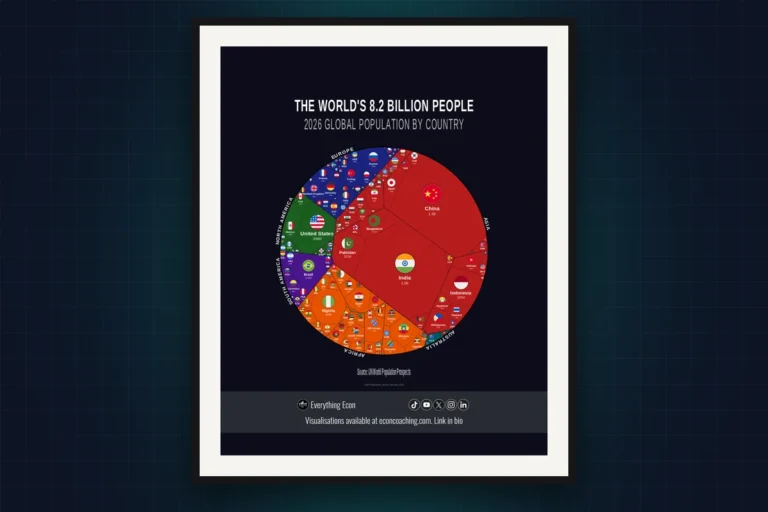
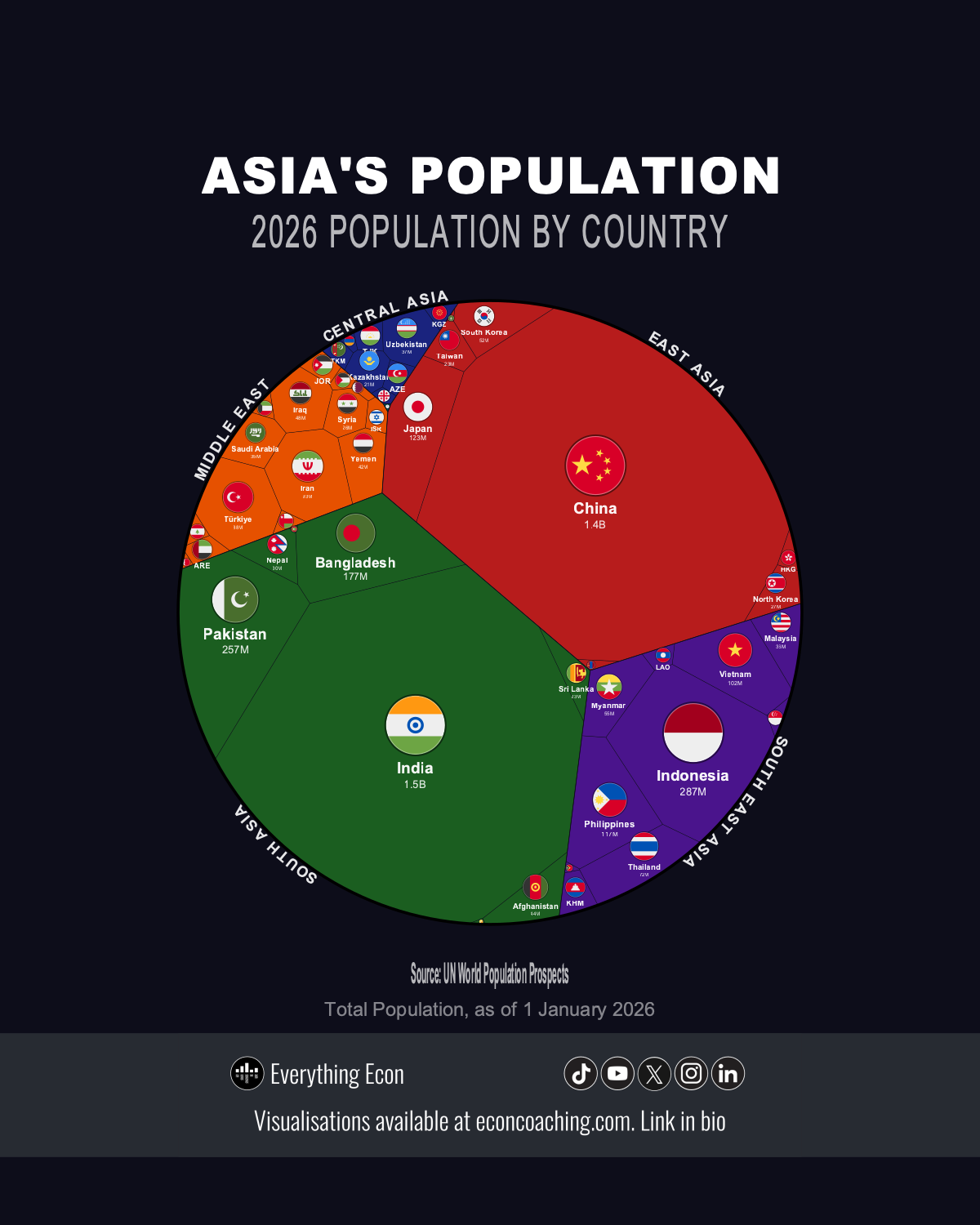
The treemap accompanying this article places India and China side by side as two enormous blocks — and then shows everything else in Asia as a fraction of those two. Indonesia, the third most populous country on the continent at 286.8 million, appears as a sliver against India's 1.470 billion. That visual compression is accurate. Asia's top two countries alone account for roughly 60% of the continent's 4.76 billion people, and the demographic trajectories of those two blocks are now pointing in opposite directions with increasing force.
India and China: The Same Starting Point, Opposite Destinations
In 1971, India and China had nearly identical total fertility rates of just under six births per woman. Divergent policy choices — China's one-child policy from 1980, India's slower voluntary transition — set the two countries on radically different paths. India formally overtook China as the world's most populous country in April 2023, and by 2026 the gap has widened to roughly 55.8 million people: India at 1.470 billion, China at 1.414 billion. China's population fell for a fourth consecutive year in 2025, declining by 3.39 million to approximately 1.405 billion — the steepest single-year loss yet. Births hit a multi-decade low of 7.92 million, roughly half the 18 million recorded in 2016, a collapse described by demographers as virtually unheard of in peacetime.
The structural nature of China's decline matters as much as the pace. Marriage registrations fell by a fifth in 2024 — the largest single-year drop on record — indicating that the birth rate contraction is driven by changed preferences around family formation, not merely a statistical hangover from the one-child era. The Shanghai Academy of Social Sciences projects China's population could fall from 1.4 billion today to approximately 633 million by 2100. Pronatalist incentives alone are unlikely to reverse a trend rooted in urban living costs and shifting cultural norms.
East Asia's Demographic Contraction Is Already Broad-Based
China is not alone. Japan's population peaked at 128 million in 2008 and has contracted continuously since 2011; it now stands at 122.8 million, a loss of roughly 4.4 million people in the decade to 2026. Japan's natural population deficit — the gap between births and deaths — was nearly 900,000 in 2025 alone. Japan has served as the demographic leading indicator for East Asia, and South Korea, Taiwan, and now China are following the same trajectory roughly one to two decades behind.
South Korea formalised that trajectory at end-2024, when it became a "super-aged" society with more than 20% of its population aged 65 or over. It reached that threshold in approximately seven years — compared with 11 years for Japan and 19 years for all of Europe, a compression that reflects how rapidly fertility collapsed. South Korea's total fertility rate hit a record low of 0.72 in 2023, the lowest of any OECD country. It has since edged up to around 0.80 in 2025, the largest annual increase since 2010, suggesting aggressive government pro-natalist spending may be producing a marginal effect. At 0.80, however, South Korea remains less than half the 2.1 replacement level, and East Asia remains the only Asian sub-region projected to sustain negative population growth continuously through 2050.
South Asia's Growth Engine and Pakistan's Understated Scale
While East Asia contracts, South Asia is the continent's primary source of population growth. India, Pakistan, Bangladesh, Afghanistan, and Nepal together account for roughly 43% of Asia's entire population — a share that has been rising since South Asia overtook East Asia as the most populous sub-region back in 2002.
Pakistan's position in that growth story is consistently underweighted in economic analysis. At 257.2 million, Pakistan ranks fourth in Asia, ahead of Bangladesh (176.8 million) and Japan (122.8 million). Its annual population growth rate of 2.55% is more than double India's 1.2% and more than double Bangladesh's 1.03%. UNFPA projects Pakistan will reach 403 million by 2050. Pakistan's total fertility rate currently stands at 3.5 — well above replacement and not expected to reach replacement level until around 2050. That trajectory raises a significant economic question: whether demographic transition will occur fast enough to generate a productivity dividend, or whether population growth will outpace the expansion of education infrastructure and formal employment. Bangladesh's dramatic fertility-rate reductions over recent decades demonstrate that rapid demographic transition is achievable in the region, but it required sustained investment in health and women's education that Pakistan has not yet replicated at scale.
Indonesia and the Mid-Tier Countries That Demographics Overlooks
Indonesia at 286.8 million holds the third spot in Asia and is the most populous country in Southeast Asia, yet it is routinely absent from population discussions dominated by India and China. The Philippines (117.3 million), Vietnam (101.9 million), Iran (92.8 million), and Thailand (71.6 million) round out the continent's second tier — each larger than any country in Western Europe, each frequently underrepresented in mainstream economic coverage relative to their actual demographic weight.
Asia's share of global population has declined from a peak of roughly 60.7% in 2001 to approximately 58.5–59% today, as Africa's faster growth gradually erodes the continent's relative dominance. Asia currently adds a net approximately 35 million people per year, and its total population is projected to peak at around 5.3 billion circa 2054–2055 before entering long-term decline.
The economic implications compound unevenly across sub-regions. Central Asia and the Middle East are the fastest-growing sub-regions on the continent, while East Asia faces a sustained workforce contraction that will weigh on domestic consumption, pension systems, and long-run GDP growth. The continent's demographic fault line in 2026 is not between Asia and the rest of the world — it runs directly through Asia itself, separating a South that is still building its labour force from a Northeast that is already past its demographic peak.
One chart like this in your inbox each week, explained in plain English — join the Everything Econ newsletter. Always free, and you can unsubscribe any time.
Take this one home
Get this visualisation as a download, wallpaper, or printed poster.
← Back to all visualisations & articles
Follow Everything Econ: YouTube · TikTok · X · Instagram · Facebook