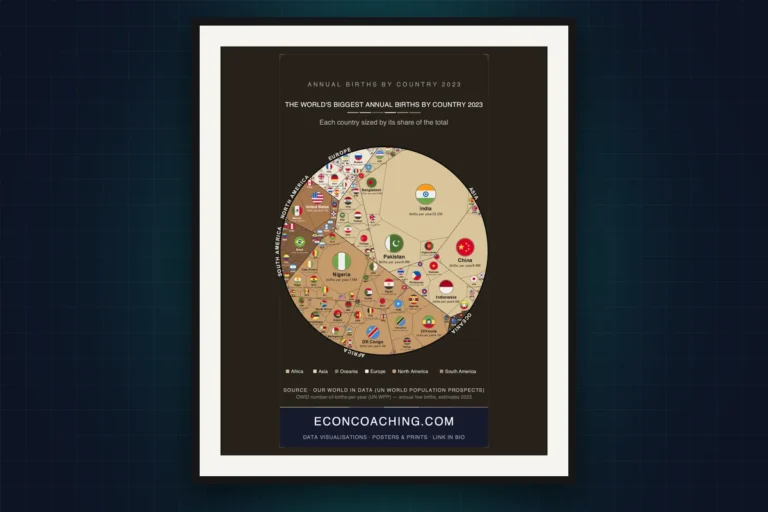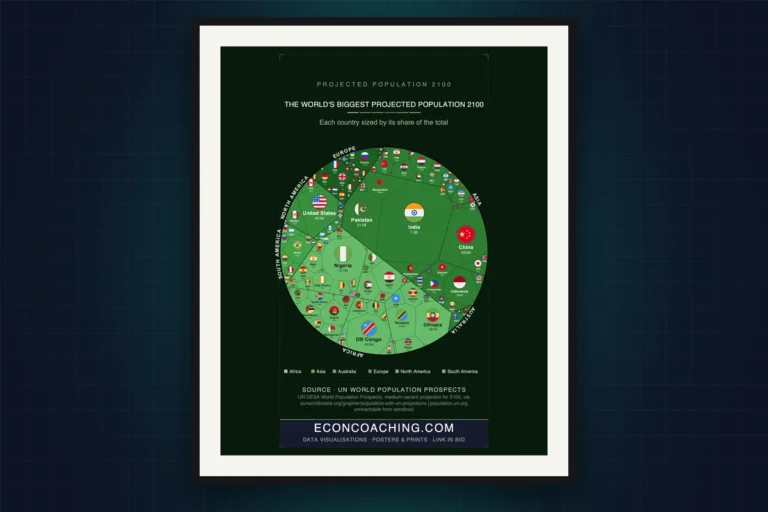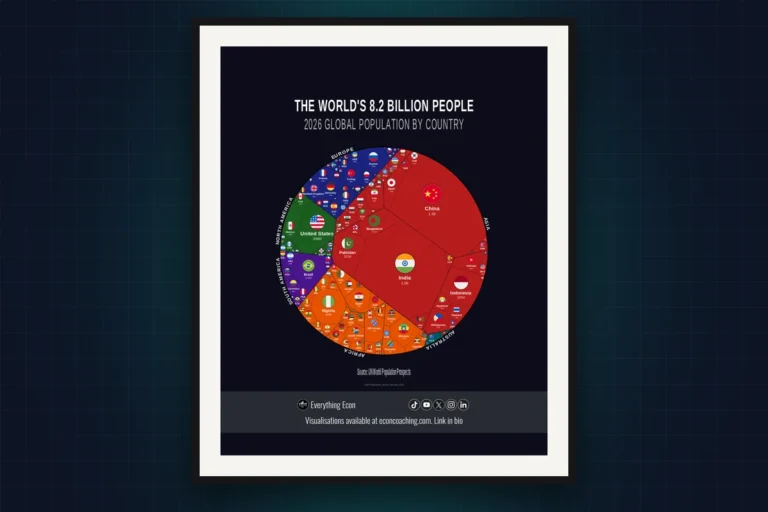
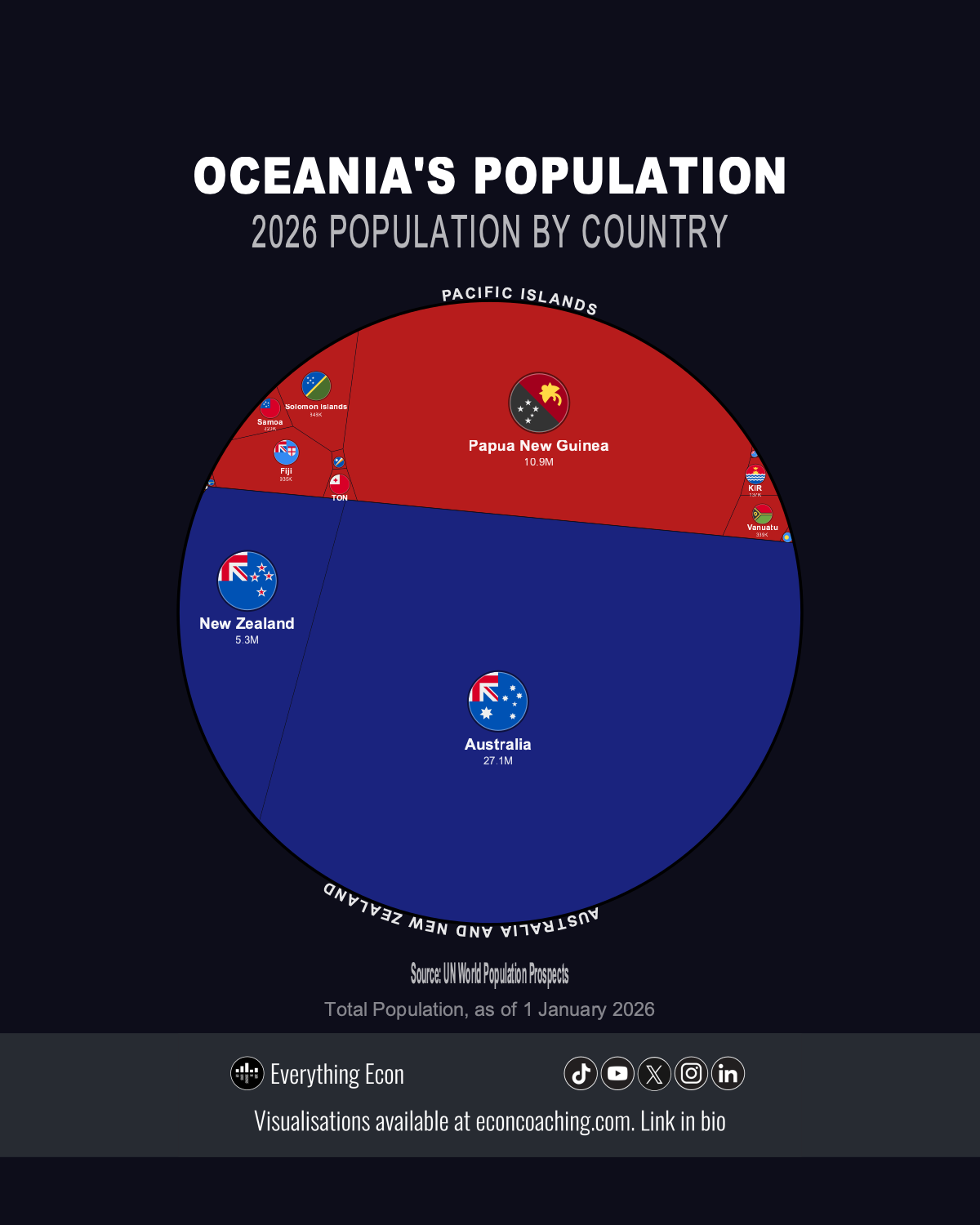
The treemap accompanying this article assigns cell area by population, not landmass — and the result immediately distorts every geographic instinct a reader brings to the Pacific. Australia, which occupies a continental landmass of 7.7 million square kilometres, holds 59.06% of Oceania's entire population: 27.1 million out of roughly 45.9 million people. Papua New Guinea, physically the second-largest country in the region, holds another 23.66%. New Zealand adds most of the remainder. The eleven Pacific island nations that fill out the rest of the chart are, in demographic terms, statistical footnotes — some measured in tens of thousands, one in single-digit thousands. Oceania as a whole represents just 0.56% of the world's 8.2 billion people, a total smaller than a single large Chinese or Indian province. Within that already-small region, the concentration of population into one country is the defining structural fact.
Australia's Population Engine Is Migration, Not Births
Australia reached 27.7 million residents by September 2025, adding 423,600 people in a single year — roughly the equivalent of a city the size of Canberra. The Australian Bureau of Statistics confirmed a 1.6% annual growth rate as of April 2026, but the mechanism driving that growth is migration rather than natural increase. Australia's total fertility rate is projected to fall to a record low of 1.45 babies per woman in 2024–25, well below the 2.1 replacement rate. Net overseas migration peaked at 435,000 in 2023–24, up from just 47,000 in 1993–94 — an almost tenfold increase over three decades. The result is that 32% of Australia's current population was born overseas, one of the highest proportions in any country globally, with India, England, China, and New Zealand as the leading countries of birth. The Centre for Population projects Australia will reach 31.5 million by 2035–36 and potentially 45.9 million by 2071 — meaning that within fifty years, Australia's population alone could equal the entire current Oceania regional total.
Papua New Guinea's Demographic Trajectory Is the Counterweight
Papua New Guinea, which holds 10.9 million people and 23.66% of the regional total, is the only other country in Oceania with demographic mass. Its median age is 24.0 years, against Australia's 39.5 — a 15.5-year gap that encodes two entirely different economic trajectories. PNG's population density stands at 24.2 people per km², nearly seven times Australia's 3.5, despite PNG covering a fraction of Australia's area. The UN World Population Prospects 2024 Revision projects PNG's population reaching 18.6 million by 2097, potentially more than doubling its current size — and progressively narrowing the gap with Australia as Australian fertility falls and PNG's high birth rate (approximately 3.9 children per woman) sustains momentum. PNG only gained independence from Australian administration in 1975, when its population was estimated at 2.7 to 3 million; it has since grown nearly fourfold. There is, however, a serious data reliability caveat: a 2022 UN satellite-imagery survey suggested PNG's population could already be as high as 17 million — nearly double the official estimate — which would raise PNG's regional share dramatically and make demographic planning across the Pacific even more uncertain than current figures suggest.
New Zealand's Growth Has Stalled
New Zealand, third in the regional ranking at 5.27 million, appeared until recently to be Oceania's reliably growing second tier. Stats NZ data shows net migration collapsed from a record 135,500 in the October 2023 year to just 8,600 by August 2025, pulling annual population growth from 2.3% in 2023 to 0.7% in the year to June 2025 — the slowest pace in a decade. New Zealand's fertility rate is also below replacement, meaning natural increase has now become the larger contributor to population growth for the first time in years. The assumption that the region's middle-tier nations are expanding robustly does not hold on current data.
The Pacific Microstates: Demographic Fragility at an Extreme
Below Australia, PNG, and New Zealand, the regional population falls off sharply. Fiji at 935,285 and Solomon Islands at 848,434 are the only other nations with populations above half a million. Nauru, the world's smallest republic at 21 square kilometres, holds just 12,063 people — 0.03% of the regional total. Tuvalu registers 9,420, recently falling below Nauru's count due to emigration pressure. The combined non-PNG, non-NZ, non-Australia population across the remaining Pacific Island nations is approximately 2.6 million people dispersed across an ocean area covering roughly 15% of the globe's surface — a configuration that makes basic governance, health services, and even reliable census-taking structurally difficult. The Marshall Islands illustrates the emigration dynamic clearly: it has lost roughly 21% of its population since 2017 through migration to the United States under a Compact of Free Association, a rate of outflow that births cannot offset.
Tuvalu and the Limits of Demographic Viability
Tuvalu's situation sits at the outer edge of what population data can represent. With 9,420 people on less than 10 square miles of low-lying coral atoll, the country gained independence from Britain in 1978 at a population of roughly 7,000 to 8,000 and has barely grown in nearly five decades. The UN estimates 95% of Tuvalu's land could be submerged by 2100. The Falepili Union Treaty, signed by Australia and Tuvalu in late 2023 and entering force in August 2024, allows 280 Tuvaluans per year to relocate to Australia permanently. When the first visa lottery opened in July 2025, more than 5,000 people applied — over half the entire national population — for 280 spots. This is not a migration trend in the conventional sense; it is the administrative mechanism by which a sovereign nation may cease to exist as a populated territory.
The structural story of Oceania in 2026 is one of extreme demographic concentration at the top and extreme fragility at the edges — with Australia projected to grow into a population that dwarfs even today's regional total, while some of the region's smallest nations face not just stagnation but physical disappearance.
One chart like this in your inbox each week, explained in plain English — join the Everything Econ newsletter. Always free, and you can unsubscribe any time.
Take this one home
Get this visualisation as a download, wallpaper, or printed poster.
← Back to all visualisations & articles
Follow Everything Econ: YouTube · TikTok · X · Instagram · Facebook