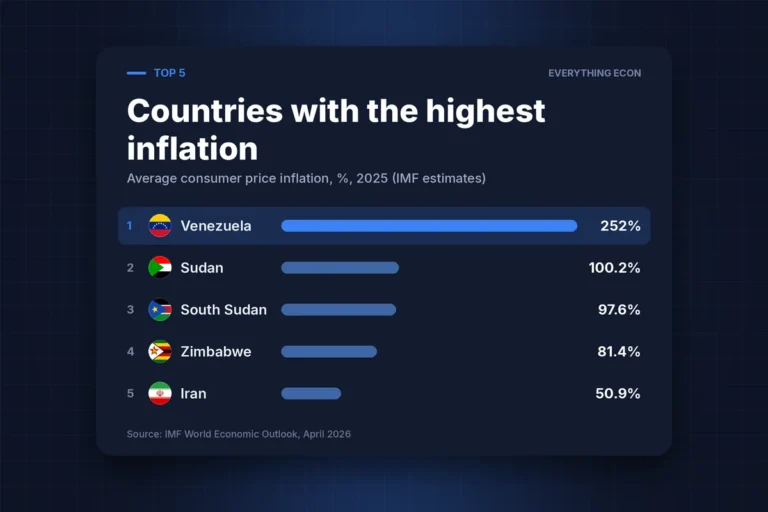
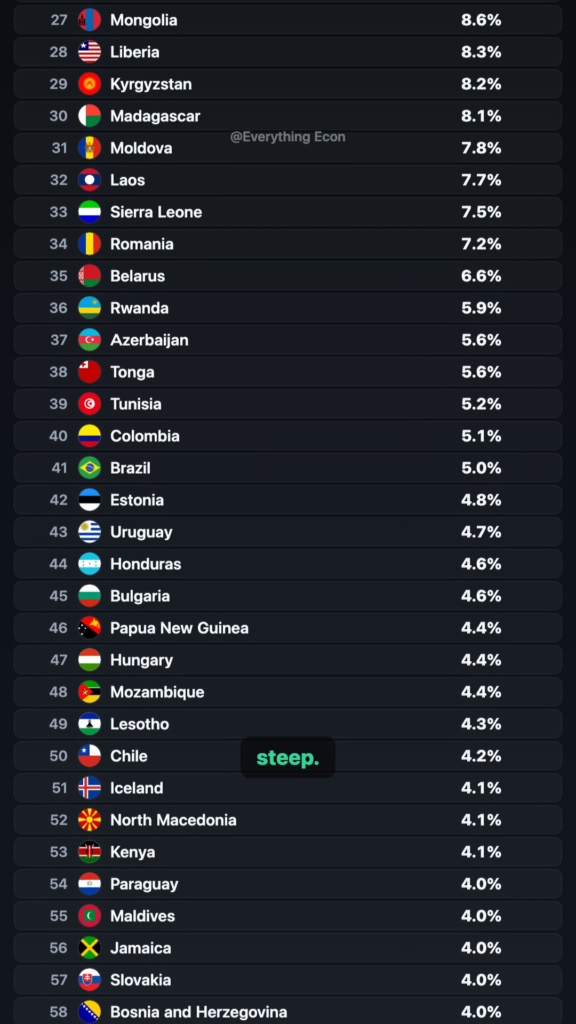
Inflation measures how quickly prices for everyday goods are rising. When inflation is high, the same wage buys less bread, less fuel, less of everything, month after month. The World Bank's figures show just how differently this is playing out around the world right now: in a handful of countries, prices are spiralling upward at a pace that erodes savings within weeks, while in a few others prices are actually falling.
Crisis economies at the top
The countries with the fastest-rising prices share a common thread: conflict, currency collapse, or governments printing money to cover their bills. Sudan's inflation stands at 138.8%, a direct consequence of civil war tearing apart its currency and food supply chains. South Sudan, also gripped by conflict, posts 91.4%. Zimbabwe's 104.7% rate is a case of history repeating itself — the government has leaned on printing money to fund spending, echoing the hyperinflation crisis the country lived through in the 2000s.
Elsewhere, the picture is less about war and more about economic policy catching up with reality. Nigeria's 23.0% inflation followed the government's decision to scrap long-standing fuel subsidies and let its currency float freely in 2023 — a painful but deliberate reset. Lebanon's 14.6% is the lingering aftershock of a banking collapse and currency crash that ran from 2021 to 2023, and while prices are still climbing, the pace has slowed considerably from the depths of that crisis.
A mixed picture across regions
There's no single region driving this ranking — it's unevenly spread across Africa, the Middle East, and South America. Sub-Saharan Africa features heavily in the top 15, with Sudan, South Sudan, Burundi (34.1%), Malawi (28.4%), Nigeria, and Angola (20.2%) all posting double-digit or higher rates, often tied to currency weakness and import costs. The Middle East shows up through Iran (42.2%) and Lebanon, both shaped by sanctions, isolation, or financial system breakdowns. Latin America's entry is more surprising: Bolivia at 19.5%, driven by fuel and foreign currency shortages.
At the other end of the scale, a small group of countries are seeing prices fall rather than rise. Afghanistan sits at the very bottom with -6.6%, reflecting an economy in deep contraction rather than any success story. Sri Lanka, at -4.8%, is cooling down after its own sovereign default crisis in 2022 — a sign of stabilisation rather than strength. Chad and Niger, at -3.9% and -4.5%, are kept steady by their shared currency, the CFA franc, which is pegged to the euro and limits how wildly prices can swing in either direction.
Argentina's extraordinary number one
Topping the entire ranking is Argentina, where prices rose by 219.9% — more than double the rate of second-placed Sudan. This is the result of years of government overspending, heavy money-printing, and a currency that has struggled to hold its value. It's worth noting, though, that this figure is already out of date in one important sense: since taking office, President Javier Milei has pushed through aggressive austerity measures, and by 2025 Argentina's inflation rate had fallen to roughly 31.5% — a dramatic drop, even if the country still ranks among the world's most expensive places to watch your money shrink.
Turkey tells a similar story of recent improvement. Its 34.9% rate, which placed it sixth, had already fallen by around 13 percentage points in 2025, slowing further to 31.1% by November — a reminder that these figures are a snapshot, not necessarily where things stand today.
Data source: World Bank.
Get a new data story like this every week — join the newsletter.
Browse every visualisation on the visualisations page.