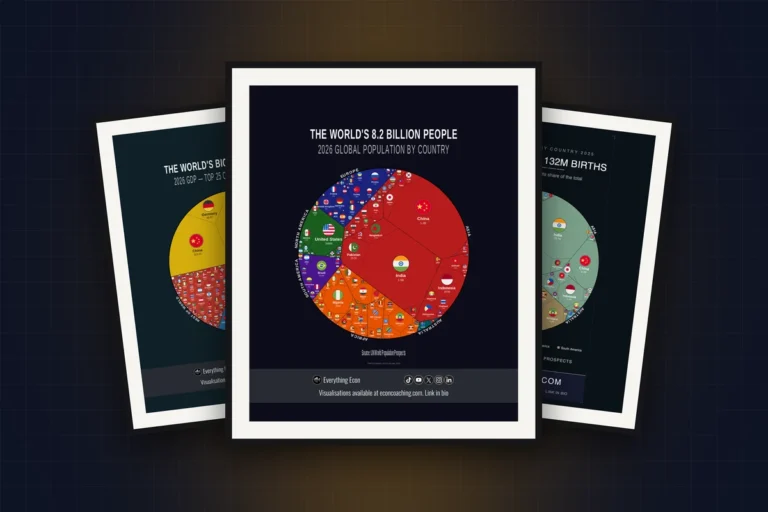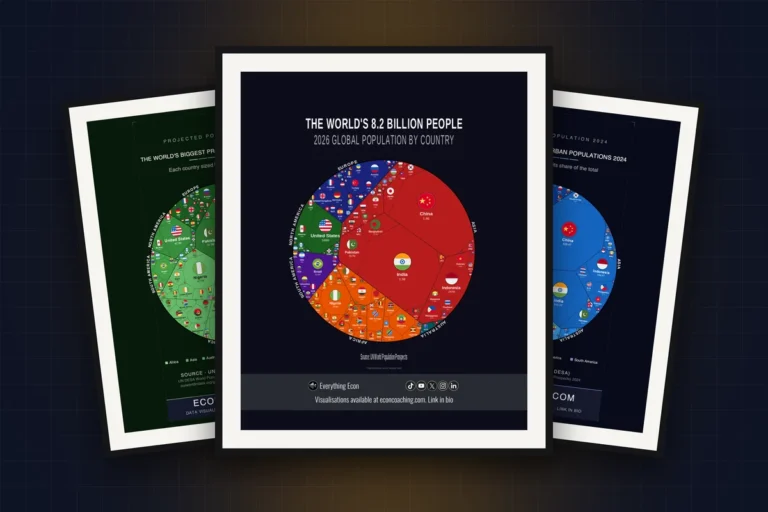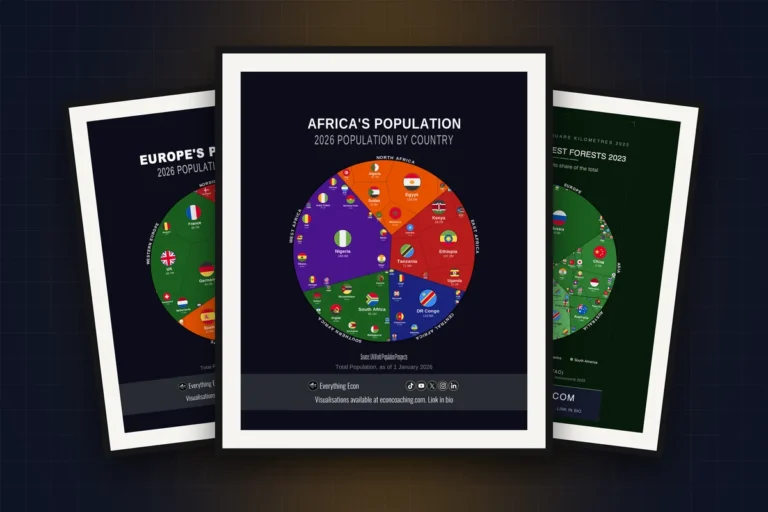
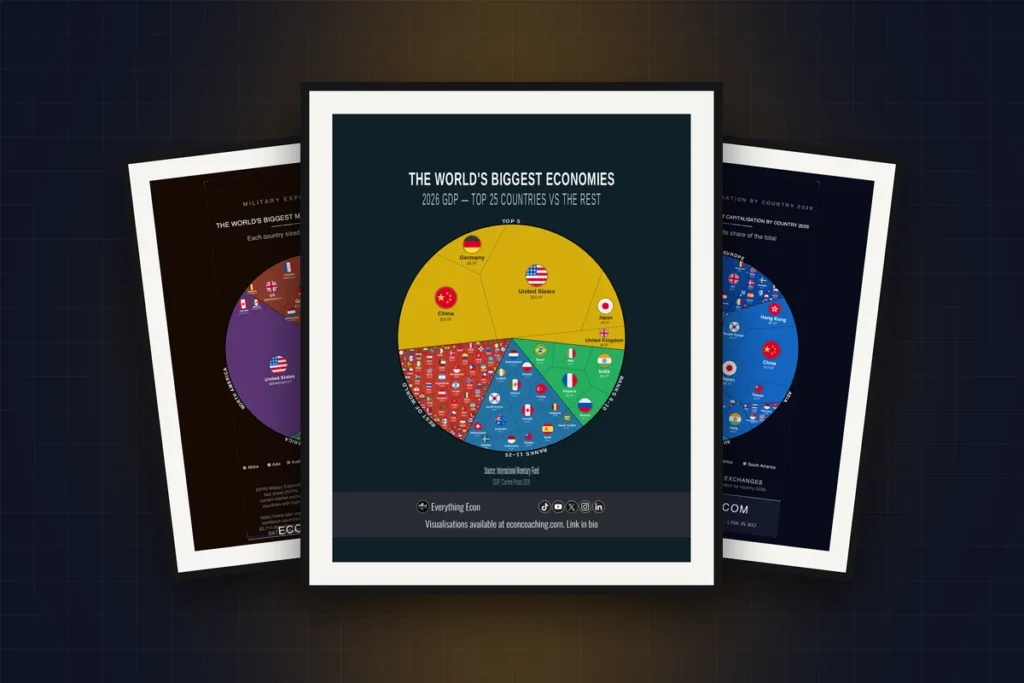
The world economy will be worth about $126 trillion in 2026, and governments owe $118 trillion of it back to somebody. Economists are the people who find both of those numbers interesting rather than alarming — which makes them unusually easy to buy for, provided you stop looking in the novelty aisle. What follows are ten gifts for economists built from actual datasets: IMF, World Bank, SIPRI, UN. Prices start at £2.99, and most of them arrive as a download in under a minute.
How to choose
Three decisions, in order: format, subject, size.
Format sets the budget. A phone wallpaper pack is £2.99 (about $4) and includes three matching designs — the full chart, a version without text, and a plain background. A printable poster is from £3.99 (about $5): you get a zipped folder with five high-resolution 300 DPI JPGs covering 4:5, 3:4 and 2:3 ratios plus 5″×7″ and 11″×14″, and a printing instructions PDF. A museum-quality matte poster, printed to order on 189 g/m² paper sourced from Japan, starts at £11.99 (about $15), with the price rising for the larger sizes.
Subject should match what they actually work on. A macroeconomist and a development economist want different walls. Trade, debt, military spending and manufacturing are all distinct designs here — pick the one closest to their reading list rather than defaulting to GDP.
Size is where most people get it wrong. These are dense graphics with dozens of labeled countries. On the printed posters the recommended size is 18″×24″; anything smaller and the smaller economies stop being legible, which defeats the point of a chart drawn to scale. If you’re printing a digital file yourself, the 2:3 ratio file goes up to 24″×36″ cleanly. Frames aren’t included with either, so budget separately — a standard 18″×24″ frame is the cheapest way to make a download look like a £60 print.
Timing. Printed posters are made individually per order, so order physical posters by early December. Digital files land in your browser the moment the payment clears, with the same link emailed to you — which is why the download options are the ones to reach for when you’ve left it late.
The picks
World GDP 2026 — the whole economy on one sheet
Every economy on earth drawn to scale by its share of a $126 trillion global total, each marked with its flag, using IMF GDP at current prices for 2026. It’s the single most useful poster for someone who teaches or explains the world economy, because the argument is made by the geometry rather than a table. Available as a World GDP 2026 printable poster from £4.99 (about $6) or a printed matte version from £12.99 (about $16). The underlying numbers are broken down in our World GDP by country 2026 writeup.
World Debt 2026 — $118 trillion, drawn to scale
Central government debt for every country, totalling $118 trillion, from IMF data for 2026. The United States, China and Japan dominate the chart to a degree that surprises people who only ever see debt quoted as a ratio to GDP. This is the pick for the fiscal-policy person, the sovereign-debt analyst, or anyone who has ever had to explain why the debt-to-GDP ratio and the absolute stock tell different stories. The World Debt 2026 printable poster is £3.99 (about $5); the matte print starts at £12.99 (about $16).
Military Spending 2025 — $2.9 trillion
The world spent $2.9 trillion on its militaries in 2025 according to SIPRI, with the United States towering over the chart and China a distant second. Defense economics has gone from a niche subfield to a dinner-table subject in about three years, and this design makes the scale legible in a way a ranked list doesn’t. Get it as a Military Spending 2025 printable poster from £4.99 (about $6) or a printed matte poster from £11.99 (about $15). See also our analysis of Europe’s military spending record.
The World’s Biggest Manufacturers 2024
China leads global manufacturing with $4.7 trillion in manufacturing value added, on World Bank figures for 2024. It’s the chart that ends arguments about industrial policy fastest, because the gap is not the sort of thing you can wave away. Suits industrial economists, trade policy people and anyone whose job involves supply chains. The printed matte poster starts at £12.99 (about $16); there’s a £3.99 printable version too. Background reading: manufacturing output 2024.
Official Gold Reserves — 35,400 tonnes
Every central bank’s official gold holdings drawn to scale against a world total of 35,400 tonnes, with the United States alone holding 8,100 tonnes. Source is the IMF via the World Gold Council, 2023. This is the one for monetary economists and the reserve-currency-skeptic in the department — gold sitting on central bank balance sheets is a topic that has quietly stopped being quaint. Printable poster, £3.99 (about $5).
Billionaire Wealth by Country
Billionaire wealth is far more concentrated than either population or GDP, and this design draws every country’s total to scale to prove it: the United States at $8.4 trillion, China at $2.2 trillion, India at $1 trillion, on the Forbes Billionaires List for 2023. The obvious gift for anyone working on inequality, wealth taxation or distributional statistics. Available as a £3.99 printable download or a matte print from £12.99 (about $16).
High-Tech Exporters 2024
China exported $856.8 billion of high-technology goods in 2024, against $246.6 billion for Germany and $232.9 billion for the United States, per World Bank data drawn from UN Comtrade. Trade economists and anyone tracking export sophistication will spend longer looking at this than they expect. The premium matte poster starts at £12.99 (about $16), with a printable version at £3.99.
Research Powerhouses 2023
China published 932,700 scientific and technical journal articles in 2023, on World Bank figures sourced from the NSF. Academic economists tend to find this one uncomfortably relevant — it’s a chart about the production function for ideas, hung above the desk where they’re trying to produce some. The printable poster is £3.99 (about $5); the printed edition starts at £12.99 (about $16).
The World In Your Year — the personalized option
Pick any year from 1950 to 2026 and a light or dark theme, preview the exact design, and get a population map where every country is drawn in proportion to its people and colored by continent, with the world total for that year. Data is UN World Population Prospects 2024. It works because it’s specific to them: a birth year, a graduation year, the year they started the job. The personalized printable poster is a digital download from £5.99 (about $8), so you can print it at any size you like.
Adam Smith portrait, and a £2.99 stocking filler
If the recipient’s tastes run classical rather than quantitative, the Adam Smith portrait poster is a clean gallery-style engraving of the author of The Wealth of Nations (1776), from £11.99 (about $15). And at the bottom of the price range, the World GDP 2026 phone wallpaper pack is £2.99 (about $4) for three matching designs — the $126 trillion world economy on a lock screen, which is a better conversation starter than most things costing ten times as much.
Digital or printed?
Digital wins on speed and price. As soon as the purchase completes you get a download link in the browser and the same link by email, so a printable poster is a viable gift twenty minutes before you need it. You’re also buying flexibility: the file set covers everything from 5″×7″ up to 24″×36″, so the recipient chooses the size and the print shop.
Printed wins on ceremony. A museum-quality matte poster on 189 g/m² paper is a thing you hand over, and it removes the small but real friction of expecting someone to go and get a file printed. Each one is made individually per order, so it needs lead time: order physical posters by early December. The honest rule: printed for occasions you’ve planned for, digital for the ones you haven’t — and digital plus a frame from a local shop if you want both.
FAQ
What exactly do I get with a printable poster?
A zipped folder containing five high-quality JPGs — one 4:5 file, one 3:4, one 2:3, one sized for 5″×7″ and one for 11″×14″ — plus a printing instructions PDF. The files are 300 DPI, sharp up to 24″×36″.
Are frames included?
No. Neither the printable files nor the printed posters ship with a frame. Because the digital files use standard photographic ratios, off-the-shelf frames fit without custom mounting.
How does delivery work?
Digital products are delivered instantly: a link appears in your browser on completion and is emailed to you as well — check the spam folder if it hasn’t arrived within a couple of minutes. Printed posters are produced to order and shipped physically.
Can I give a download as a gift?
Yes. Buy it, download the zip, and pass on the files — or print one yourself and hand over something physical. The digital products are licensed for personal use.
What size should I choose for a printed poster?
18″×24″ is the recommended size for the data visualizations. They’re detailed graphics with a lot of labeled countries, and going smaller costs you the detail that makes them worth hanging.
Where to start
If you know their field, buy the chart that matches it. If you don’t, World GDP 2026 is the safe default and the personalized year poster is the sentimental one. The full range, sorted and filtered for exactly this problem, is on the gifts for economists page.