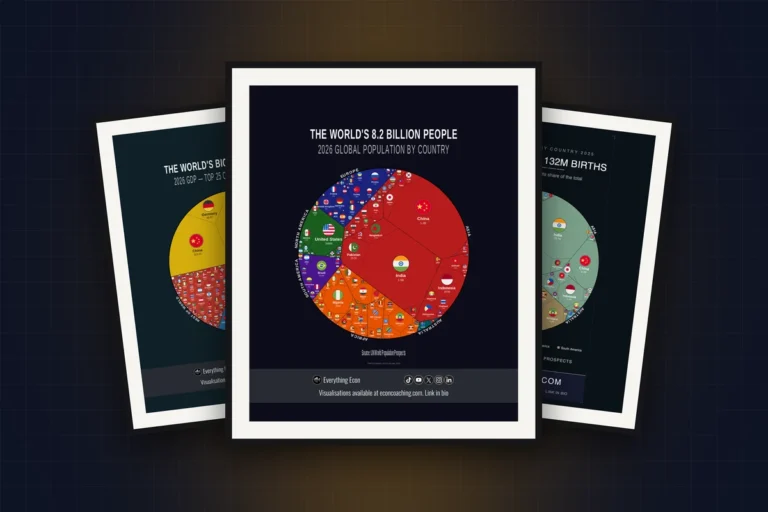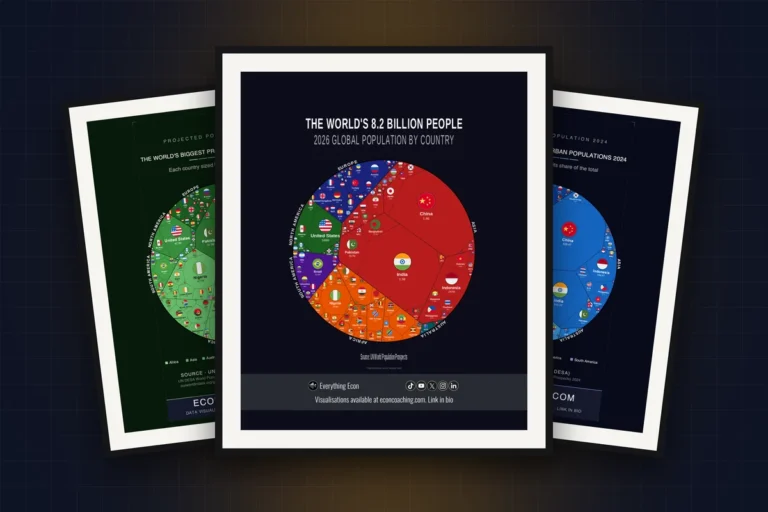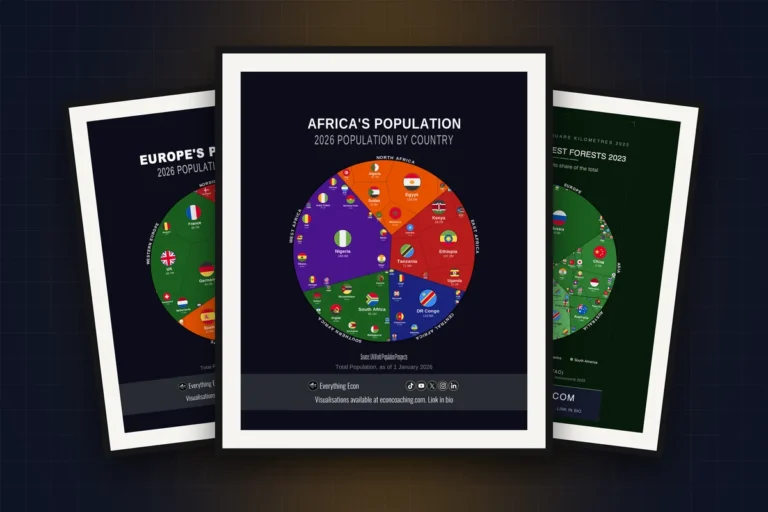
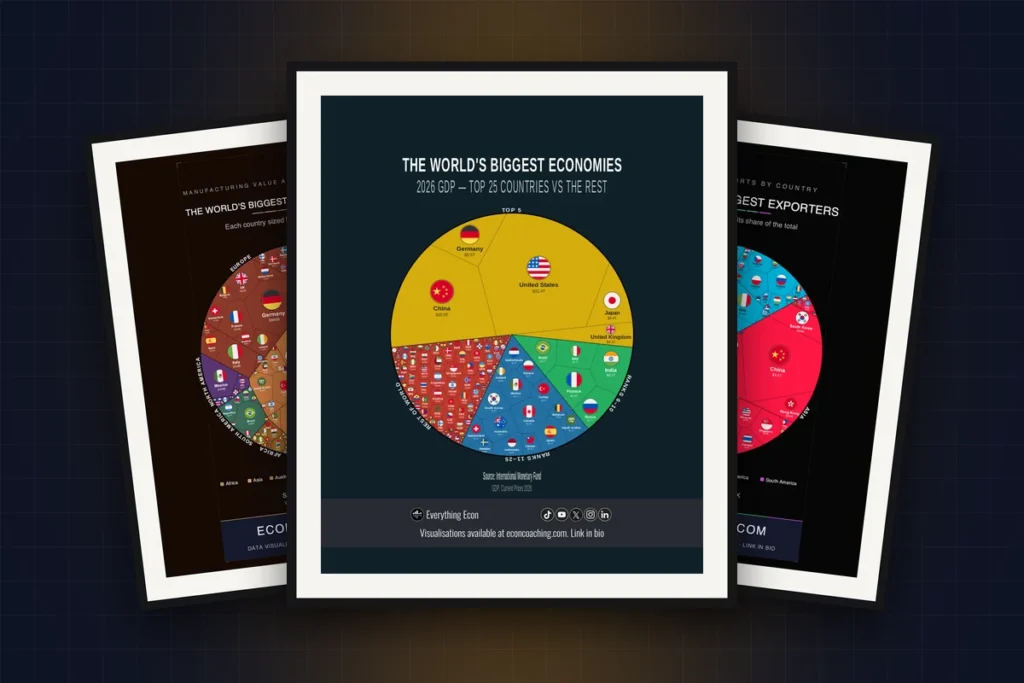
The IMF puts the 2026 world economy at $126 trillion. That figure is impossible to actually feel, which is the problem an economics teacher spends every September trying to solve. Most gifts for economics teachers ignore that entirely and default to a mug with a supply-and-demand joke printed on it. The better move is something that does part of the teaching for them — a wall-sized chart they can point at mid-lesson, built from datasets they would cite anyway.
Everything below is a real product with a real source behind it. No mugs.
How to choose
Start with the price tier, because it decides the format. At £2.99 (about $4) you get a phone wallpaper pack of three designs — a stocking filler or a Secret Santa, not a main gift. At £3.99 (about $5) you get a printable poster: a ZIP of 300 DPI JPGs at 4:5, 3:4 and 2:3 ratios, plus dedicated 5″×7″ and 11″×14″ files and a printing instructions PDF. At £12.99 (about $16) and up you get a premium matte poster printed to order on 189 g/m² paper sourced from Japan.
Then think about where it will hang. A classroom is a hostile environment for paper: humidity, tape, thirty teenagers. Printables win there, because a file can be reprinted for £0 when the corners inevitably curl, and the teacher can run off an 8″×10″ for the desk and an 18″×24″ for the wall from the same purchase. A home study is the opposite — that’s where the printed matte poster earns its money.
On sizing, these are dense graphics. Every country is drawn to scale, which means small countries are small. The store’s own recommendation on the printed posters is 18″×24″, and that is the right instinct: at 8″×10″ you lose the long tail of the distribution, which is usually the interesting part. Frames are not included, so a standard-ratio size (A-sizes, or 18″×24″) saves the recipient a custom framing bill. And if the gift is for a specific date, a digital download removes the delivery question altogether — the link lands in the browser as soon as the purchase completes.
The picks
World GDP 2026 — the whole economy on one sheet
The entire $126 trillion world economy, every country drawn to scale in a circular Voronoi treemap with flags attached (IMF, GDP at current prices, 2026). This is the single most useful poster on the list for a teacher, because almost every introductory lesson eventually needs a sense of relative size and this supplies it in one glance. Available as a World GDP 2026 printable poster from £4.99 (about $6). We also wrote up the top 25 economies versus the rest if you want the argument before the artwork.
The World’s Biggest Economies by Purchasing Power 2026
Measured at purchasing power parity, China leads on $44.3 trillion against the United States on $32.4 trillion, with Japan on $7.3 trillion and Germany on $6.4 trillion (IMF, 2026). Hang this next to the nominal GDP poster and you have a lesson on why the measure you pick determines the answer you get — which is close to the entire point of teaching macro. The purchasing power printable poster is £3.99 (about $5); the background is in our write-up on the PPP rankings.
World Debt 2026 — $118 trillion, to scale
Central government debt worldwide comes to $118 trillion, with the United States, China and Japan towering over everyone else (IMF, 2026). Debt-to-GDP tables are abstract; a chart where three countries physically dominate the page is not. Suits anyone teaching fiscal policy or A-level macro. The World Debt 2026 premium matte poster starts at £12.99 (about $16), and there’s a £3.99 printable of the same design. Related reading: who’s really drowning in debt.
The World’s Biggest Workforces 2025
China holds the largest labor force at 768.1 million, India follows at 617.6 million, the United States sits at 174.8 million and Nigeria at 116.6 million (World Bank, ILO modeled estimates, 2025). The India–China gap is much narrower than the GDP gap, which makes this a productivity lesson disguised as decoration. Good for anyone teaching labor markets or development. The workforces printable poster is £3.99 (about $5).
The World’s Biggest Manufacturers 2024
China’s manufacturing value added reaches $4.7 trillion, against $2.5 trillion for the United States and $788 billion for Japan (World Bank, 2024). Students who have absorbed a general sense that “China makes things” usually have no idea of the magnitude, and the ratio does the arguing for you. This one is worth having printed — the manufacturers premium matte poster starts at £12.99 (about $16) and is printed to order.
The World’s Biggest Exporters
Merchandise exports for 2024: China at $3.6 trillion, the United States at $2.1 trillion, Germany at $1.7 trillion and Japan at $707 billion (World Bank, 2024). Comparative advantage is a hard sell in the abstract and an easy sell when the numbers are drawn to scale on a wall. Pairs naturally with the importers design if you want a two-poster set. The exporters printable poster is £3.99 (about $5).
High-tech Exporters 2024 — the £2.99 option
China exports $856.8 billion of high-technology goods, Germany $246.6 billion and the United States $232.9 billion (World Bank, UN Comtrade, 2024). The United States sitting third is the detail that makes people stop and re-read. As a phone wallpaper pack of three designs at £2.99 (about $4), it’s the cheapest genuine gift here and the one most likely to be seen forty times a day.
Millionaires by Country 2024
The United States has 23.8 million millionaires, China 6.3 million, Japan 2.7 million and the UK 2.6 million (UBS Global Wealth Report, 2024). Set against population, the ranking inverts in ways that make a decent starter question for an inequality unit. The millionaires printable poster is £3.99 (about $5), with printed and wallpaper versions of the same design if you’d rather not print it yourself.
Military Spending 2025
The world spent $2.9 trillion on its militaries in 2025, with the United States, China and Russia leading the chart (SIPRI, 2025). This is the crossover gift for a teacher who also covers politics or government spending, and it prompts the opportunity-cost conversation without anyone having to introduce it. The Military Spending 2025 printable poster is from £4.99 (about $6).
Adam Smith Portrait
Not a chart, but the one piece of non-data wall art that belongs in an economics classroom: a gallery-style engraved portrait of the author of The Wealth of Nations (1776). Straight-faced rather than kitsch, which is the difference between this and the mug. The Adam Smith portrait matte poster starts at £11.99 (about $15). For reference on sizing, 11″×14″ is the closest option to A3 and 18″×24″ is closest to A2.
The World In Your Year — the personal one
Pick any year from 1950 to 2026 and get a population map of the world as it was that year, every country sized by its share of the total, colored by continent (UN World Population Prospects, 2024). For a retiring teacher or a milestone birthday it beats a generic chart, because it’s about them. The personalized printable version is from £5.99 (about $8), and you print it yourself at the size you want.
Digital or printed?
Digital wins on two things: speed and reprinting. The download link appears in your browser the moment the purchase completes and arrives by email at the same time, so a printable bought at 11pm the night before term starts is still a gift. It also survives classroom life — when a poster gets torn, the file is still sitting in an inbox, and the same purchase covers every size from 4″×5″ up to 24″×36″. The personalized year poster works on the same logic, from £5.99 (about $8).
Printed wins on presentation. A 189 g/m² matte poster printed to order looks like something someone chose, and it arrives ready to hang rather than as a task on the recipient’s to-do list. If the teacher is the kind of person who has never once been to a print shop, buy printed.
Questions
What file formats do the printable posters come in?
A ZIP containing five 300 DPI JPG files — a 4:5 ratio file, a 3:4 file, a 2:3 file, plus dedicated files for 5″×7″ and 11″×14″ — and a download and printing instructions PDF. The files are roughly 11,000 × 17,000 pixels, enough for sharp prints up to 24″×36″.
How do I gift a digital download?
Buy it, then forward the download email. There’s no unwrapping moment, so most people print it themselves and hand over the physical poster — which also means you control the size and the paper.
Are frames included with the printed posters?
No. Frames are not included on any of the printed posters, which is why picking a standard size matters. The Adam Smith listing includes a conversion table: 8″×10″ is closest to A4, 11″×14″ to A3, 18″×24″ to A2 and 24″×36″ to A1.
How long does shipping take on the printed posters?
Each printed poster is made to order, so allow production time before dispatch on top of shipping. Order physical posters by early December; digital downloads arrive instantly. If you’re buying close to a deadline, the printable version of the same design removes the risk entirely.
Which size should I pick for a classroom?
18″×24″ is the recommended size on the printed posters, and it’s the sensible default for a room where people are looking from several meters away. Anything smaller than 11″×14″ works on a desk but not on a wall.
Where to start
If you want one recommendation: the World GDP 2026 printable from £4.99, printed at 18″×24″ and framed. It costs less than a mug, it’s defensible in front of a room of students, and it cites the IMF. The full range is on the gifts for teachers page, and the gift guide index covers economists, finance and graduation if you’re buying for someone adjacent.