Every year, the World Bank counts how many babies are born for every 1,000 people living in a country. That single number, known as the crude birth rate, reveals a great deal about a society: its healthcare, its economy, the choices available to women, and sometimes the weight of conflict or poverty. The global picture is one of stark division — some countries are producing the next generation at extraordinary speed, while others are struggling to produce one at all.
At a glance · Top 5
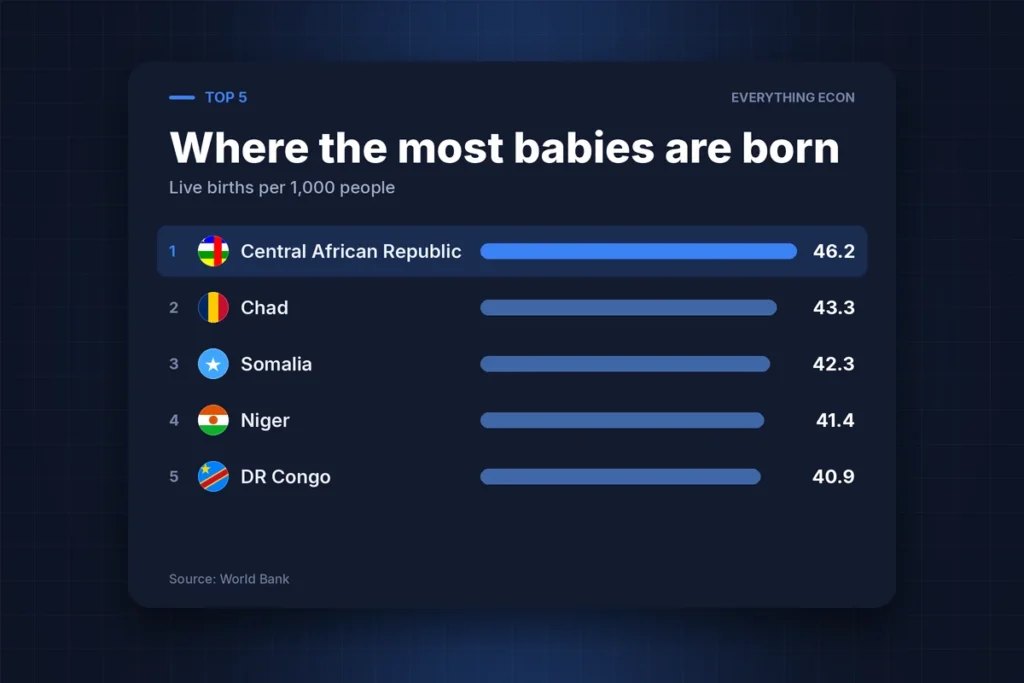
Live births per 1,000 people
- 1Central African Republic46.2
- 2Chad43.3
- 3Somalia42.3
- 4Niger41.4
- 5DR Congo40.9
Source: World Bank
The Bottom of the Table: Fewer Babies Than Ever Before
The countries with the lowest birth rates are concentrated in East Asia and parts of Europe. South Korea records just 4.7 births per 1,000 people — the second-lowest in the world — despite spending roughly $280 billion over 18 years trying to reverse the trend. It has not worked. South Korean women had an average of 6.0 children in 1960; by 2023, that figure had collapsed to just 0.72 — the lowest ever recorded for any country in the modern era. South Korea is the only member of the OECD, the club of wealthy nations, ever to have fallen below one birth per woman.
Ukraine sits near the bottom too, at 5.5 births per 1,000 people — a figure that has fallen 28% since Russia's full-scale invasion began. That is the largest single drop since Ukrainian independence in 1991. The reasons are painfully straightforward: men are dying or fighting, millions of women of childbearing age have left the country, and the future feels deeply uncertain. Ukraine's average births per woman fell from 1.22 in 2021 to just 1.00 in 2025.
The Top of the Table: Why Sub-Saharan Africa Leads
At the opposite end, nearly every country in the top 15 is in sub-Saharan Africa. The pattern is driven by two structural forces that reinforce each other. First, when infant and child mortality is high, families tend to have more children as a form of insurance — knowing that not all of them will survive. Second, in regions where small-scale farming dominates, children contribute real labour from an early age, making larger families a practical economic decision rather than simply a cultural preference.
These forces are especially visible in Niger, which ranks fourth globally at 41.4 births per 1,000 people. Only 14% of married women there use modern contraception, and more than three-quarters of girls are married before they turn 18. Both factors push birth rates to levels that are almost impossible to shift without deep structural change. Africa as a whole remains the only world region still above the replacement level of 2.1 births per woman, with a regional average of 4.0.
Number One: The Central African Republic
Topping the global ranking is the Central African Republic, at 46.2 births per 1,000 people — the highest figure of all 54 African nations tracked by the World Bank. This is not simply a story of culture or tradition. The country is living through a humanitarian catastrophe. A 2022 survey found that 5.6% of its entire population died that year as a result of ongoing conflict and abuses linked to the Wagner Group, the Russian mercenary organisation operating in the region. In conditions of extreme violence and instability, high birth rates function partly as a survival response — communities replacing losses as fast as they can.
Afghanistan, at 35.0 births per 1,000, is the only non-African country in the global top 20, driven by low female education, minimal access to contraception, early marriage, and persistently high infant mortality.
The contrast between the top and bottom of this ranking could hardly be more dramatic — and the forces driving both extremes are deeply human ones.
Data: World Bank, most recent available year.
Get a new data story like this every week — join the newsletter.
Browse every visualisation on the visualisations page.
Take one home
Every country drawn to scale, as an instant printable download or a museum-quality matte poster printed to order.