Population density — the number of people living within each square kilometre of a country's land — is one of the clearest ways to understand how squeezed, or how spacious, life in a given country really is. The latest World Bank figures reveal a world of extremes: from vast, near-empty stretches of Mongolia and Greenland to a handful of places so packed that density figures read less like statistics and more like a thought experiment.
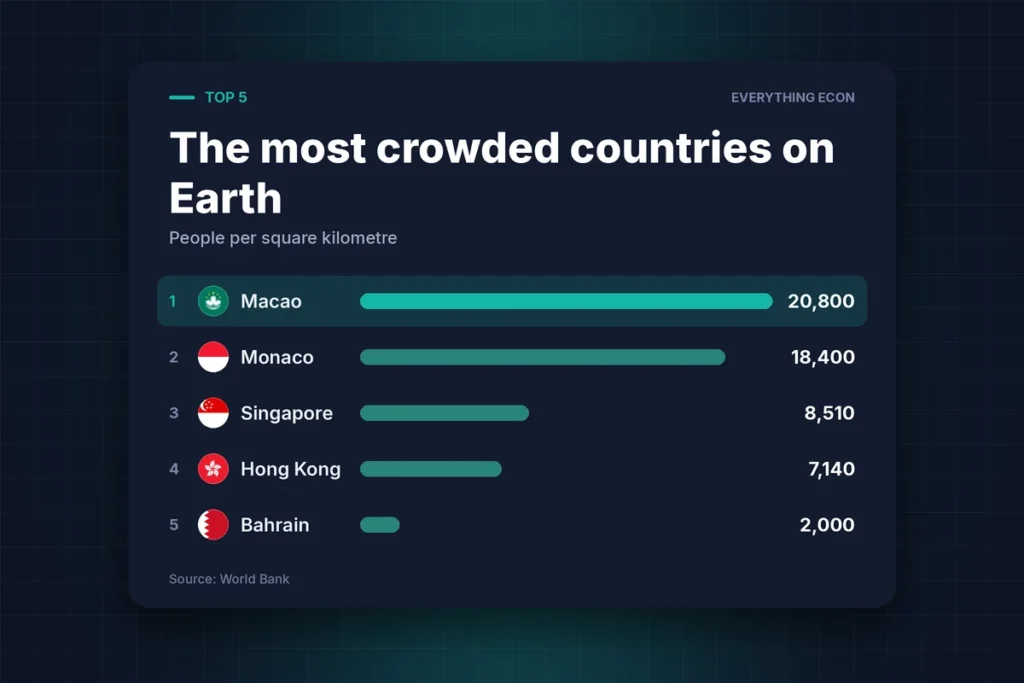
At a glance · Top 5
People per square kilometre
- 1Macao20,800
- 2Monaco18,400
- 3Singapore8,510
- 4Hong Kong7,140
- 5Bahrain2,000
Source: World Bank
The Forces That Push Density to Extremes
At the top of the ranking, a pattern is hard to miss. Singapore (8,510 people/km²), Hong Kong (7,140), Monaco (18,400), and Macao (20,800) all share a common origin: they grew as strategically positioned ports, transshipment hubs, or financial centres planted on major sea routes. Trade concentrated people. Money followed. And because the land never expanded to match, the numbers per square kilometre climbed to extraordinary heights.
At the opposite end, the bottom five — Iceland (3.89), Namibia (3.76), Australia (3.59), Mongolia (2.29), and Greenland (0.139) — are defined by sheer scale and harsh terrain. Greenland's figure of fewer than one person per seven square kilometres reflects a landmass dominated by ice sheet that is simply uninhabitable for most of its surface.
Stories Hidden in the Middle
Not every densely populated place is a glittering city-state. Bangladesh, ranked eighth at 1,350 people per square kilometre, tells a starkly different story. Its megacity capital, Dhaka, holds over 22 million people alone, and the country sits on the Ganges-Brahmaputra-Meghna delta — land that is fertile but constantly threatened by flooding, cyclones, and erosion. When water swallows portions of the country during monsoon season, the people who live there are pushed onto whatever higher ground remains, compressing an already dense population further still. That pressure is set to increase: density is projected to rise from roughly 1,350 today to around 1,551 people per square kilometre by 2050.
Rwanda, at 591 people/km² and ranked thirteenth, stands out as Africa's most densely populated non-island nation. More than 90% of its people depend on small-scale farming, creating fierce competition for limited land. Its high density is partly the result of a dramatic recovery in population since the 1994 genocide, driven by improvements in healthcare, economic stability, and a young population that has grown rapidly in the decades since.
Lebanon, ranked fourteenth at 572 people/km², is unusual in the opposite direction — its density is actually falling. A severe economic crisis that began in 2019 pushed large numbers of Lebanese citizens abroad, with cumulative emigration since then surpassing half a million people. In 2025 alone, Lebanon recorded more than 220,000 net departures. Syrian refugees have also begun returning home in significant numbers since late 2024. The result is a country whose place in this ranking may look quite different within a few years.
The Number One: Macao
The most densely populated place on Earth is Macao, at 20,800 people per square kilometre. That figure needs a moment to land: an entire territory of 33 square kilometres — roughly the size of a small town — holding a population that has grown by 185,000 residents over just 25 years, driven almost entirely by its role as a gambling and tourism hub. Every café, every tower block, every narrow street represents land doing an almost unimaginable amount of work.
Monaco, at 18,400, squeezes its figures from the opposite end of the wealth spectrum: a zero-income-tax policy draws the world's richest residents into just 2 square kilometres, pushing density to similarly dizzying heights.
—
Data: World Bank, 2025 population estimates divided by land area.
Get a new data story like this every week — join the newsletter.
Browse every visualisation on the visualisations page.
Take one home
Every country drawn to scale, as an instant printable download or a museum-quality matte poster printed to order.