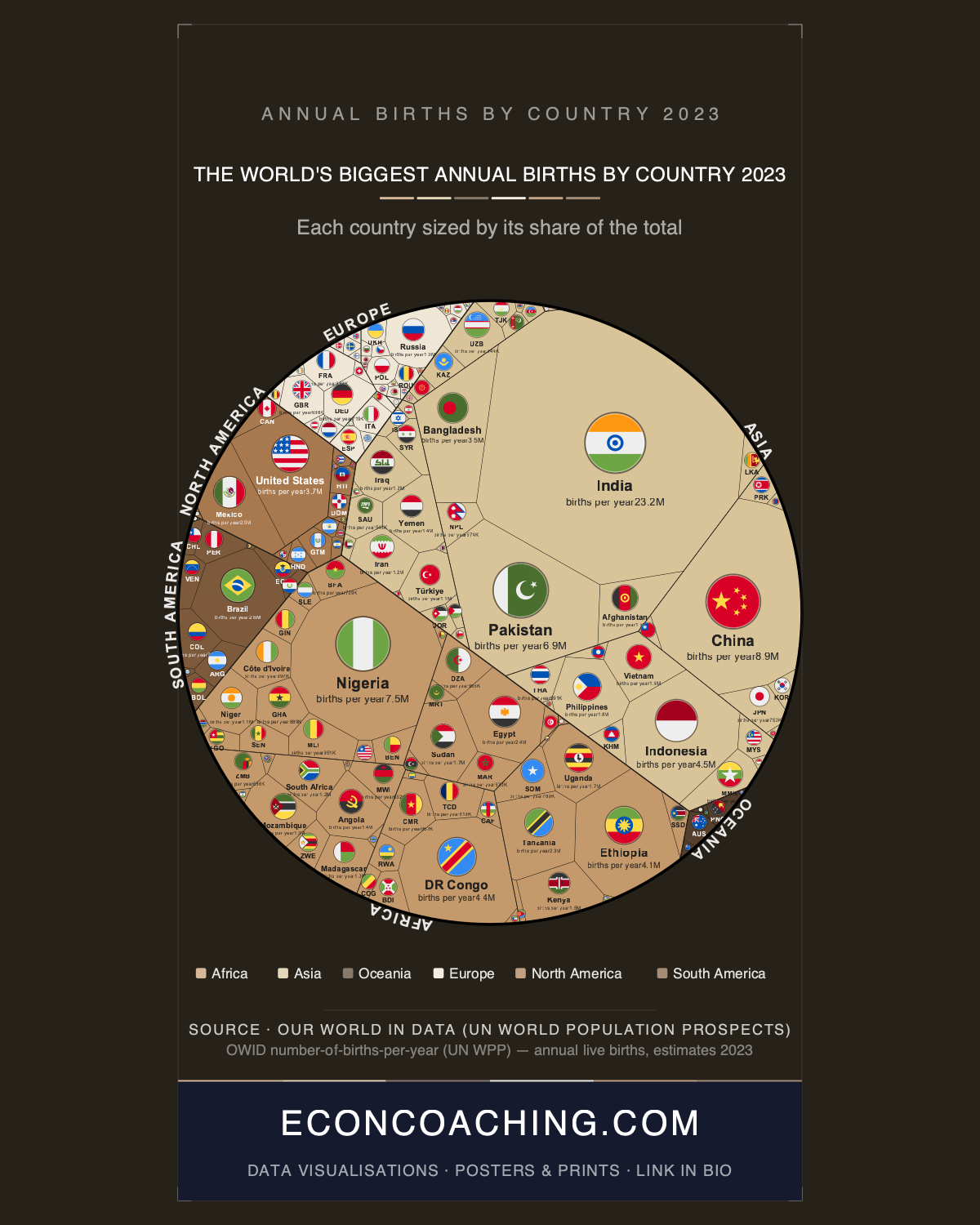
The treemap accompanying this article makes one comparison impossible to miss: India's cell is larger than China's by a margin that defies most readers' expectations, and Nigeria's cell is bigger than any country in Europe. India produced 23.2 million births in 2023, accounting for 17.59% of all global births. China, its closest demographic peer for most of the twentieth century, recorded 8.9 million, its lowest in modern recorded history. That gap is the product of two countries that started from the same point and diverged through entirely different policy paths, and it is only one of several structural breaks that make 2023 the most demographically polarised year in recent data.
How India and China Arrived at Opposite Ends
In 1971, India and China had nearly identical fertility rates of just under 6 births per woman. China's one-child policy drove its total fertility rate below 3 within a decade; India's equivalent decline took three and a half decades. The consequence in 2023 is a birth gap of 14.3 million between countries of comparable population size. China's annual birth count has roughly halved since 2016-2017, and its population shrank by more than 2 million in 2023. India's total fertility rate sits at approximately 2.0, just below the 2.1 replacement threshold, meaning India's lead in birth counts is real but time-limited. Projections show India's population could begin declining as early as 2047 under a low-fertility scenario, so the window for converting its demographic scale into sustained economic productivity is narrower than it appears in current rankings.
Africa's Rising Share and What It Does Not Guarantee
Africa produced 46 million births in 2023, representing 34.9% of the global total, up from roughly 12% in 1950. The UN World Population Prospects 2024 projects that share rising to approximately 42% by 2050 and nearly 48% by 2100. Five of the eight countries projected to account for more than half of global population growth to 2050 are African: DR Congo, Egypt, Ethiopia, Nigeria, and Tanzania, all of which appear in the global top 20 births list.
Nigeria ranks third globally with 7.5 million births in 2023 and a median age of approximately 18-19 years. At current trends, its population is projected to grow from 228 million in 2023 to around 380 million by 2043, positioning it to overtake the United States as the world's third most populous country. Those birth numbers carry a significant structural caveat. Nigeria's life expectancy sits at only 54-56 years, with fewer than 4 doctors per 10,000 people and more than 10 million out-of-school children, the highest figure globally. UNICEF projects that over half of global child mortality already occurs in Africa, and that share could rise to approximately 70% by 2050 if healthcare investment does not keep pace with population growth. A high birth count is a demographic input, not a demographic dividend. Whether it becomes the latter depends on child survival rates, female education, and institutional capacity that the birth data alone cannot measure.
Sub-Saharan Africa's share of global adolescent births surged from 12% in 1950 to 47% in 2020 and is projected to reach 67% by 2035, driven by limited contraceptive access and early marriage. That trajectory makes the region's fertility rate more structural than purely cultural, which complicates projections that assume rapid convergence toward lower fertility.
Europe's Accelerating Contraction
Every European cell in the treemap is small, and their combined area is smaller than Nigeria's. Eurostat recorded 3.67 million births across the EU in 2023, a 5.4% drop from 2022 and the largest single-year decline since Eurostat records began in 1961. Deaths outnumbered births in the EU by nearly 1.2 million, and the bloc's total fertility rate fell to 1.38. France's births fell to their lowest annual number since World War II, despite France holding the highest fertility rate in Western Europe.
Europe's births peaked in the mid-1960s. By 1990 the EU still recorded over 5 million births annually. The 2023 figure of 3.67 million represents a loss of more than 1.3 million annual births within a single generation, with no structural reversal in sight given current fertility trends. The United States, ranked eighth globally with 3.66 million births, produces nearly as many babies as Germany, the UK, France, and Italy combined, approximately 2.43 million, despite having a far smaller total population than the EU's 449 million.
South Korea and the Limits of Policy Spending
South Korea recorded a total fertility rate of 0.72 in 2023, the world's lowest, and only 236,000 births for a country of approximately 51 million, a 7.7% year-on-year drop. Seoul's fertility rate was 0.55. South Korea has spent over 360 trillion won, approximately $270 billion, on pro-natalist policies since 2006 with no measurable reversal. At 0.72, the current generation of Koreans will produce well under half the number of children needed to replace itself. The South Korean case is the clearest available evidence that government spending alone cannot reverse fertility decline once the structural conditions driving it, including housing costs, labour market pressure, and changed social expectations around parenthood, are sufficiently entrenched.
Asia's Dominance and Oceania's Footnote
Asia as a whole produces 49.7% of all global births, with South Asia alone, including India, Pakistan, Bangladesh, Afghanistan, and Nepal, contributing more than 35 million births, roughly 27% of the world total. Pakistan ranks fourth globally with 6.9 million births, more than the entire EU produces. At the opposite extreme, Oceania accounts for 0.5% of global births. Australia recorded 304,000 births and Papua New Guinea 255,000, with those two countries comprising the vast majority of the region's 679,000 total.
The structural implication of the 2023 data is that the geography of future labour supply, consumer markets, and tax bases is shifting toward regions where institutional investment will determine whether demographic scale converts into economic weight or compounds existing fragility. Africa's rising birth share and Europe's declining one are both self-reinforcing in the near term, and the policy responses available to either region are more constrained than the headline numbers suggest.
For more data-driven analysis of global economics and the trends reshaping the world economy, visit econcoaching.com.
Take this one home
Get this visualisation as a download, wallpaper, or printed poster.
← Back to all visualisations & articles
Follow Everything Econ: YouTube · TikTok · X · Instagram · Facebook