
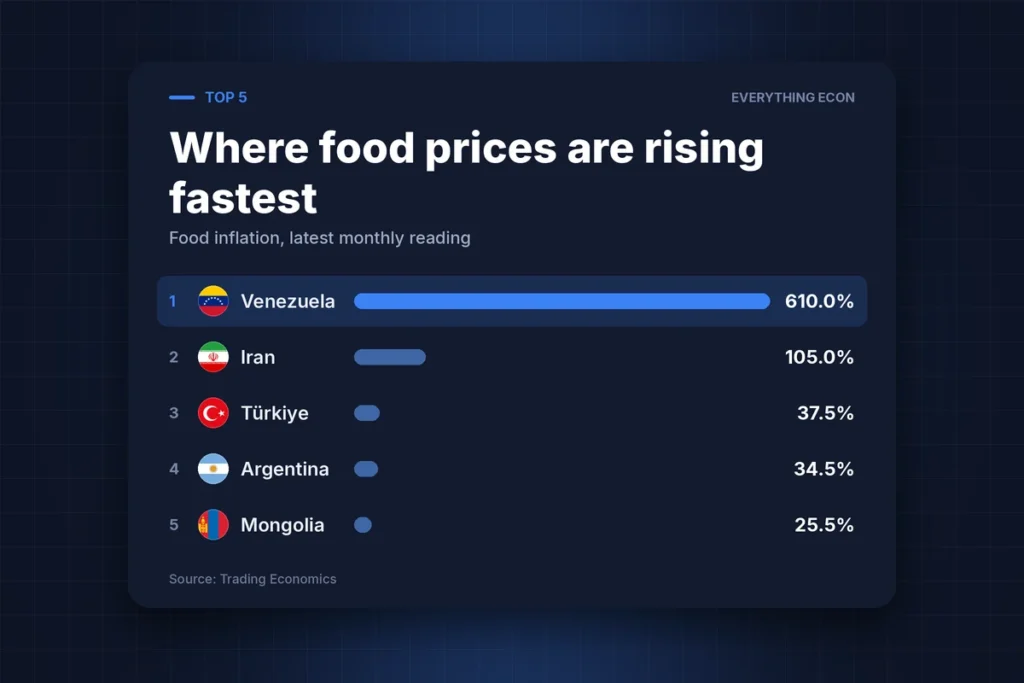
Food inflation measures how much more (or less) it costs to buy the same basket of groceries than it did a year earlier. When the number is high, a family's weekly shop eats up more of their income even if nothing about their diet has changed. Trading Economics tracks this figure for 169 countries, and the range this year is staggering: from prices falling by more than two-thirds in one place to prices rising sixfold in another. That gap says a lot about which economies are stable and which are in real trouble.
At a glance · Top 5
Food inflation, latest monthly reading
- 1Venezuela610.0%
- 2Iran105.0%
- 3Türkiye37.5%
- 4Argentina34.5%
- 5Mongolia25.5%
Source: Trading Economics
The world's worst-hit kitchens
Outside the very top of the list, Iran's food inflation sits at around 105%, driven by a rial that keeps losing value and by US sanctions that make imports more expensive. Türkiye isn't far behind in the global rankings, with food prices up roughly 34–37.5% — the result of the lira shedding about 93% of its value over the past decade. Argentina, at 34.5%, is actually a good-news story in disguise: food inflation there has been falling sharply, down from around 70% in early 2024 to 41.4% by March 2025, as President Milei's austerity programme starts to bite. Nigeria tells a similar story of improvement — its rate has cooled from 39.16% in October 2024 to the 13–23% range shown here, as the naira has stabilised. Mongolia (25.5%), Syria (22.0%), Haiti (19.4%) and Lebanon (18.0%) round out a group of countries where currency weakness, conflict, or both are pushing grocery bills up fast.
Regional patterns: South America runs hot, Europe stays cool
Zoom out and clear regional divides appear. South America is the world's most expensive place for food inflation, averaging 53.1% across its 13 countries — nearly eight times the global norm — largely because Argentina and Venezuela drag the average up. Europe sits at the opposite extreme, with an average of just 0.7% food inflation across 41 countries, making it by far the calmest region on Earth. That calm shows up directly in this ranking's bottom entries: Sweden (-7.2%), Serbia (-6.1%) and Hungary (-4.4%) all have food prices that are now falling outright, meaning groceries are cheaper than they were a year ago. Ghana offers a useful middle-ground example of a country turning things around through policy rather than economic collapse — it cut food inflation from 22.9% in 2024 to 14.6% in 2025, with twelve straight months of falling prices on staples like plantain and tomatoes.
What's driving the extremes
The pattern at the top of the list is remarkably consistent: currency collapse. Whether it's Iran's rial, Turkey's lira, or Argentina's peso, when a currency loses value fast, imported food and farming inputs become more expensive almost overnight, and that gets passed straight to shoppers. Sanctions and conflict make it worse, as seen in Iran and Syria. At the bottom of the list, the story is different in each case. Falling prices in Sweden, Serbia and Hungary reflect genuinely stable economies where inflation has cooled after earlier spikes. Palestine is the outlier that needs its own explanation: its extraordinary -68.6% doesn't mean food has become a bargain. It reflects the collapse of markets and normal commercial activity in Gaza, not real relief for people trying to buy food there.
Venezuela, by a huge margin
At the very top sits Venezuela, with food inflation of 610% — more than five times higher than second-placed Iran. To put that in perspective, prices there rocketed by 532% in 2025 alone. This is the product of years of US sanctions, a collapsing bolivar, and an economy that has struggled to produce or import enough food to meet demand. For ordinary Venezuelans, it means the cost of a basic weekly shop can change dramatically within weeks, making budgeting for essentials almost impossible.
Together, these numbers show how currency stability, sanctions and conflict shape something as basic as the price of dinner — sometimes making it unaffordable, and sometimes, as in much of Europe, barely noticeable at all.
Source: Trading Economics, 2025 data.
Get a new data story like this every week — join the newsletter.
Browse every visualisation on the visualisations page.
Keep exploring
 Economy · GraphicWho Holds America’s Debt? The $9.25tn Owned Abroad407K views3 min read
 Economy · RankingThe Countries Where an Extra Three Decades of Life Comes as Standard293K views3 min read
 Economy · RankingThe Countries Where Money Is Growing Fastest — and Where It’s Vanishing279K views3 min read