Every economy needs someone growing food, someone building things, and someone providing services — banking, retail, healthcare, logistics, tourism. This ranking measures that last group: the share of a country's workforce employed in services rather than agriculture or industry. At the extremes, it tells a story about how far an economy has travelled from producing physical goods to moving money, people and information instead.
At a glance · Top 5
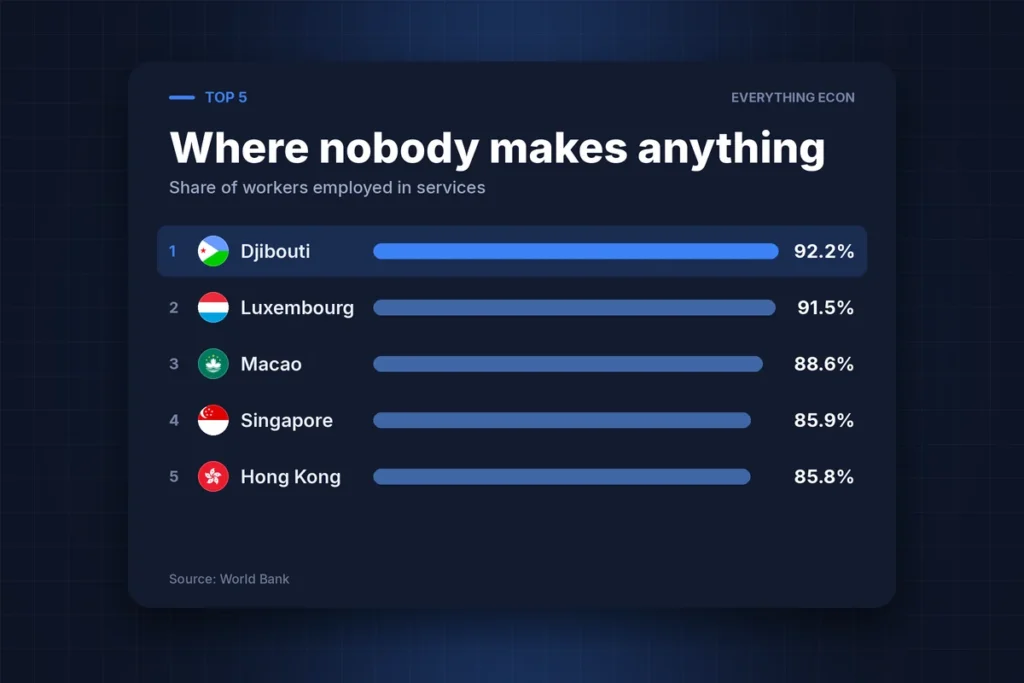
Share of workers employed in services
- 1Djibouti92.2%
- 2Luxembourg91.5%
- 3Macao88.6%
- 4Singapore85.9%
- 5Hong Kong85.8%
Source: World Bank
The City-States and Micro-Economies at the Top
The countries topping this list share a common trait: they are small, and they've made a deliberate trade. Singapore (85.9%) and Hong Kong (85.8%) both walked away from manufacturing decades ago, choosing instead to become hubs for trade, finance and shipping. Luxembourg (91.5%) has gone further still, with almost no farming or industry left at all — its workforce has been absorbed into banking and European Union institutional jobs. Small territories like Macao (88.6%), the Bahamas (84.4%) and Puerto Rico (84.1%) round out the top ten, mostly on the back of tourism and financial services rather than factories or farms.
Not every top performer got there through wealth. Jordan sits at 80.8%, comfortably inside the global top 15, despite modest national income. Its high services share reflects an oversized public sector rather than a booming, service-driven economy — a reminder that this metric measures the shape of an economy, not necessarily its strength.
Old Industrial Powers, Different Speeds
Sweden and Malta are tied at exactly 81.4%, having arrived by opposite routes — one a Nordic economy built on welfare systems and technology, the other a Mediterranean economy leaning on tourism and finance. The United Kingdom, at 83.2%, shows how thoroughly manufacturing can hollow out over time: its industrial workforce share collapsed from roughly a quarter of all jobs in 1973 to about one in ten by 2016. The United States tells the same story at a larger scale — manufacturing employment peaked at 19.5 million jobs in 1979 and has since fallen to about 13 million.
China and India show that this shift is still under way elsewhere. China's services sector only became the country's largest employer in 2011, and by 2024 it accounted for 48.8% of workers. India sits further behind still, at just 32.6% in services, with 41.6% of its workforce still in agriculture — despite the country's global reputation for IT outsourcing.
What Sits at the Bottom
At the opposite end of the ranking are countries where agriculture still dominates employment. Burundi has the lowest services share in the world at 11.6%, followed by Niger (17.7%), Chad (19.8%) and the Central African Republic (20.5%). These are largely low-income economies where most people still work the land, and where industry and formal services have yet to develop enough to draw workers away from farming.
The Country at the Very Top
Topping the entire ranking is Djibouti, at 92.2%. It's an unusual number-one: a small nation whose economy is built almost entirely around port logistics, serving as the maritime gateway for its much larger, landlocked neighbour, Ethiopia. Djibouti has barely any farming or manufacturing to speak of — instead, its workforce is overwhelmingly tied up in shipping, customs and the logistics chain that keeps Ethiopian trade moving. It's a case study in how a single strategic asset — a coastline — can push a country's employment structure further towards services than almost anywhere else on Earth.
Source: World Bank.
Get a new data story like this every week — join the newsletter.
Browse every visualisation on the visualisations page.