
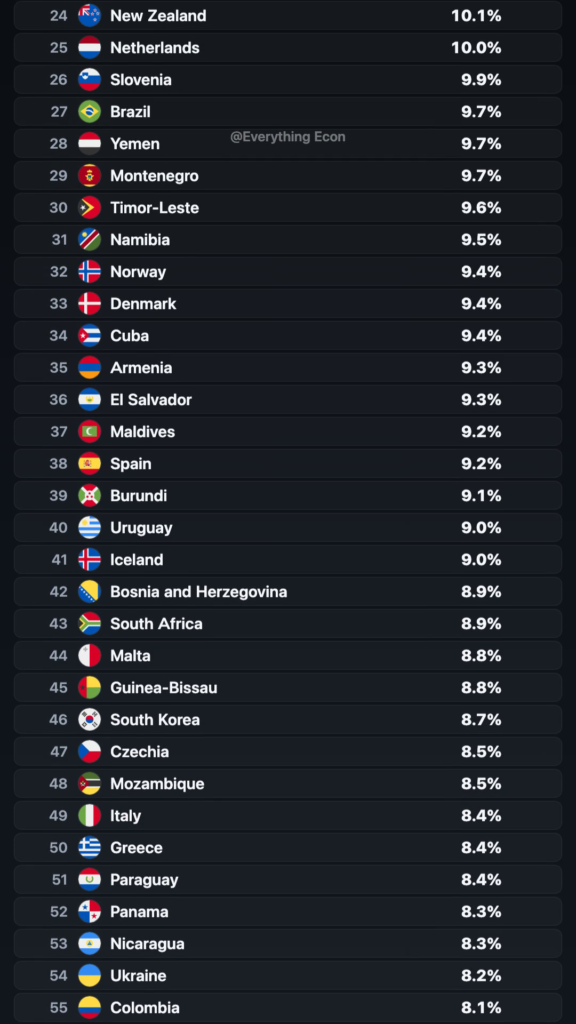
When economists measure health spending as a share of GDP, they're asking a simple question: out of everything a country produces and earns in a year, how much gets ploughed into hospitals, doctors, medicines and health insurance? It's a measure of national priority and pressure, not generosity — a high number can mean a country is caring brilliantly for an ageing population, or it can mean a small, fragile economy is being kept afloat almost entirely by foreign aid. This ranking of over 180 countries shows both stories playing out at once, often in the very same top ten.
The outlier at the very top
Before naming the world leader, it's worth flagging the country that would otherwise be the headline: the United States, at 16.7% of GDP, spending nearly double the average of other wealthy nations. That gap isn't explained by Americans visiting the doctor more often or receiving more treatment — study after study points to higher prices for the same procedures, medicines and hospital stays, not a higher volume of care. It's a uniquely expensive system, not necessarily a uniquely well-resourced one.
When a small economy skews the picture
Several countries near the top show a different pattern entirely: tiny economies where health spending looks enormous only because everything else looks small. Afghanistan sits at 15.0%, but over 77% of that spending is paid directly out of pocket by households, with the rest propped up by donors — a sign of scarcity, not strong provision. South Sudan (11.6%) tells a similar story: its total GDP is only around $6 billion, so even modest foreign-funded health programmes register as a huge percentage. Nauru, at roughly 18%, is the same phenomenon on an even smaller scale. In these cases, a big percentage is really a symptom of a small denominator, not lavish healthcare.
Rich Europe's shared habit — and Asia's restraint
Strip out the aid-dependent economies and a clearer regional pattern appears: wealthy European welfare states cluster tightly together, all spending comparable shares to the US. Germany leads Europe at 12.3%, followed by Austria (11.8%), Switzerland (11.7%), France (11.5%), Canada (11.3%), Sweden (11.2%) and the UK (11.1%). These are universal-coverage systems supporting ageing populations, and their similarity suggests high health spending is simply the price of looking after older citizens well — not an American quirk. Japan, despite having one of the oldest populations on Earth, spends notably less at 10.7%, largely because its government directly controls the fees doctors and hospitals can charge. At the other extreme, China spends just 5.9% and Laos, Bangladesh and Brunei anchor the very bottom of the table at 2.2% or below, reflecting much lower overall access to formal healthcare.
The actual number one: Tuvalu
Topping the entire ranking is Tuvalu, at 27.1% of GDP — up sharply from 21.3% just a couple of years earlier. Tuvalu is one of the smallest economies on the planet, and like South Sudan or Nauru, its health spending is modest in real dollar terms but enormous relative to its size, heavily reliant on foreign aid to keep services running. It's a reminder that topping a "percentage of GDP" ranking says more about the size of the economy than the size of the healthcare system.
Source: World Bank, most recent available data.
Get a new data story like this every week — join the newsletter.
Browse every visualisation on the visualisations page.
Keep exploring
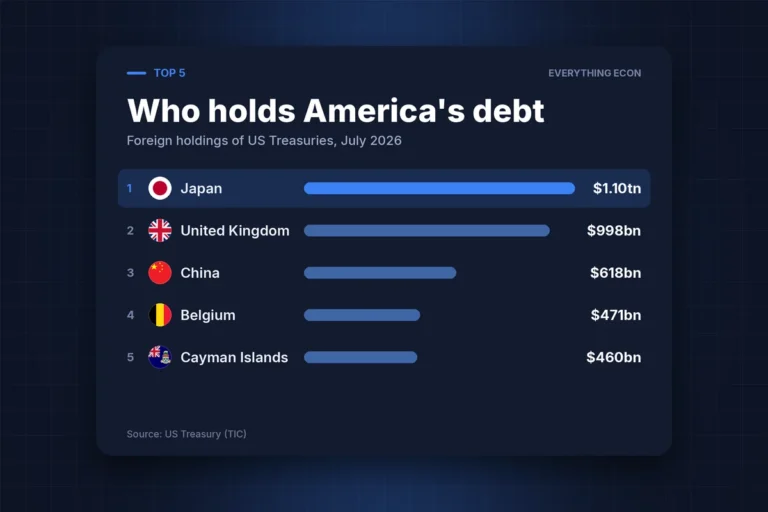 Economy · GraphicWho Holds America’s Debt? The $9.25tn Owned Abroad407K views3 min read
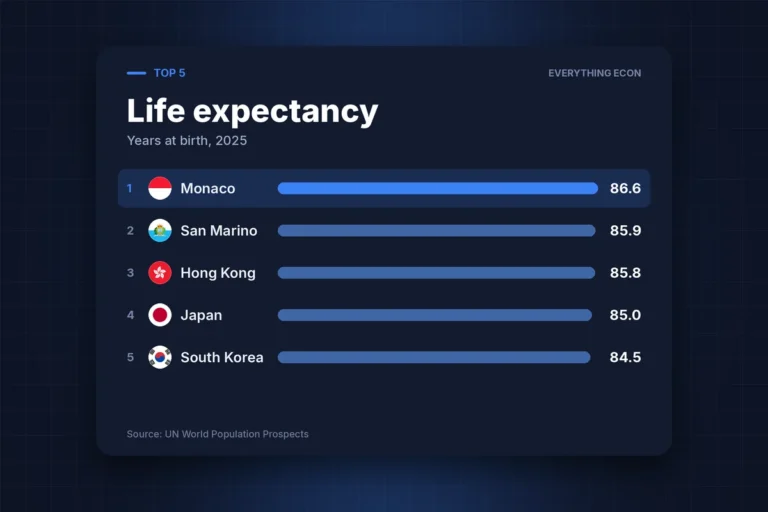 Economy · RankingThe Countries Where an Extra Three Decades of Life Comes as Standard293K views3 min read
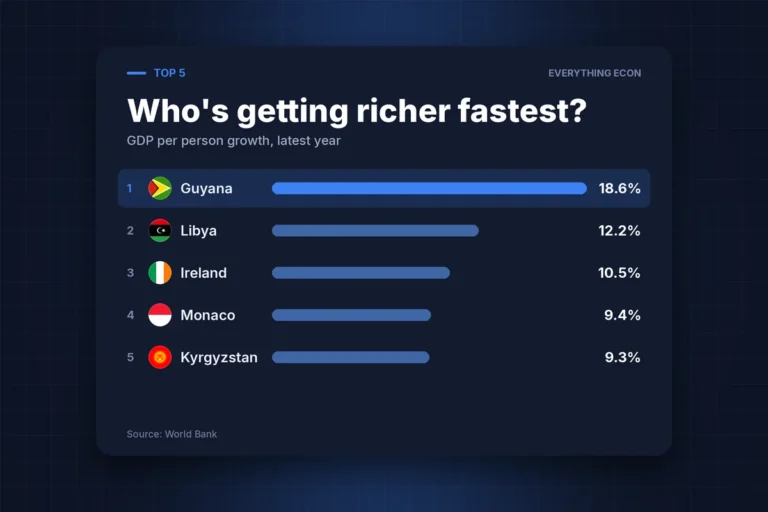 Economy · RankingThe Countries Where Money Is Growing Fastest — and Where It’s Vanishing279K views3 min read