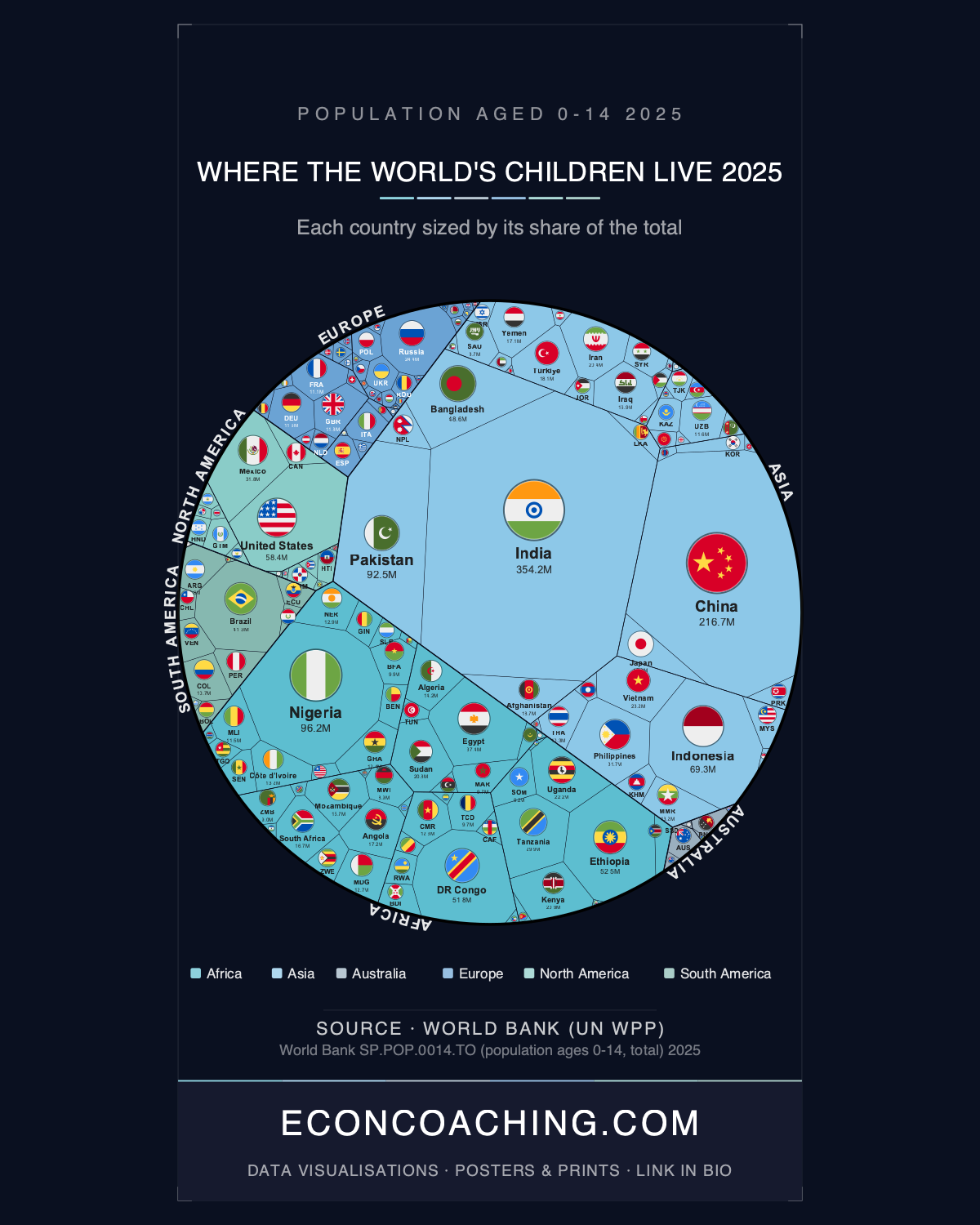
Japan, the world's third-largest economy, has fewer children than Uganda or Kenya, 13.9 million against 22.2 million and 20.9 million respectively. The treemap accompanying this article sizes every country by its child population rather than by land area or GDP, and that single comparison captures the distortion running through the entire chart: economic weight and demographic weight no longer point in the same direction. Of the 2,002,268,182 children counted across 169 countries in 2025, the largest concentrations sit in countries that a map of global GDP would barely register.
India's Record Lead, Built on a Fading Foundation
India's 354.2 million children outnumber the combined totals of China (216.7 million) and Nigeria (96.2 million), the second and third-ranked countries, by roughly 41 million. According to the UN World Population Prospects 2024 Revision, India overtook China as the world's most populous country in 2023, and this chart shows the same crossover has happened even more starkly among children: India's child population now exceeds China's by more than 137 million. The scale is misleading on its own. India's fertility rate has already fallen to around 1.9, below the 2.1 replacement threshold, so today's child count reflects births from past decades rather than a fertility rate that will sustain it. Demographers at the Center for the Advanced Study of India, University of Pennsylvania, project that within about two decades India will have more people over 60 than children, a reversal the current #1 ranking obscures rather than reveals.
China's Fourth Straight Year of Decline
China recorded 7.92 million births in 2025, a 17% fall from the prior year and the lowest figure since records began in 1949. It is the fourth consecutive year of population decline. China's fertility rate has dropped to roughly 1.0 births per woman, less than half the replacement level, a trajectory rooted in the one-child policy enforced from 1980 to 2015 and now compounding alongside rising childcare costs and falling marriage rates. Its 216.7 million children remain the second-highest total of any country, but the flow of new births has reversed even as that base stays large.
Asia's Peak, Africa's Ascent
Asia holds 53.3% of the world's children, 1.07 billion in total, with India and China alone contributing 28.5 percentage points of that share. Africa's share stands at 30.0% today, 600.2 million children, and UNICEF projects that will rise to roughly 40% by 2050, up from about 10% in 1950, the most dramatic long-run regional shift in the data. UNICEF frames this rise as bringing "unprecedented challenges" alongside opportunity, and the qualification matters: a large child population becomes an economic asset only with sufficient investment in health, education and job creation. Without that investment, the same numbers that suggest a future labour force instead describe a future dependency burden. Asia's largest economies, China, Japan and South Korea among them, are in absolute child-population decline while Sub-Saharan Africa is still climbing, meaning the global total describes two opposite regional stories rather than one converging trend.
Economic Output and Child Population Diverge Sharply
The Democratic Republic of the Congo's 51.8 million children are nearly 4.4 times the United Kingdom's 11.8 million, Europe's highest total, despite a fraction of the UK's GDP. Egypt and Sudan's children combined reach 58.1 million, almost exactly the United States' 58.4 million, a gap of only about 315,000. Oceania in its entirety, Australia, New Zealand, Papua New Guinea and every Pacific Island included, counts 10.3 million children, fewer than Cameroon's 12.3 million on its own. None of this measures dependency burden by itself: a country's share of children within its total population, rather than the raw count, is the better indicator of the strain a young population places on schools, healthcare and job markets, and several African nations carry far higher shares than India or China despite smaller absolute totals.
Nigeria's Trajectory and the Limits of the Ranking
Nigeria's 96.2 million children, third-highest globally, rest on a fertility rate of roughly 4.5 to 5.3 children per woman, well above the momentum driving India's or China's current totals. The UN projects Nigeria will overtake the United States in total population by 2050, becoming the world's third most populous country. Russia is the only European country to appear in the global top 20, ranked 15th with 24.4 million children, yet it still sits behind Uganda, Kenya and Sudan, three countries with a fraction of Russia's economic output. Rankings like this reward population scale built up over past decades as much as they reflect current fertility, which is why China and India, both now below replacement, still occupy the top two positions.
What the Handoff Means Next
The 2025 snapshot marks a baseline rather than an endpoint: China's births fell to a record low the same year UNICEF's 2050 projections show Africa's child share climbing toward 40%, and the two facts describe a single handoff in where the next generation of workers, consumers and taxpayers will be concentrated. Whether that shift converts into the economic dividend UNICEF describes as possible, or into the strain it warns of, depends on decisions about education and job creation that the population figures alone cannot answer.
For more data-driven analysis of global economics and the trends reshaping the world economy, visit econcoaching.com.
Take this one home
Get this visualisation as a download, wallpaper, or printed poster.
← Back to all visualisations & articles
Follow Everything Econ: YouTube · TikTok · X · Instagram · Facebook