
Some countries run on debt the way a car runs on petrol — borrowed money fuels businesses, mortgages and government spending, and as long as the economy keeps growing, the debt gets paid down along the way. This ranking compares total debt (households, companies and government combined) to the size of each country's economy, expressed as a percentage of GDP. A ratio above 100% means a country owes more than its entire economy produces in a year. It's not automatically a danger sign — some of the world's richest, most stable economies carry enormous debt loads — but it does show how leveraged a country has become, and how exposed it might be if borrowing costs rise or growth slows.
At a glance · Top 5
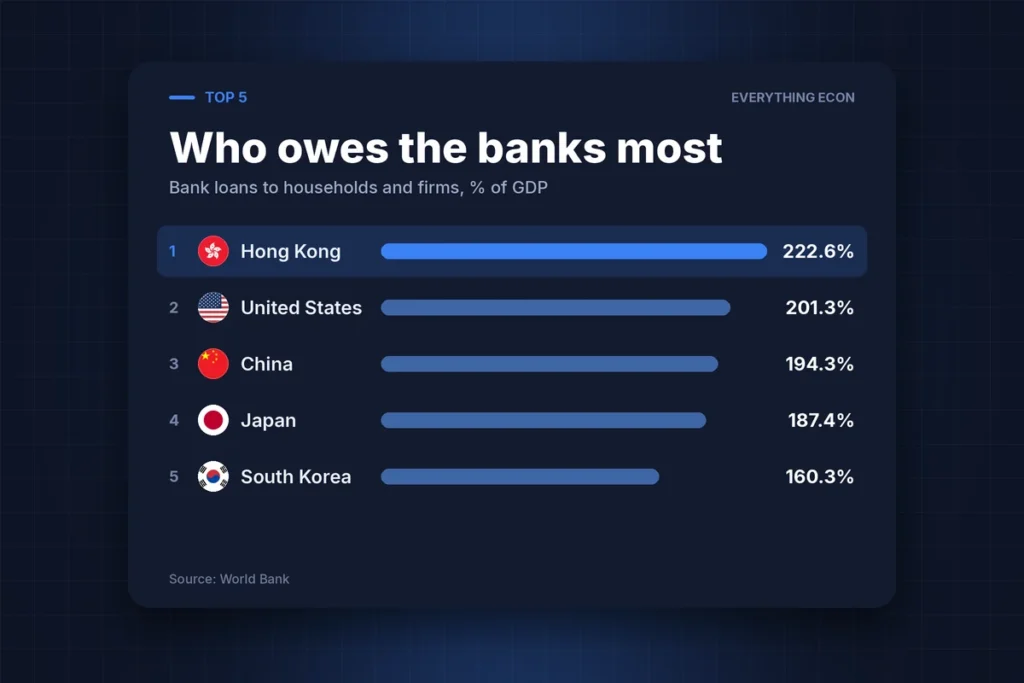
Bank loans to households and firms, % of GDP
- 1Hong Kong222.6%
- 2United States201.3%
- 3China194.3%
- 4Japan187.4%
- 5South Korea160.3%
Source: World Bank
The usual suspects — and one repeat offender
The United States sits second overall at 201.3% of GDP, though the trend is easing: private debt alone fell 4.5 percentage points in 2024. China, in third place here at 194.3%, tells a more strained story — separate data puts its total debt (including a fast-growing government share) at a record 336% of GDP by mid-2025, with corporate borrowing alone equal to 142% of GDP. That's the legacy of years of debt-fuelled construction and infrastructure spending.
Then there's Japan, in fourth at 187.4%. This isn't a new problem — it's a 30-year hangover from the asset-price bubble that burst in the early 1990s, kept on life support by interest rates that have hovered near zero ever since. Households matter too: South Korea's overall ratio of 160.3% includes household debt worth 91.7% of GDP, the second-highest in the world after Canada, whose households alone owe 100.6% of GDP.
Rich, small and financially connected
Look past the giants and a pattern emerges: many of the most indebted economies are small, wealthy and deeply tied into global finance. Denmark (144.1%), New Zealand (143.4%), Sweden (125.3%) and Norway (124.4%) are all high-income Nordic or Pacific economies with sophisticated banking systems and high homeownership rates, which tends to push household borrowing up. Qatar (126.8%) reflects a different story — heavy corporate and government borrowing tied to energy infrastructure. And a few developing economies punch above their weight too: Vietnam (125.0%) has leaned hard on credit to fund its manufacturing boom, far outpacing India, where private credit is just 57% of GDP — less than half of Vietnam's level.
Who borrows the least, and why
At the other end of the table, low debt often means limited access to credit rather than financial discipline. Haiti and South Sudan share the world's lowest ratio, at just 3.2% of GDP — both economies where banking systems reach only a small share of the population. Kuwait, at 4.9%, is a telling contrast: an oil-rich, wealthy nation that simply doesn't need to borrow, because energy exports generate enough cash to fund the state directly.
The top of the table: Hong Kong
At the very top sits Hong Kong, with debt worth an extraordinary 222.6% of GDP. This isn't a story of financial distress — it reflects Hong Kong's role as one of the world's great offshore banking hubs, where a huge volume of lending flows through the territory relative to the size of its own economy. A dense concentration of banks, low taxes and free capital flows draws in far more borrowing and lending activity than a typical economy of its size would generate on its own, pushing the ratio well past even the United States or China.
What ties the top and bottom of this ranking together is access: the most indebted places tend to be the ones with the deepest, most developed financial systems, while the least indebted are often locked out of borrowing altogether rather than avoiding it by choice.
Source: World Bank.
Get a new data story like this every week — join the newsletter.
Browse every visualisation on the visualisations page.
Keep exploring
 Economy · GraphicWho Holds America’s Debt? The $9.25tn Owned Abroad407K views3 min read
 Economy · RankingThe Countries Where an Extra Three Decades of Life Comes as Standard293K views3 min read
 Economy · RankingThe Countries Where Money Is Growing Fastest — and Where It’s Vanishing279K views3 min read