A budget deficit is simple in principle: a government spends more in a year than it collects in taxes and other revenue, and the gap has to be borrowed or covered some other way. Economists usually measure the size of that gap against GDP — the total value of everything a country produces in a year — because it shows how large the shortfall is relative to the economy that has to eventually pay it off. Some deficits are a temporary response to a shock. Others, as this ranking shows, are structural, meaning they persist year after year regardless of the economic weather.
At a glance · Top 5
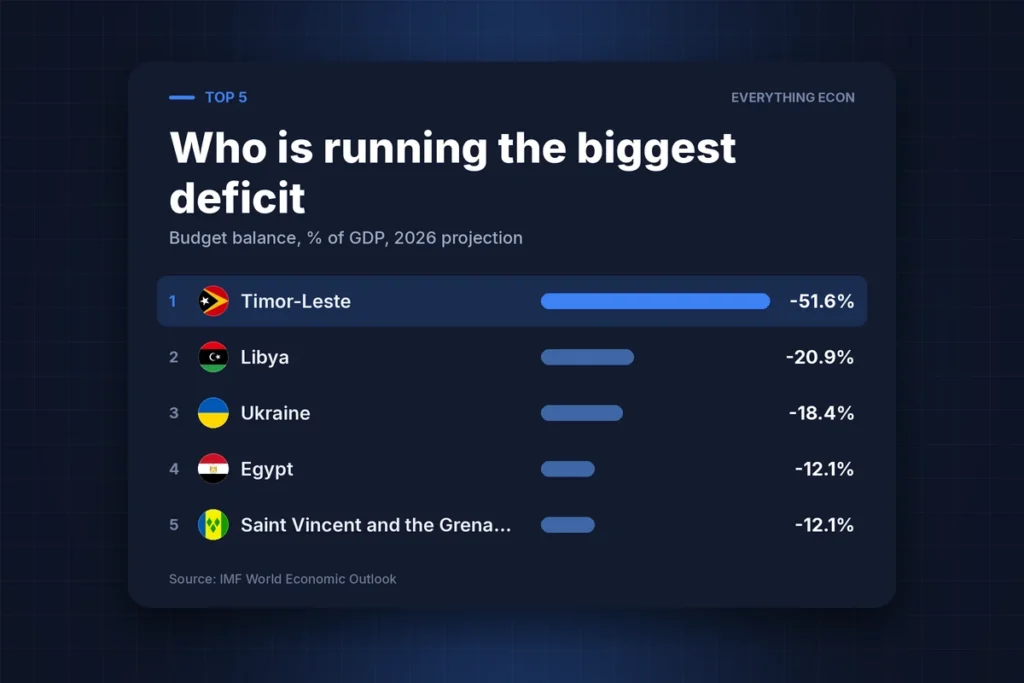
Budget balance, % of GDP, 2026 projection
- 1Timor-Leste-51.6%
- 2Libya-20.9%
- 3Ukraine-18.4%
- 4Egypt-12.1%
- 5Saint Vincent and the Grenadines-12.1%
Source: IMF World Economic Outlook
War, oil, and diamonds
Three very different stories dominate the top of the list. Ukraine's deficit runs at around -18.4% of GDP, and it is almost entirely explained by war: military spending eats up 60% of the entire government budget, leaving foreign loans and grants to cover pensions, public sector wages, and humanitarian support. The country's public debt has nearly doubled since the invasion began, jumping from 49% of GDP at the end of 2021 to more than 95% in 2025.
Libya, at -20.9%, is a different kind of crisis. It isn't short of oil revenue so much as unable to control how that revenue is spent, because political division between rival administrations has crippled normal budgeting and reform.
Then there are the resource economies caught on the way down. Algeria's deficit widened as falling oil and gas prices ate into the gains from a 2024 spending push, draining the financial buffers it had built up. Botswana, whose economy depends heavily on diamonds, saw its deficit widen to roughly -10.7% of GDP as diamond output fell, with the underlying (primary) shortfall deteriorating even further, to -18.7%.
Chronic strain versus manageable debt
Not every country on this list is in the middle of a crisis. Egypt, Algeria, and Bolivia were already running large deficits before the pandemic — Egypt at -7.6%, Algeria at -8.5%, Bolivia at -7.2% back in 2019 — which tells us their fiscal strain is a long-term condition, not a one-off shock. Egypt is a useful case of nuance here: its headline deficit is swollen by debt service costs expected to top 9% of GDP in the coming fiscal year, yet if you strip out interest payments, Egypt is actually running a surplus of 4% of GDP. It's paying heavily for past borrowing, not currently overspending on services. For comparison, the United States runs a deficit of about -7.4% of GDP — modest as a share of its economy, but a vast sum in dollar terms simply because the US economy is so large.
The Petroleum Fund running dry
The country with the largest deficit in the world by far is Timor-Leste, at roughly -51.6% of GDP — nearly two and a half times larger than second-placed Libya. The country's oil and gas production has stopped, and its government has been drawing down its Petroleum Fund, a savings account built from past energy revenue, to keep public spending going. That fund risks running out entirely by the late 2030s. The scale of the problem is striking: over 2013–2023, Timor-Leste's public spending averaged 85% of GDP, yet delivered only 1.3% average annual economic growth — a huge amount of spending translating into very little lasting output.
At the other extreme sit resource-rich economies with the opposite problem: Kuwait, Norway, Oman, and the UAE all post surpluses, banking oil and gas revenue rather than borrowing against it — a reminder that being resource-dependent can land a country at either end of this ranking, depending on whether the resource is rising or falling.
Source: IMF World Economic Outlook, 2025.
Get a new data story like this every week — join the newsletter.
Browse every visualisation on the visualisations page.
Take one home
Every country drawn to scale, as an instant printable download or a museum-quality matte poster printed to order.