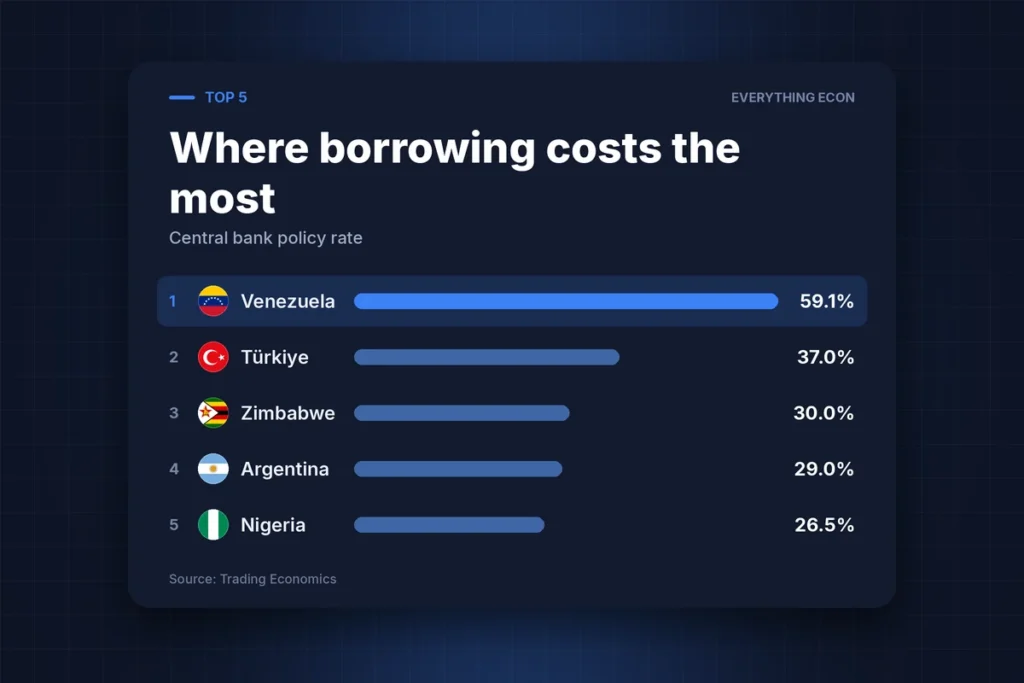
When a country's central bank sets its main interest rate, it isn't just tweaking mortgages and savings accounts — it's setting the price of borrowing for the whole economy, from government bonds to business loans. A high rate usually means a central bank is fighting fires: runaway inflation, a collapsing currency, or a debt crisis that's spooked lenders. A near-zero rate usually means the opposite — prices are stable, and the economy doesn't need to be reined in. This ranking, based on official policy rates from Trading Economics, spans an extraordinary range: from 0.00% in Switzerland to over 59% at the very top, a gap that says a lot about how differently economies around the world are being managed right now.
At a glance · Top 5
Central bank policy rate
- 1Venezuela59.1%
- 2Türkiye37.0%
- 3Zimbabwe30.0%
- 4Argentina29.0%
- 5Nigeria26.5%
Source: Trading Economics
The world's most expensive borrowers
Most of the countries with punishing borrowing costs are dealing with inflation that's spiralled out of control. Zimbabwe (30%), Lebanon (25%) and Iran (23%) all sit near the top for the same basic reason: their currencies have lost credibility, and high rates are one of the few tools left to slow the bleeding. Malawi's 24% rate tells a similar story, weighed down by heavy debt and a severe currency crisis. Türkiye is a more unusual case — its 37% rate is the tail end of years of unorthodox rate-cutting under President Erdoğan, which fuelled runaway inflation and forced a sharp reversal.
Argentina offers a rare bright spot on this list. Its rate has fallen to 29% from a staggering 133% in late 2023, as President Javier Milei's rate-cutting campaign has taken hold — still painfully high, but a dramatic retreat. Nigeria's 26.50% rate reflects the opposite path: an aggressive 875 basis point hike in 2024 aimed squarely at taming inflation, even as it drove borrowing costs sharply higher.
A cautious thaw across Africa
Africa dominates the upper half of this ranking, but the regional picture is turning. Nearly 60% of Sub-Saharan African countries saw inflation slow in 2025, giving several central banks room to start easing rather than tightening. Ghana is the standout example: it slashed its policy rate from 27% to 18% during 2025, the most decisive rate-cutting move anywhere on the continent that year. It's a reminder that many of the countries at the top of this list aren't necessarily stuck there — high rates are often a response to a specific crisis, and they can come down quickly once inflation cools.
Where money is cheapest — and the outlier at the very top
At the bottom of the table, rates are barely above zero. Singapore (0.88%), Cambodia (0.46%), Belarus and Fiji (both 0.25%) all reflect low, stable inflation and economies that simply don't need the brakes applied. Switzerland sits at rock bottom with a 0.00% rate, cut in June 2025 after consumer prices actually fell — the Swiss National Bank had no inflation left to fight. For comparison, even Japan, long famous for near-zero rates, has been tightening: its rate climbed to 1.00% during 2025 before easing slightly to 0.75% by December, the fastest pace of rate rises in modern Japanese history.
But nothing in this ranking comes close to Venezuela, which tops the world at 59.12%. That figure is a direct response to inflation running at roughly 475% — the highest of any country on Earth. It's an extreme case, but it illustrates the whole point of this ranking: interest rates are less a policy choice and more a mirror, reflecting just how much trust — or distrust — the world has in a country's money.
Data from Trading Economics, 2025–2026.
Get a new data story like this every week — join the newsletter.
Browse every visualisation on the visualisations page.
Take one home
Every country drawn to scale, as an instant printable download or a museum-quality matte poster printed to order.