Female labour-force participation measures something simple: what share of working-age women are employed or actively looking for work. It doesn't measure pay, job quality, or whether work is a choice — only whether women are counted as part of the paid or market-oriented workforce. On that narrow measure, the gap between the top and bottom of the global ranking is enormous: from over 80% of women working in some countries to under 5% in others. The pattern that emerges has little to do with "progress" in the way people often assume.
The top isn't about equality — it's about necessity
Madagascar tops the ranking at 82.9%, and the reason isn't a progressive labour market — it's subsistence farming. In economies built around small-scale agriculture, everyone works, because the household's survival depends on it. There's no real option to stay home when "home" is also the farm. Nigeria (80.7%), Tanzania (80.3%), Burundi (79.5%), and Mozambique (77.1%) follow a similar pattern: these are agrarian economies where paid work and subsistence labour blur together, and women's participation is high not because barriers have fallen, but because they were never affordable in the first place.
North Korea is the outlier that proves the rule from the opposite direction. It sits among the global leaders at 77.7%, but the driver here is the state, not the market — labour is effectively mandated for both men and women under the system. High participation, in other words, can come from desperation or from compulsion just as easily as from opportunity.
The bottom is shaped by law and conflict, not economics
The five lowest-ranked countries in the world — Iran (14.0%), Syria (12.7%), Iraq (10.9%), Afghanistan (5.1%), and Yemen (4.7%) — are clustered almost entirely in one region. This isn't a coincidence of economic development; it reflects legal restrictions, conservative social norms around women's work outside the home, and in several cases, the lasting effects of war. Afghanistan's 5.1% is the starkest example: Taliban restrictions now bar most women from formal employment altogether, collapsing participation that had been rising before 2021. Yemen, at the very bottom with 4.7%, has been shaped by years of civil war alongside some of the strictest social restrictions on women's work in the world.
It's worth noting what doesn't explain the bottom of this list: poverty alone doesn't do it. Some of the poorest countries in the world (Madagascar, Niger, Burundi) have the highest participation rates, precisely because poverty forces everyone into the workforce. The lowest rates instead come from places where work is restricted by law or custom, regardless of how much a household might need the income.
Where the big economies sit
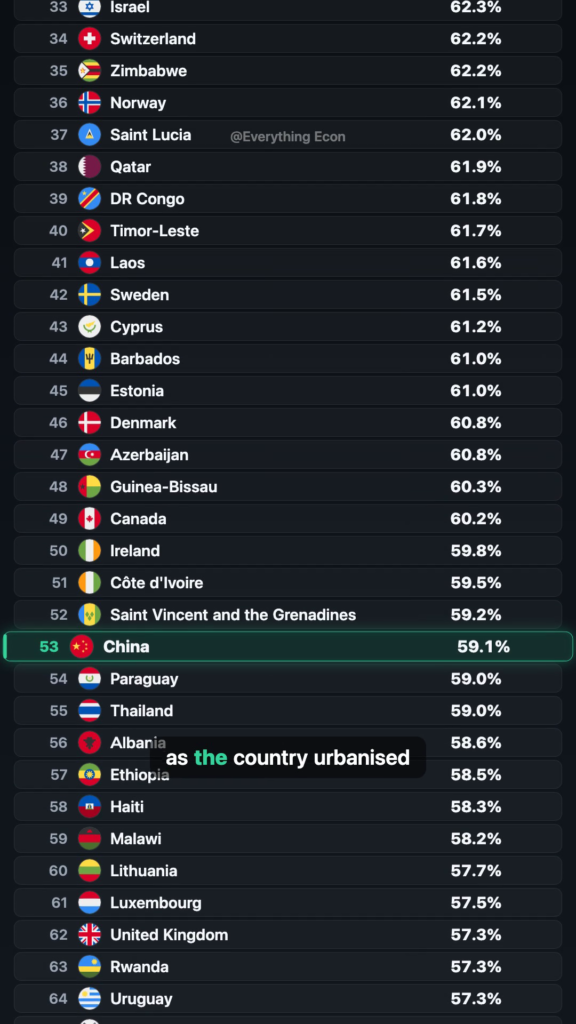
Away from the extremes, the ranking tells a more gradual story. China's female participation has fallen from a 1990 peak of 74% to 59.1% today, as economic growth has let more households get by on one income. The US sits at 56.3%, also down from a 1999 peak near 60%. Japan has moved the other way, climbing to 55.9% as "Womenomics" policies have pulled more women into paid work since the early 2010s. India, at 41.7% in 2023-24, remains lower than these peers, though rural women's participation has nearly doubled since 2017-18. And Saudi Arabia shows how fast this can shift with policy: women's participation more than doubled from 17% in 2016 to 36.3% today, beating the government's 2030 target seven years early.
The overall lesson is that a high number at the top of this ranking isn't necessarily a sign of opportunity, and a low number at the bottom isn't necessarily a sign of poverty — both often reflect how much choice women actually have over whether, and how, they work.
Source: World Bank / ILO.
Get a new data story like this every week — join the newsletter.
Browse every visualisation on the visualisations page.