If you turned $1 into local currency in different countries right now, you'd end up with wildly different piles of notes. In Kuwait, that dollar barely buys a third of a dinar. In some countries near the top of this ranking, it buys tens of thousands of units of local currency. This list uses the World Bank's official exchange rate — the rate a government or central bank recognises for converting dollars into its own currency — to show just how far apart these numbers can be. The gap tells a story about inflation, war, sanctions and decades of currency history.
At a glance · Top 5
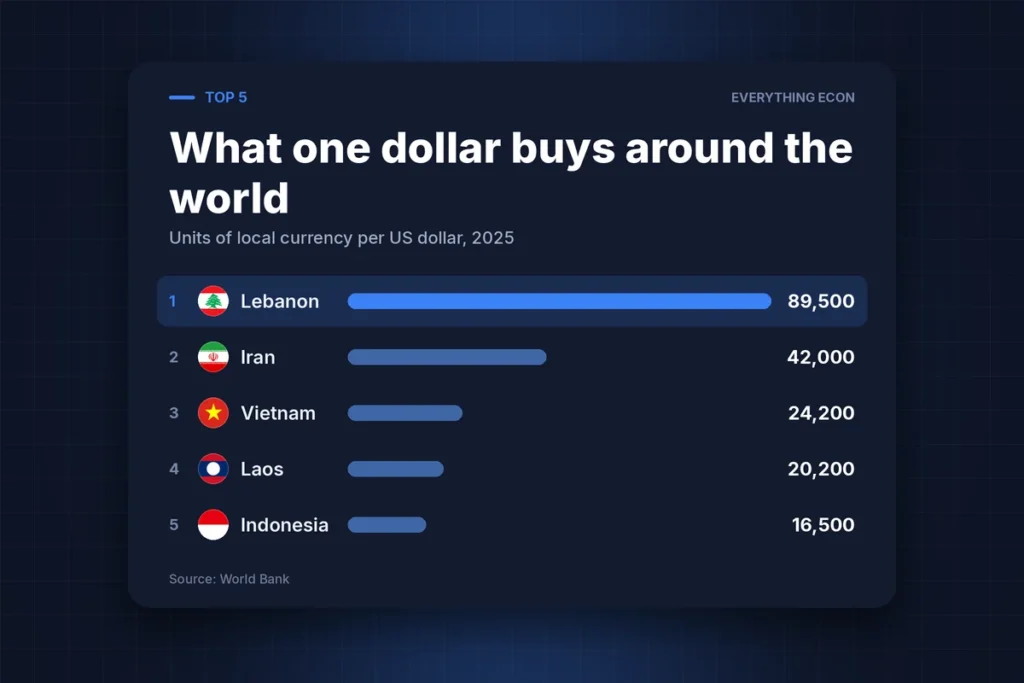
Units of local currency per US dollar, 2025
- 1Lebanon89,500
- 2Iran42,000
- 3Vietnam24,200
- 4Laos20,200
- 5Indonesia16,500
Source: World Bank
Currencies stretched thin by crisis
The top of the ranking is dominated by countries where a dollar buys an enormous number of local units, usually because that currency has lost most of its value over time. Iran sits at 42,000 rials per dollar on the official rate — though on the open market, the rate is far higher and jumped from roughly 800,000 to about 1,620,000 rials per dollar around the war with Israel in June 2025. Iran's rial has fallen a long way: it traded at just 70 to the dollar before the 1979 revolution, and has lost over 90% of its value since the United States reimposed sanctions in 2018. That decline has been so severe that Iran's parliament has discussed simply cutting four zeros from the currency to make prices manageable again.
Other countries near the top — Vietnam, Laos, Indonesia, Uzbekistan — aren't in acute crisis, but their currencies have always used large numbers, in part because they never redenominated (reset the currency to smaller, simpler units) after periods of past inflation.
A cluster of strong currencies in the Gulf
At the opposite end, a dollar buys less than one full unit of currency, and several of the strongest currencies in the world share the same neighbourhood. Kuwait's dinar (0.306 per dollar), Bahrain's dinar (0.376) and Oman's rial (0.385) form a Gulf sweep of the world's most valuable currency units, underpinned by oil wealth and currencies that are pegged to, or closely managed against, the dollar. Jordan (0.710 per dollar) belongs in this group too, despite having no oil wealth of its own — its dinar has been fixed to the dollar since 1995, and the government has defended that peg through years of regional instability, backed by $22 billion in reserves as of March 2025. The United Kingdom (0.759) also appears near the bottom simply because the pound has long been a high-value currency, not because of any peg.
Why the gap exists
The distance between the top and bottom of this ranking mostly comes down to two forces: inflation history and policy choice. Countries at the top have typically seen years of price rises erode their currency's value, sometimes compounded by war or sanctions, as with Iran. Countries at the bottom have either avoided major inflation for decades or have deliberately pegged their currency to the dollar at a strong, fixed rate. Switzerland shows a third path — its franc isn't pegged to anything, but gained almost 13% against the dollar over 2025 alone, hitting an 11-year high, simply because global investors see it as a safe place to hold money.
The top of the list: Lebanon
The country where a dollar buys the most is Lebanon, at 89,500 pounds. For decades, the Lebanese pound was pegged at 1,507 to the dollar, a rate that held from 1997 until Lebanon's banking and currency crisis made it unsustainable. In February 2024, the central bank finally set a new official rate of 89,500 — around 60 times higher than the old peg — bringing the official number closer to the rate Lebanese people had already been using informally on the street for years.
Source: World Bank, official exchange rate (period average), 2024.
Get a new data story like this every week — join the newsletter.
Browse every visualisation on the visualisations page.
Take one home
Every country drawn to scale, as an instant printable download or a museum-quality matte poster printed to order.