Military spending as a share of GDP measures how much of a country's total economic output goes towards its armed forces, rather than schools, hospitals, roads or anything else. It's a better gauge of national priorities than raw dollar figures, because a small, poor country spending heavily relative to its size can carry a far bigger economic burden than a wealthy superpower spending vastly more in absolute terms. Global military spending has been climbing sharply, driven by wars, regional rivalries and shifting alliances — and the countries at the top of this ranking show just how much a state can be reshaped by the demands of defence.
At a glance · Top 5
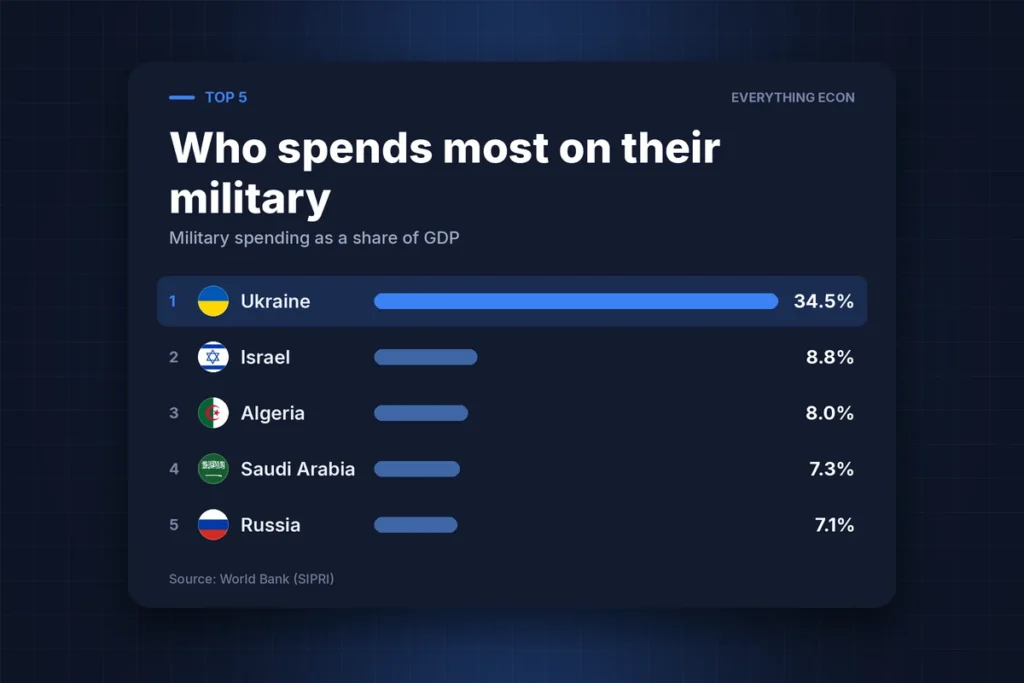
Military spending as a share of GDP
- 1Ukraine34.5%
- 2Israel8.8%
- 3Algeria8.0%
- 4Saudi Arabia7.3%
- 5Russia7.1%
Source: World Bank (SIPRI)
The Gulf and the Middle East dominate the upper ranks
Seven of the top fifteen spenders — Israel, Algeria, Saudi Arabia, Qatar, Oman, Kuwait and Jordan — sit in the Middle East and North Africa. Israel stands out: its military spending surged 65% in 2024 to $46.5 billion, the steepest single-year jump since the Six Day War in 1967, pushing its burden to 8.8% of GDP. That figure has more than doubled since 2015, when it stood at just 5.4%, reflecting the scale and duration of recent conflict. The Gulf states around it — oil-rich but living in a volatile neighbourhood — have long used their wealth to fund large militaries as insurance against regional instability, keeping countries like Saudi Arabia (7.3%) and Qatar (6.5%) consistently high on this list.
Conflict and instability elsewhere in the top fifteen
A second cluster reflects active or recent fighting. Russia's spending hit an estimated $149 billion in 2024 — 7.1% of GDP and 19% of all government spending — after jumping 38% in a single year, far outpacing the 2.9% rise on the Ukrainian side and widening the gap in wartime spending. Myanmar, gripped by civil war, saw its own spending rise 66% in 2024, giving it the largest military burden (6.8%) anywhere in the Asia-Pacific region. Armenia and Azerbaijan, still shadowed by their conflict over Nagorno-Karabakh, and Burkina Faso and Mali, fighting jihadist insurgencies in the Sahel, round out a top fifteen defined almost entirely by war rather than routine defence planning.
This wartime pressure isn't confined to the top of the table. Elsewhere in NATO, Poland raised spending 31% to $38 billion, becoming the alliance's top spender as a share of GDP for the first time since the Second World War, while Germany's spending rose 28% to $88.5 billion — its biggest outlay since reunification. Eighteen of NATO's 32 members hit the alliance's 2%-of-GDP target in 2024, up from just eleven the year before. Meanwhile the United States, the world's largest military spender in dollar terms, actually cut spending by 7.5% in 2025 to $954 billion, as Congress approved no new aid for Ukraine.
At the bottom of the table sit countries largely untouched by these pressures: Zimbabwe (0.4%), Papua New Guinea (0.3%), Ireland (0.2%), Mauritius (0.1%) and Haiti (0.1%). Some, like Ireland, keep spending low by long-standing policy and geography. Others, like Haiti, spend little not because they are secure, but because the state itself has limited capacity to fund an army at all.
Ukraine, by a huge margin
No country comes close to Ukraine, where military spending reached 34.5% of GDP in 2024 — more than double Israel's burden and nearly five times Russia's. At the extreme, effectively all of Ukraine's tax revenue is now going towards defence, a stark illustration of what full-scale war does to a national economy. It is a figure with no real peacetime parallel among the countries in this ranking, and a reminder that behind the percentages are decisions about what a country can no longer afford to fund.
Source: World Bank (SIPRI), 2024 data.
Get a new data story like this every week — join the newsletter.
Browse every visualisation on the visualisations page.
Take one home
Every country drawn to scale, as an instant printable download or a museum-quality matte poster printed to order.