Most people in rich countries work for someone else: they get a payslip, a contract, and a manager. But that arrangement is far from universal. Across much of the world, working for yourself — farming a small plot, running a market stall, fixing things for cash — isn't a lifestyle choice, it's the only option available. The World Bank tracks the share of each country's workforce that is self-employed, and the gap between the top and bottom of this ranking is enormous: from over 90% in the highest countries down to under 1% in the lowest.
At a glance · Top 5
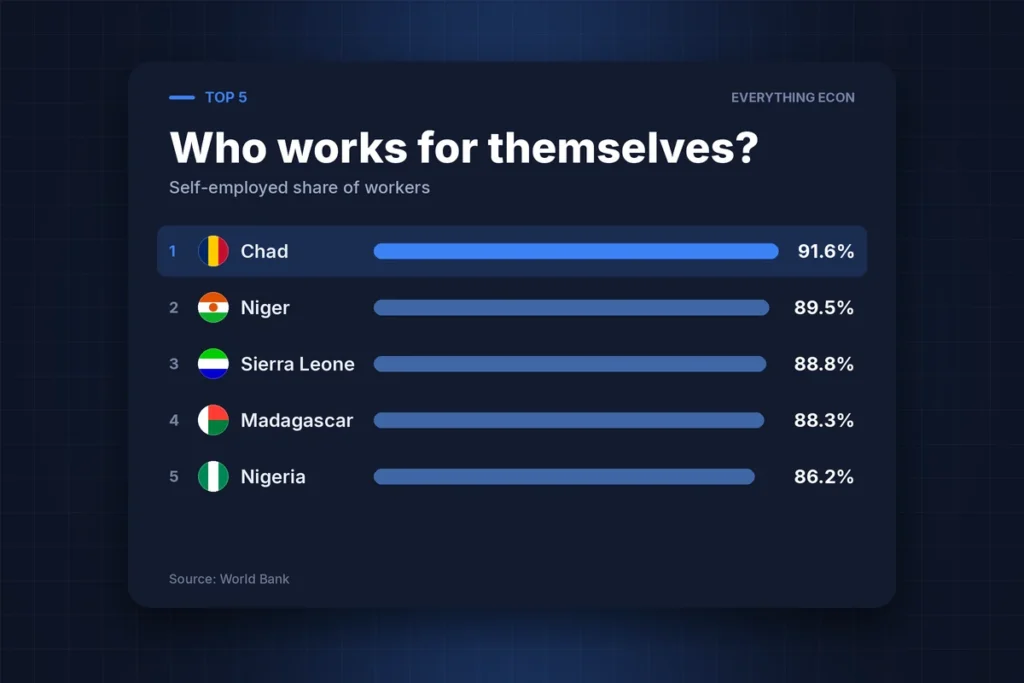
Self-employed share of workers
- 1Chad91.6%
- 2Niger89.5%
- 3Sierra Leone88.8%
- 4Madagascar88.3%
- 5Nigeria86.2%
Source: World Bank
Africa's near-total sweep of the top
The list of countries with the highest self-employment rates is overwhelmingly African. Niger (89.5%), Sierra Leone (88.8%), Madagascar (88.3%), Nigeria (86.2%), the Central African Republic (85.4%), Tanzania and Mozambique (both 85.3%), DR Congo (85.1%) and Burundi (84.9%) all sit above 84%. Afghanistan (83.4%) is the one clear outlier among them, but the pattern elsewhere is consistent: economies still built around small-scale farming and informal trade rather than large employers.
This isn't really about ambition or entrepreneurship in the way the term is often used elsewhere. In Niger, for example, women and young people are frequently pushed into self-employment out of necessity rather than choice, because there simply aren't enough formal jobs to go around. Central Africa as a whole has the highest share of informal employment in the world, at 92.5% of all jobs, with West Africa close behind at 91.8%. Self-employment and informal work go hand in hand here: when there's no formal wage economy to speak of, working for yourself is often the only way to earn a living.
The Gulf states sit at the opposite extreme
At the bottom of the ranking are Qatar (0.8%), Bahrain (2.4%), Kuwait (3.2%), Norway (4.9%) and Oman (5.0%). The Gulf countries dominate this end of the list for a distinctive reason: their economies rely heavily on foreign labour. In Qatar, over 94% of the workforce is made up of foreign workers, typically employed on fixed contracts in construction, services, and other formal-sector jobs — the opposite of informal, self-directed work. Meanwhile, Kuwaiti and Bahraini nationals strongly favour secure public-sector jobs, which offer stability and benefits that self-employment can't match. Norway's low rate reflects a different story: a wealthy economy with a large, well-established formal job market and strong social protections, so few people need to strike out on their own.
The middle tells its own story
The countries in between show that self-employment rates don't simply track wealth in a straight line. China sits at a middling 37.67%, a legacy of decades of rapid industrialisation that built a large formal-employment sector. India, despite a broadly similar population size, stands at 74.90% — far closer to the African countries at the top of the list than to China. That gap reflects how much of India's workforce still works in agriculture and informal trade rather than in factories or offices.
Chad tops the world
At the very top of the ranking is Chad, where 91.6% of workers are self-employed — the highest rate anywhere. The reason is straightforward: Chad's economy is dominated by subsistence agriculture, and there is almost no formal wage economy to speak of. For the vast majority of Chadians, working for yourself isn't a career decision — it's simply what having a livelihood looks like.
Taken together, this ranking is less a map of ambition than a map of formal job availability. Where wage jobs are scarce, self-employment is high, often out of necessity. Where formal employment is abundant — whether through industrialisation, public-sector hiring, or reliance on foreign labour — self-employment nearly disappears.
Source: World Bank.
Get a new data story like this every week — join the newsletter.
Browse every visualisation on the visualisations page.
Take one home
Every country drawn to scale, as an instant printable download or a museum-quality matte poster printed to order.