Population growth sounds simple: more births than deaths, and the numbers go up. In practice, it is far messier. War, migration, economic booms, and demographic collapse can swing a country's population by millions within just a few years. The World Bank's latest ranking of annual population growth rates reveals some striking surprises — and the countries at the very top may not be the ones you expect.
Gulf States and Conflict Zones Dominate the Top
The upper reaches of the ranking are split between two very different stories. Four of the top five spots belong to Gulf states — Saudi Arabia (4.63%), Oman (3.96%), and Qatar (3.92%) all cluster near the summit — and their growth has almost nothing to do with babies. In Qatar, for instance, more than 75% of residents are migrants, drawn by construction booms and high-paying work. These countries are growing because people are moving in, not because families are unusually large.
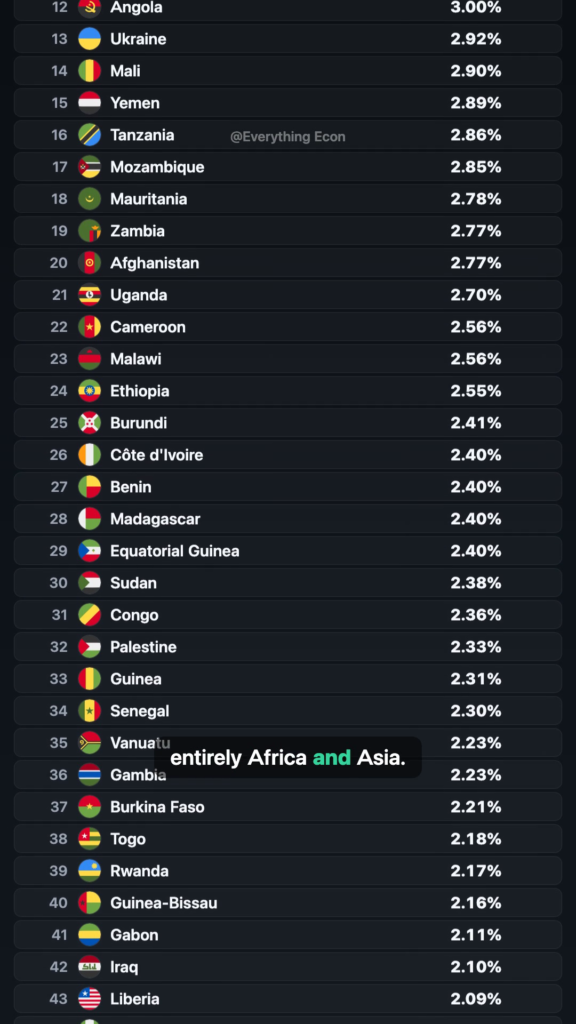
The other story is Sub-Saharan Africa. Chad (3.41%), the Central African Republic (3.37%), Somalia (3.34%), Niger (3.22%), and DR Congo (3.20%) fill positions six through ten. Here, the engine is birth rates: women in these countries have close to six children on average. Niger's situation is particularly striking — the median age is just 15.3 years, and nearly half the population is under 15. That means even if birth rates were to fall tomorrow, the sheer number of young people already alive guarantees decades of continued growth.
Two Wars, Two Unexpected Consequences
Two countries on this list owe their rankings directly to ongoing conflict, and both tell counter-intuitive stories.
Georgia, ranked eleventh at 3.18%, is not a country many people would associate with a population boom. Yet since Russia launched its full-scale invasion of Ukraine in February 2022, an estimated 1.2 million Russians relocated to Georgia. Cities like Tbilisi and Batumi visibly changed almost overnight. Georgia's growth is essentially borrowed — it reflects another country's crisis rather than any domestic trend.
Ukraine itself appears at thirteenth place with 2.92% growth, which seems baffling for a country at war. The World Bank's methodology captures returning refugees coming back to Ukrainian territory, which pushes the headline figure upward. Underneath that number, however, Ukraine's birth rate has collapsed to just 0.9 children per woman — one of the lowest ever recorded anywhere in the world.
The World's Fastest-Growing Population
At the very top of the ranking sits the United Arab Emirates, at 4.68% annual growth. The UAE's rise is almost entirely a migration story. Expatriates make up roughly 89% of the country's population — the highest share of any nation on Earth, bar the Vatican City. The country's population grew from around 4 million in 2004 to 11.35 million in 2024, not because Emirati families are large, but because migrant workers kept arriving in enormous numbers. Strip away migration, and the underlying natural growth rate would look very different indeed.
Where Populations Are Falling
At the other end of the table, Moldova stands out as the starkest case of long-run decline. At -1.75%, it is the fastest-shrinking country in the dataset, and the numbers behind that figure are sobering: Moldova's population has fallen from 4.36 million in 1991 to roughly 2.4 million today — close to half its people gone in just over three decades. Latvia (-0.99%), Kosovo (-1.10%), Albania (-1.17%), and Tuvalu (-1.61%) round out the bottom five, each emptied by emigration rather than falling birth rates.
Data: World Bank. Figures reflect the most recent available annual population growth rates.
Get a new data story like this every week — join the newsletter.
Browse every visualisation on the visualisations page.