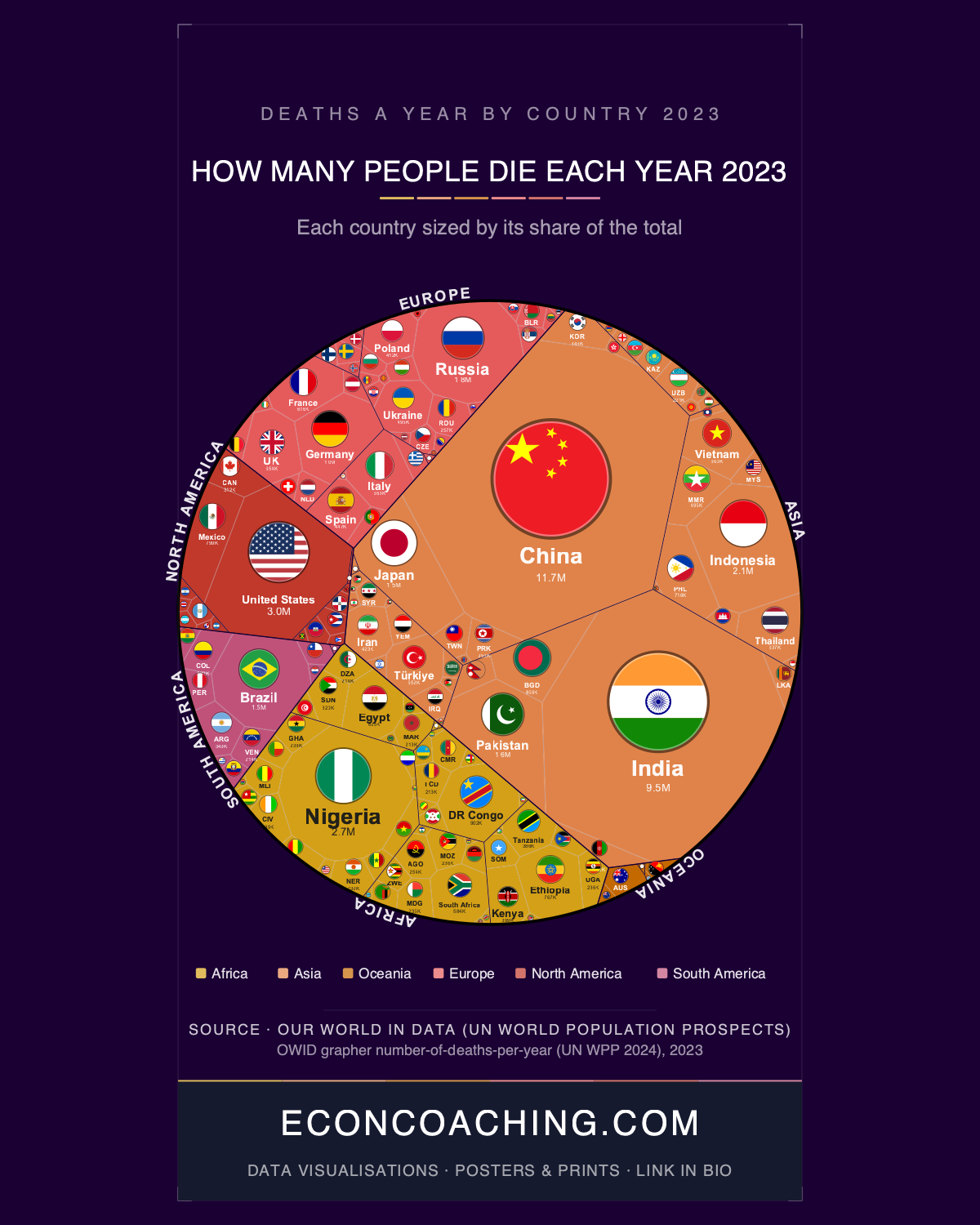
Nigeria recorded 2,675,439 deaths in 2023, ranking it fourth in the world, directly behind the United States. Its median age is approximately 18 years and its crude death rate is 11.74 per 1,000, lower than Japan's 12.7 per 1,000. Japan ranks eighth. A country with one of the youngest populations on Earth is generating a death toll that exceeds Russia, Pakistan, Japan, and Brazil, and is closing on the United States. That is the central tension the treemap makes visible: cell size reflects population scale and age structure, not the severity of suffering in any given country.
China's 19% and What the One-Child Policy Built
China's 11,684,178 deaths in 2023 account for nearly 19% of the global total of 61,608,783, a share that dwarfs every other country on the chart. The structural cause is the age distortion produced by the one-child policy, introduced in 1979 and not fully relaxed until 2015. Decades of suppressed fertility created an outsized elderly cohort now entering peak mortality years. By 2025, China had 323 million people over age 60, representing 23% of its population. Since 2022, deaths have outstripped births, a threshold that demographers once placed further into the future. China will likely hold or expand its position at the top of this ranking for decades, even as its total population contracts, because the structural imbalance in its age pyramid will keep producing high death counts regardless of what happens to fertility.
India's 9,507,013 deaths place it second, reflecting sheer population scale rather than an aged society. The two countries together account for more than one in three deaths globally.
Nigeria's Paradox: Mass Death and Explosive Growth
The fourth-place ranking for Nigeria is the chart's most counterintuitive result. Nigeria's death toll has more than doubled since 1950, rising from roughly 1.03 million to 2.68 million in 2023, but that increase is driven entirely by population growth. Its crude death rate has actually fallen from 26.46 per 1,000 in 1960 to 11.74 in 2023, one of the steepest per-capita health improvements of any large country over that period. More deaths in absolute terms, substantially fewer deaths per person: the two facts coexist because the population base has expanded so rapidly.
The Democratic Republic of Congo makes the same point in sharper form. At rank 11 with 901,849 deaths, the DRC also recorded 4.37 million births in 2023, close to five births for every death. Its under-five mortality rate is among the world's worst, yet it contributes only 1.46% of global deaths because its total population, while large, cannot compete in raw scale with China or India. Countries with the most preventable mortality can be statistically invisible on a chart dominated by populous giants. Nigeria's trajectory points toward greater visibility: it is projected to overtake the United States as the world's third most populous country before 2050, at which point its death count could approach or rival the current US figure of 2,975,657, driven by population size rather than a high per-capita rate.
Japan and Germany: Structural Decline Already in Progress
Japan recorded 1,524,431 deaths in 2023 against 758,631 births, a natural population loss of over 830,000 people in a single year at a pace demographers had not expected until around 2035. Deaths have outnumbered births in Japan every year since 2007, and by 2023 more than one in ten Japanese residents was aged 80 or older. Japan's National Institute of Population and Social Security Research projects that the country's population will decline by approximately one million people per year in the 2040s-2060s as the structural gap between births and deaths compounds further.
Germany's position at rank 10, with 1,034,138 deaths, reflects more than five decades of the same dynamic. Germany has recorded more deaths than births every year since 1972, meaning 2023 was its 52nd consecutive year of natural population decline, offset only by immigration. Its death rate per 1,000 is higher than that of the United States, even though the US has nearly three times as many total deaths. Scale and age structure, not health system failure, explain Germany's ranking.
Africa's Share and What the Raw Numbers Conceal
Africa accounts for 18.4% of global deaths, or 11,331,516, a figure that sounds alarming until you note that Africa holds roughly 18% of the world's population. Its share of deaths is broadly proportional to its share of people. The more telling signal is the composition of those deaths. African mortality is heavily concentrated in children and younger adults dying of infectious and preventable diseases, whereas European and East Asian deaths are concentrated in older adults dying of chronic conditions. Europe, with a far older population, accounts for 13.5% of global deaths, or 8,289,316, a lower share than Africa despite a more aged demographic profile, which reflects Africa's higher birth and fertility rates producing a larger base population.
Asia as a whole accounts for 55.3% of all global deaths, or 34,055,540, driven by the combined weight of China and India. All of Oceania, including Australia, contributes just 307,193 deaths, 0.5% of the global total, fewer than South Korea alone at 345,503.
Causes: Heart Disease Reasserts, COVID Retreats
The WHO's 2023 global causes-of-death data confirms that ischaemic heart disease has retaken its position as the world's leading killer, responsible for 16% of all deaths and reaching 9.5 million deaths. Eight of the ten leading causes globally are noncommunicable diseases. COVID-19, which ranked first globally in 2021 with 9.4 million attributed deaths, had fallen to 14th by 2023 with 0.9 million, a decline that reflects both vaccination and natural immunity accumulation. The post-COVID normalisation of mortality patterns means the 2023 data from the UN World Population Prospects 2024 Revision represents a reasonably stable baseline for comparing country-level trends rather than a pandemic-distorted snapshot.
The forward pressure on global death counts will come from two opposite directions simultaneously: aging rich-world populations generating more deaths per capita each year as large elderly cohorts move through the final decades of life, and young high-fertility populations in Africa and South Asia generating more deaths in absolute terms as their population bases expand. Both trends are structural and will not reverse on short timescales, which means the gap between the two worlds visible in this treemap will widen before it narrows.
For more data-driven analysis of global economics and the trends reshaping the world economy, visit econcoaching.com.
Take one home
Every country drawn to scale, as an instant printable download or a museum-quality matte poster printed to order.
← Back to all visualisations & articles
Follow Everything Econ: YouTube · TikTok · X · Instagram · Facebook