Teen birth rate measures how many babies are born to every 1,000 girls aged 15 to 19 in a given country each year. It's a number that captures far more than biology — it reflects how much schooling girls get, how young they marry, how poor their families are, and how much choice they have over their own futures. Across the world today, that number ranges from essentially zero to well over 150, and the gap between the two extremes tells a story about opportunity as much as it does about childbirth.
At a glance · Top 5
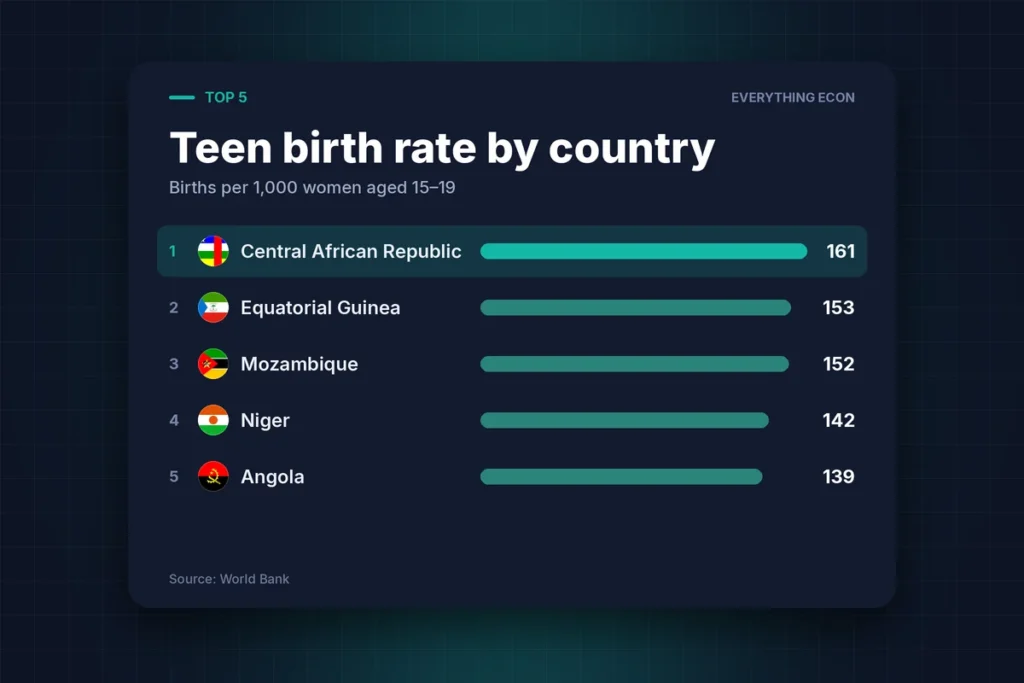
Births per 1,000 women aged 15–19
- 1Central African Republic161
- 2Equatorial Guinea153
- 3Mozambique152
- 4Niger142
- 5Angola139
Source: World Bank
The countries at the top
Sub-Saharan Africa dominates the upper end of the ranking almost entirely. Mozambique (152), Niger (142), Angola (139), Mali (136) and Chad (132) all post rates so high that, in effect, a substantial share of teenage girls are becoming mothers before they finish adolescence. Niger's case is particularly stark: families there average seven children, 40.8% of the population lives in poverty, and only 17% of girls complete secondary school. That last figure matters more than it might seem — research shows each additional year of schooling a girl completes cuts her odds of marrying young by 5 to 10%. Keep girls in school, and birth rates tend to follow downward.
What drives the extremes
At the bottom, the pattern flips entirely. Hong Kong and Denmark sit at just 1 birth per 1,000 teens, South Korea and North Korea also record 1, and Macao registers essentially 0. These are places — spanning very different political systems — where teenage childbearing has become vanishingly rare, whether through access to education and contraception, strong social norms against early marriage, or, in North Korea's case, tight state control over life more broadly.
The most telling comparison, though, is between countries moving in opposite directions. From 1986 to 2017, every country in West and Central Africa reduced its rate of adolescent marriage — except two: the Central African Republic and Niger, where it actually rose. That's a rare and troubling reversal against a regional trend, and it helps explain why both countries sit at the very top of this ranking today.
Progress is possible — and fast
Elsewhere, the story is one of dramatic change. India's teen birth rate collapsed from 155.3 per 1,000 in 1960 to just 13 in 2024 — a drop of more than 90% in little over sixty years. Its neighbour Bangladesh has fallen too, from over 150 in 1995 to just above 60 today, though it remains far higher than India's. Even wealthy countries continue to see sharp declines: the United States hit a record low of 11.7 births per 1,000 teens in 2025, down 7% in a single year and about 68% lower than in 2007. South Africa has also made recent gains, with adolescent births falling 16% across all nine provinces between 2021 and 2025, and births to girls under 15 down nearly 40%.
The country at the very top
That brings us to the Central African Republic, which tops the entire ranking at 161 births per 1,000 teens — the highest rate anywhere on Earth. The driving force is child marriage: 61% of girls there marry before turning 18. What makes the Central African Republic unusual is that, unlike almost everywhere else, wealth and education barely move the needle on child marriage rates. In most countries, richer and better-educated families marry off daughters later; in the Central African Republic, that protective effect largely disappears, which helps explain why its rate has kept climbing even as the rest of the region has improved.
Source: World Bank.
Take one home
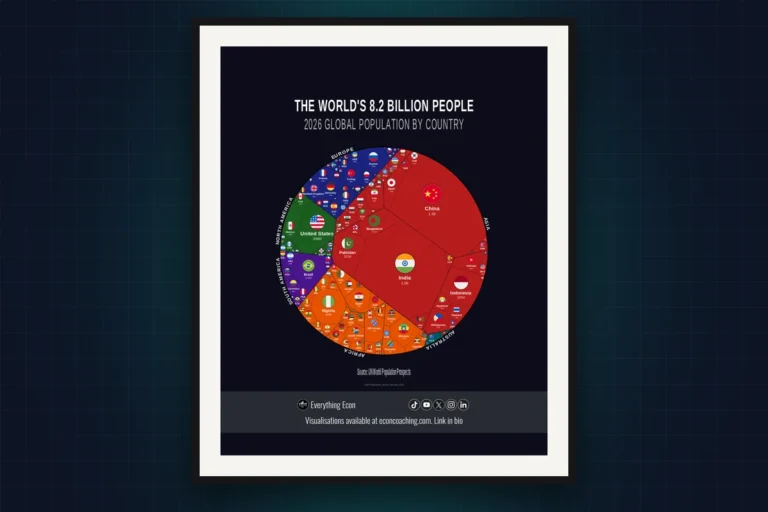
Every country drawn to scale, as an instant printable download or a museum-quality matte poster printed to order.
Get a new data story like this every week — join the newsletter.
Browse every visualisation on the visualisations page.