
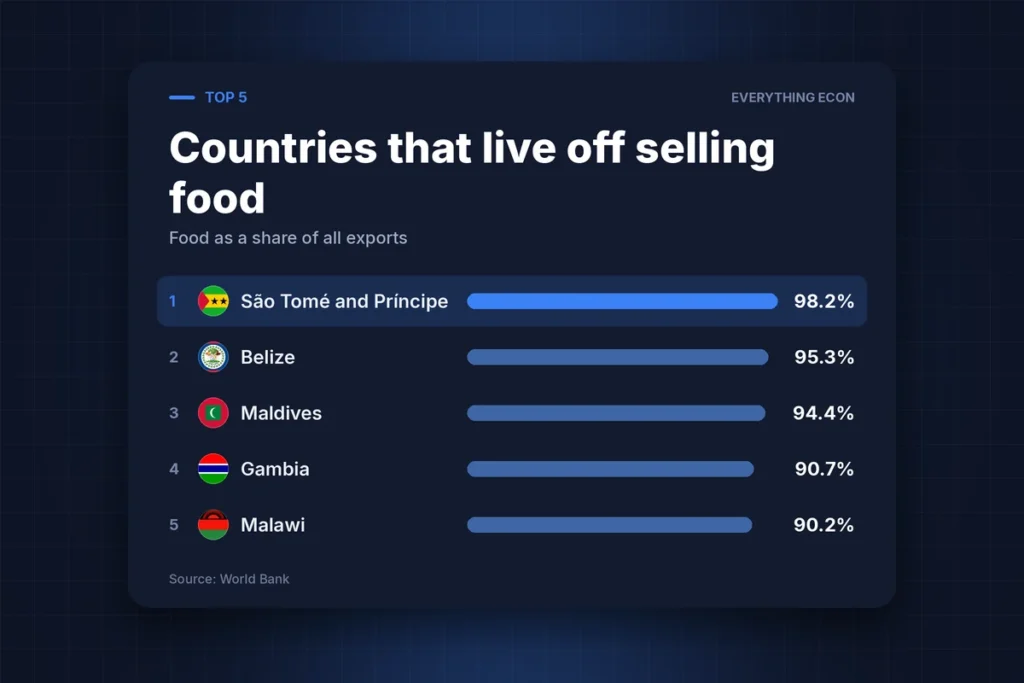
Most countries sell a mix of things abroad — machinery, oil, services, minerals, food. But for a surprising number of nations, food exports aren't just one line item on the balance sheet; they're nearly the whole story. This ranking looks at the share of total goods exports that come from food and agricultural products, using World Bank data. At the top end, some countries earn more than 90% of their entire export income from things people eat or drink. At the bottom end, a handful of countries barely sell food abroad at all, because oil, minerals or other goods dominate instead.
At a glance · Top 5
Food as a share of all exports
- 1São Tomé and Príncipe98.2%
- 2Belize95.3%
- 3Maldives94.4%
- 4Gambia90.7%
- 5Malawi90.2%
Source: World Bank
The islands and single-crop economies at the top
The countries with the highest food-export shares tend to have one thing in common: they don't have much else to sell. Sao Tome and Principe leads the entire ranking at 98.2%, with cocoa alone accounting for roughly 79% of everything the small African island nation exports. Belize follows at 95.3%, built almost entirely on sugar and citrus fruit. The Maldives comes in at 94.4%, where tuna does the heavy lifting — fitting for a nation made up mostly of ocean.
This pattern repeats across small island states: Seychelles sits at 85.9% thanks to canned fish, while Comoros reaches 88.5% on vanilla and cloves. These are economies where a single crop or catch effectively is the export sector. Gambia (90.7%) leans on groundnuts, and Malawi (90.2%) has long depended on tobacco, though that crop's dominance has eased — from 71% of exports in 2017 down to roughly half today.
Bigger economies can be food-dependent too
It's not only small islands on this list. Ethiopia ranks 10th at 80.4%, driven by coffee, which just had a blockbuster year: earnings hit a record $3 billion in the 2025/26 season, up 47% on the year before. Panama, better known for its canal and banking industry, ranks 11th at 73.6% — a reminder that a country's global reputation doesn't always match what actually pays the bills, since its exports are dominated by bananas and seafood. Paraguay ties for 13th at 69.1%, standing out as the world's fourth-largest soybean exporter, with soy products making up about 41% of everything it sells abroad.
What separates the top from the bottom
The common thread among the top performers is a lack of alternatives — small economies, limited industry, and a favourable climate or coastline for producing one or two food commodities at scale. The bottom of the ranking tells the opposite story. Angola (0.4%), the Central African Republic (0.2%) and Congo (0.2%) export almost no food because oil, diamonds and other minerals dwarf everything else in their trade figures. Qatar (0.1%) and Brunei (0.1%) sit at the very bottom for the same reason, just with natural gas and oil instead of minerals — food exports aren't zero, they're simply drowned out by resource wealth.
Sao Tome and Principe's position at the very top is worth dwelling on. This is a country of around 220,000 people, and cocoa has been central to its economy since colonial times. A 98.2% food-export share means the nation's entire trade fortunes rise and fall with global cocoa prices and harvest conditions — there is essentially no cushion from other industries. It's an extreme version of a pattern seen throughout this list: the smaller and less diversified the economy, the more exposed it is to the ups and downs of a single crop.
Source: World Bank, 2025/26 trade data.
Get a new data story like this every week — join the newsletter.
Browse every visualisation on the visualisations page.
Keep exploring
 Economy · GraphicWho Holds America’s Debt? The $9.25tn Owned Abroad407K views3 min read
 Economy · RankingThe Countries Where an Extra Three Decades of Life Comes as Standard293K views3 min read
 Economy · RankingThe Countries Where Money Is Growing Fastest — and Where It’s Vanishing279K views3 min read