
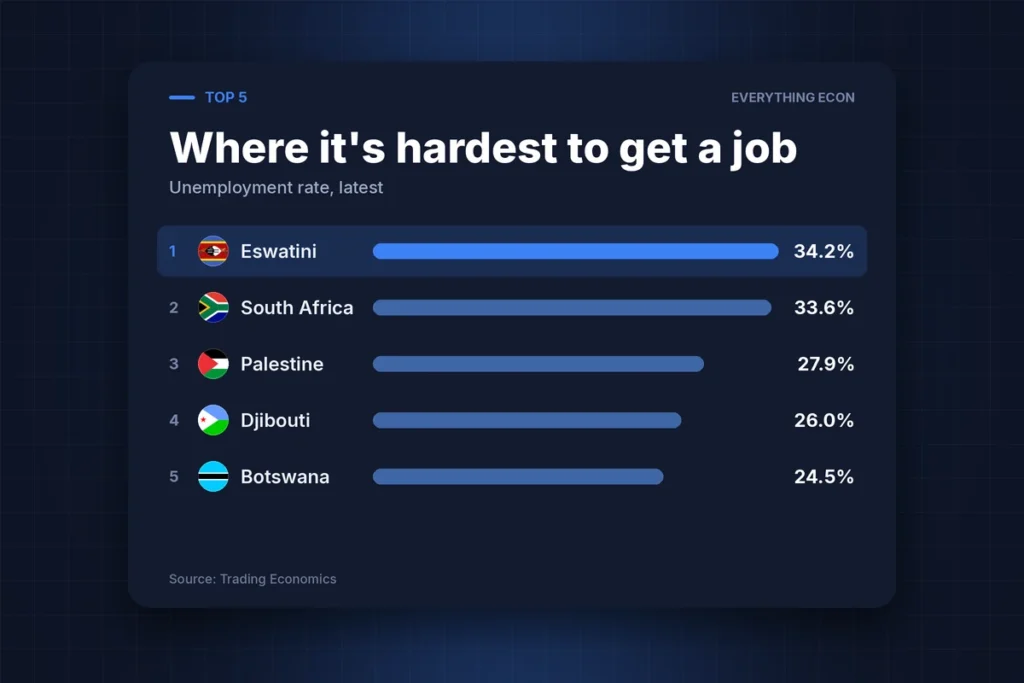
Unemployment sounds like a simple number: the share of people who want a job but don't have one. But when you line up 175 countries side by side, the gap between the easiest and hardest places to find work is enormous — driven by everything from war to oil wealth to how "employment" gets counted in the first place. This ranking, based on Trading Economics data, shows just how wide that gap really is.
At a glance · Top 5
Unemployment rate, latest
- 1Eswatini34.2%
- 2South Africa33.6%
- 3Palestine27.9%
- 4Djibouti26.0%
- 5Botswana24.5%
Source: Trading Economics
The hardest places to find work
Southern Africa dominates the top of the list. Eswatini leads the world at 34.2% unemployment, a country almost entirely dependent on trade with neighbouring South Africa and with little industry of its own to fall back on. Right behind it, South Africa sits at 33.6% — and the picture is even bleaker for the young, where unemployment alone reaches 58%.
Palestine's 27.9% rate tells a different story: this is a conflict economy, with unemployment driven almost entirely by economic collapse and blockade restrictions rather than the usual ups and downs of a labour market. Djibouti (26.0%) and Botswana (24.5%) round out the top five, followed by a run of African nations — Senegal, Angola, Jordan, Sudan, Gabon and Congo — all above 19%.
A continental problem
This isn't a handful of unlucky countries — it's a pattern. Africa has the highest regional unemployment average in the world, at 10.0%, and the maths behind it is stark: for every 11 young people entering the workforce across the continent, the economy creates only 3 new jobs. That imbalance explains why so many African nations cluster at the top of this ranking.
Europe has its own version of this problem, just less severe. The EU's overall unemployment rate sits at a comparatively low 6.2%, but youth unemployment across Northern, Southern and Western Europe is stuck at 15% — a reminder that headline figures can hide who is actually struggling to get started in the job market. Not every European economy is standing still, though: Greece cut its unemployment rate by 1.48 percentage points in 2025, down to 8.54%, one of the sharpest turnarounds anywhere in the developed world, while Spain trimmed just over a point to roughly 10.4%.
Why the bottom of the list is misleading
At the other end, the numbers get harder to trust at face value. Niger (0.4%), Cambodia (0.3%) and Qatar (0.1%) look like triumphs of job creation, but the reality is more complicated. Cambodia's near-zero rate is possible because over 80% of its workforce is informally employed — think small-scale farming or garment work — jobs that exist outside the formal counting system, whether or not they pay well or offer any security.
The reveal: Qatar
Qatar has the world's lowest unemployment rate of all, at just 0.1%. That's not really a story about job creation — it's a story about oil-and-gas wealth combined with a migrant workforce that does most of the labour but is rarely counted in unemployment statistics at all. When your labour market is built around bringing workers in only when there's a job for them, "zero unemployment" becomes almost a structural default rather than an achievement.
Put Eswatini and Qatar side by side, and the gap is staggering: unemployment in Eswatini is over 340 times higher than in Qatar — the widest spread anywhere in this 175-country dataset, and a reminder that a single global average can hide two completely different economic worlds.
Source: Trading Economics, 2025 data.
Take one home
Every country drawn to scale, as an instant printable download or a museum-quality matte poster printed to order.
Get a new data story like this every week — join the newsletter.
Browse every visualisation on the visualisations page.
Keep exploring
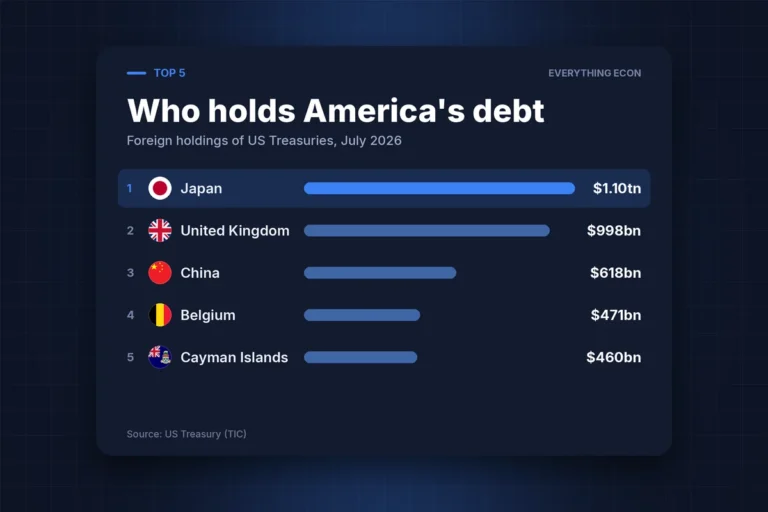 Economy · GraphicWho Holds America’s Debt? The $9.25tn Owned Abroad407K views3 min read
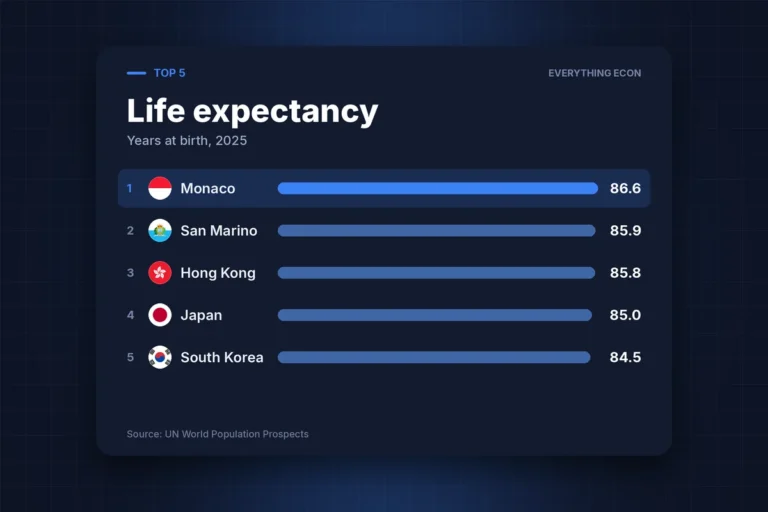 Economy · RankingThe Countries Where an Extra Three Decades of Life Comes as Standard293K views3 min read
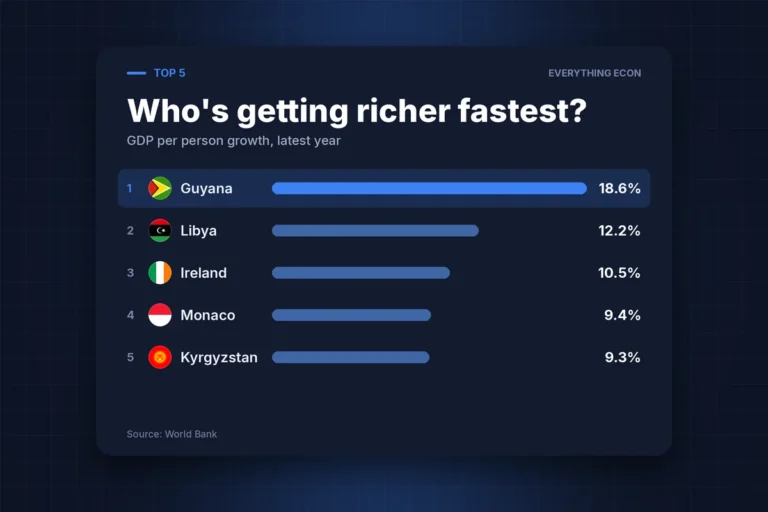 Economy · RankingThe Countries Where Money Is Growing Fastest — and Where It’s Vanishing279K views3 min read