Unemployment sounds like a simple number: the share of people who want to work, are actively looking, but can't find a job. Yet line up the countries with the highest rates and the picture that emerges is anything but simple — it's a map of collapsed economies, broken labour markets, and, in some cases, statistics that hide more than they reveal. At the extremes, the gap is staggering: one country reports unemployment of just 0.1%, while another sits above 34%. Neither figure tells the whole story on its own.
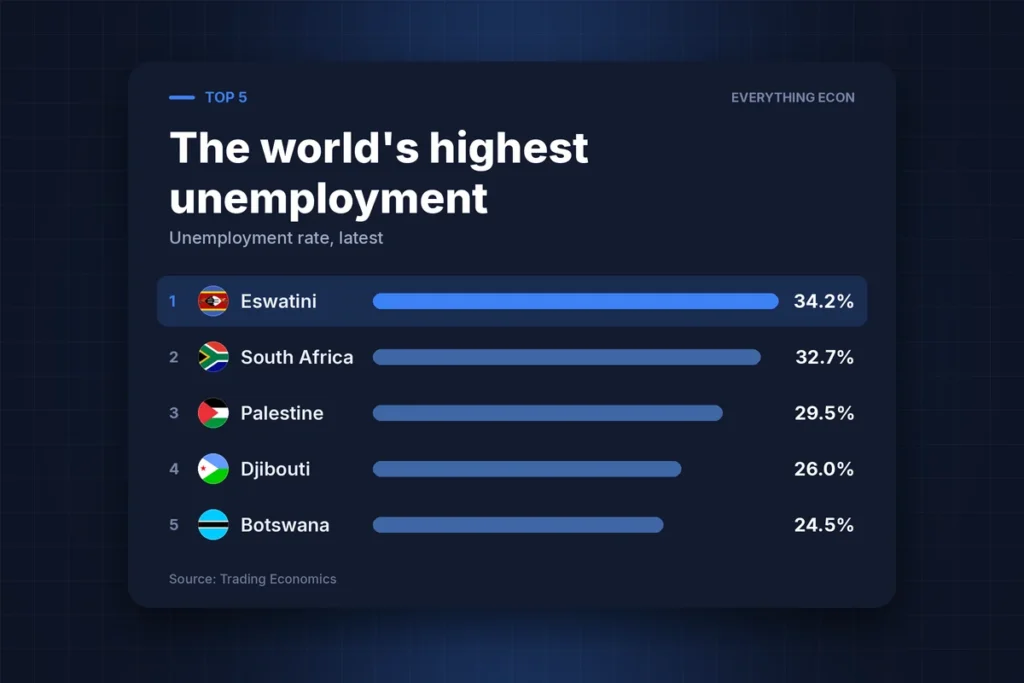
At a glance · Top 5
Unemployment rate, latest
- 1Eswatini34.2%
- 2South Africa32.7%
- 3Palestine29.5%
- 4Djibouti26.0%
- 5Botswana24.5%
Source: Trading Economics
Southern Africa's jobs crisis
Look at the top of the ranking and one region stands out immediately. Eswatini, South Africa, Botswana, Namibia and Lesotho all appear in the top 15, making Southern Africa the epicentre of global joblessness. South Africa's official rate of 32.7% is already alarming, but it understates the problem: once you include people who have simply given up looking for work — the so-called "expanded" measure — the figure climbs above 40%. There has been modest improvement recently, with the rate easing from a peak of 33.2% in the second quarter of 2025 to 31.4% by the end of the year, its best showing since 2020. But youth unemployment in South Africa has stayed stuck at 57%, meaning more than half of young jobseekers remain shut out regardless of the headline trend.
Conflict, collapse, and paradox
A second pattern cuts across the ranking: crisis economies. Palestine's overall rate of 29.5% masks a far starker reality in Gaza, where the economy has shrunk by 84% since 2023 and unemployment there exceeded 77% in 2025 — compared with 29% in the West Bank. By the end of 2024, Palestine's total economic output had fallen back to where it stood in 2009, erasing 15 years of progress in a single conflict. Sudan (20.8%), Libya (18.8%) and Yemen (17.3%) tell similar stories of economies disrupted by war and instability.
Not every high-unemployment country fits that mould, though. Jordan, at 21.1%, presents a genuine puzzle: it has more engineers per person than any country on Earth, yet can't put them to work. It's a reminder that education alone doesn't create jobs — an economy still needs industries able to absorb skilled workers.
Why the bottom of the table can mislead
At the other end, low unemployment doesn't always mean a healthy economy. Niger reports just 0.4% unemployment, but this reflects a population overwhelmingly engaged in unpaid subsistence farming — people working the land to survive, not holding jobs in the conventional sense. Qatar's world-record-low 0.1% comes from a different quirk: expatriate workers make up 84.5% of everyone employed there, so the rate mostly reflects a labour force that was brought in specifically to fill jobs, rather than local job creation. Both cases show why unemployment figures need context, not just comparison.
The country at the very top
That context matters most when explaining Eswatini, which tops the ranking at 34.2%. Among young people, the figure is even more severe: 58% are unemployed, according to the IMF's 2025 review of the country. The mathematics behind this are brutal — Eswatini's economy generates only around 1,000 new jobs each year, while roughly 25,000 young people enter the job market annually seeking work. With demand for jobs outstripping supply by 25 to one, meaningful recovery is not simply difficult; it is structurally almost impossible without a fundamental shift in the economy's ability to create work.
Source: Trading Economics, 2025 data.
Get a new data story like this every week — join the newsletter.
Browse every visualisation on the visualisations page.
Take one home
Every country drawn to scale, as an instant printable download or a museum-quality matte poster printed to order.