Every year, the International Monetary Fund forecasts how much each country's economy is expected to grow, measured as the change in real GDP — the total value of goods and services a country produces, adjusted so that rising prices don't get mistaken for genuine growth. Line up all 184 economies the IMF tracks and a clear pattern emerges: the fastest growth is concentrated in poorer countries starting from a small base, often powered by a single booming industry, while a cluster of oil and gas exporters sit at the very bottom, weighed down by falling energy prices and production.
At a glance · Top 5
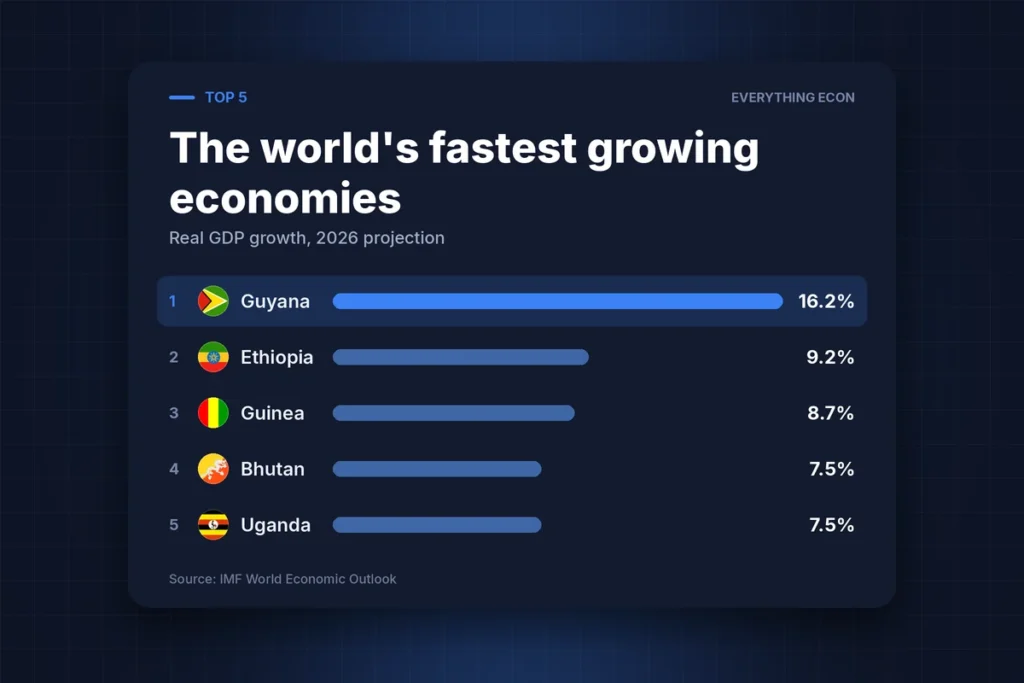
Real GDP growth, 2026 projection
- 1Guyana16.2%
- 2Ethiopia9.2%
- 3Guinea8.7%
- 4Bhutan7.5%
- 5Uganda7.5%
Source: IMF World Economic Outlook
Small economies, big jumps
Several countries near the top of the ranking are growing quickly precisely because they are small enough for one project to move the whole economy. Ethiopia is projected to grow 9.2% in 2026, more than double the average for its region, thanks to a broad mix of mining, construction, manufacturing and agriculture rather than any single sector. That marks a turnaround after years in which conflict, foreign-currency shortages, debt problems and inflation held the country back. Guinea (8.7%), Bhutan and Uganda (both 7.5%) and Rwanda (7.2%) fill out the rest of the top tier. Rwanda stands out as one of Africa's most consistent performers, a result credited to steady policy-making, investment in technology, and its growing role as a services hub for the region.
The bigger players still in the mix
Fast growth usually belongs to small economies, which makes the presence of two much larger countries notable. Vietnam, growing at 7.1% (revised up from an earlier estimate of 7.1% to as high as 7.5% by mid-2026, after IMF analysts raised their forecast on stronger-than-expected tech and electronics exports), is the only country from Southeast Asia to make the global top 15. Its trade with the rest of the world is worth nearly 170% of its entire economic output, reflecting how central manufacturing exports have become to its growth. India, at 6.5%, is the only country among the world's ten largest economies to appear on this list at all, making it the fastest-growing major economy on the planet. Much of that resilience comes from India's services exports — things like software and IT support sold abroad — which have helped offset pressures from a difficult global trading environment.
Oil producers at both ends
Energy tells two very different stories in this ranking. At the bottom, Qatar (-8.6%), Iraq (-6.8%), Iran (-6.1%) and Bolivia (-3.3%) are all economies where oil or gas dominates output, and where falling production or prices have dragged growth into negative territory. Yet at the very top of the entire list sits an oil story running in the opposite direction: Guyana, forecast to grow 16.2% in 2026 — after already growing 43.8% in 2024 and 19.3% in 2025. The driver is a massive offshore oil boom led by ExxonMobil, which pushed Guyana's production past 900,000 barrels a day by the end of 2025, a jump of roughly 35% in a single year. That makes it Latin America's fifth-largest crude exporter, ahead of Colombia. The scale of the transformation is striking: Guyana's economy was worth just $3.5 billion before oil was discovered in 2015, sits above $21 billion today, and is projected to exceed $50 billion by 2030. It is a reminder that the same resource driving some countries into decline is, for a lucky few, still the fastest route to growth.
Source: IMF World Economic Outlook, 2026 projections.
Get a new data story like this every week — join the newsletter.
Browse every visualisation on the visualisations page.
Take one home
Every country drawn to scale, as an instant printable download or a museum-quality matte poster printed to order.