Every country sets a headline rate of tax that companies pay on their profits — the government's cut before a business can call the money its own. Line up these rates across the world and you get less a map of taxation and more a map of national priorities: some governments lean hard on corporate profits to fund public spending, others compete for investment by charging almost nothing at all. The gap between the two extremes is enormous. At the top, companies hand over more than a third of their profits. At the bottom, several places take nothing whatsoever.
At a glance · Top 5
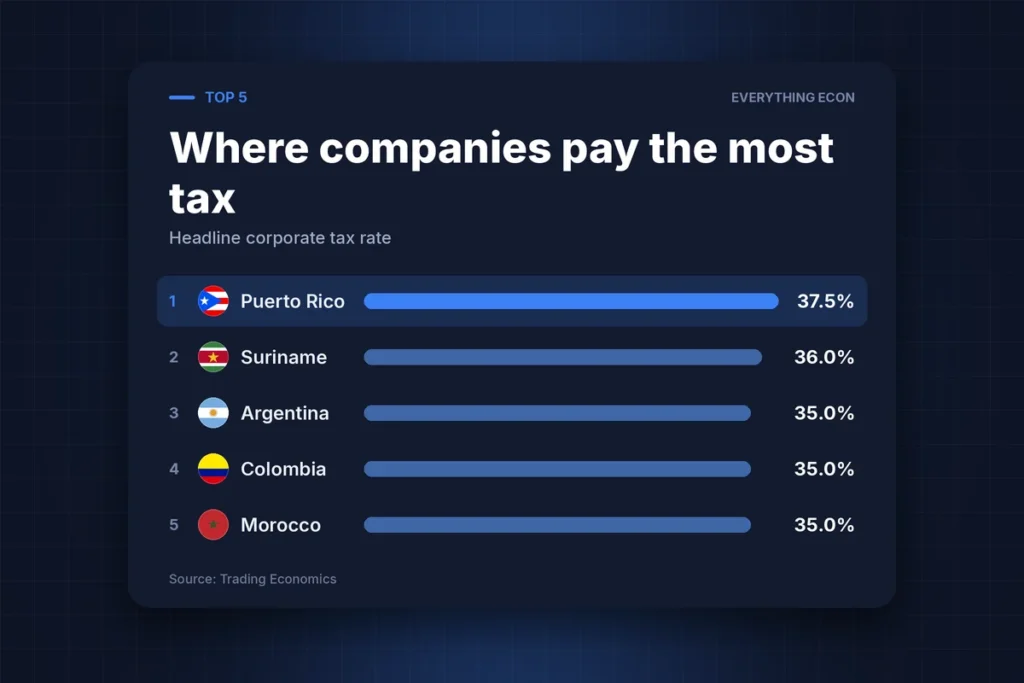
Headline corporate tax rate
- 1Puerto Rico37.5%
- 2Suriname36.0%
- 3Argentina35.0%
- 4Colombia35.0%
- 5Morocco35.0%
Source: Trading Economics
The usual suspects, and some surprises
Several of the names near the top make sense once you know the backstory. Colombia sits at 35%, having raised its rate from 30% in 2022 specifically to help fund the country's recovery from COVID-19. India's headline figure of 34.9% looks similarly punishing, but it's partly an illusion: the base rate is topped up with surcharges of up to 12% and a 4% "Health and Education Cess," pushing the number higher than the tax most companies actually pay. India also offers a way out — firms can opt into a simpler 22% rate, or as little as 15% if they're a new manufacturer. So the headline figure and the lived reality can differ sharply.
At the other end, Hungary charges just 9%, the lowest rate in Europe, and has done since 2017. Bahrain, the Bahamas and Vanuatu charge nothing at all. These aren't accidents — they're deliberate strategies to attract foreign business in places with little other economic leverage.
A race that keeps shifting
The trend among richer economies has mostly run downhill. The United States cut its rate from 35% to 21% in 2017 in the largest corporate tax cut in its history. The effect on its global standing was dramatic: before that cut, only three countries taxed corporations more heavily than the US did. By 2023, 71 countries did — including China, Japan, the UK and Italy. A country's competitiveness on this measure isn't fixed; it moves as everyone else moves too.
Now the direction is starting to reverse in some places, thanks to a global effort to stop countries competing down to zero. Cyprus is raising its rate from 12.5% to 15%, and Lithuania from 15% to 17%, both in 2026, under pressure from an international push for a minimum tax floor. Even the United Arab Emirates, long a byword for zero-tax business, introduced its first-ever federal corporate tax in June 2023 — a shift driven both by its wish to rely less on oil revenue and by the same international pressure against tax avoidance.
The top of the table
Despite all this, the highest rate in this ranking doesn't belong to a major economy at all — it's Puerto Rico, at 37.5%. It narrowly beats Suriname (36.0%) and a cluster of countries at 35%, including Argentina, Colombia, Morocco, Malta, Sudan and Chad. For context, France currently has the highest rate among the OECD's wealthy-nation group, at 36.1% in 2025 — meaning Puerto Rico's rate is unusually high even by the standards of the world's highest-taxing economies.
Together, the two ends of this ranking tell a simple story: corporate tax rates aren't just numbers on a spreadsheet, they're a signal of what each government is trying to achieve — funding services, chasing investment, or simply keeping pace with everyone else.
Source: Trading Economics, 2025 data.
Get a new data story like this every week — join the newsletter.
Browse every visualisation on the visualisations page.
Take one home
Every country drawn to scale, as an instant printable download or a museum-quality matte poster printed to order.