Cereal yield measures how much grain — wheat, maize, rice and the like — a country squeezes out of each hectare of farmland it plants. It's a measure of farming intensity, not farming size: a tiny country with greenhouses and irrigation can easily out-yield a vast one relying on open fields and rainfall. And that gap turns out to be enormous, stretching from over 29,000 kilograms per hectare at the top to just 40 kilograms per hectare at the bottom.
Desert states dominate the top
The most striking pattern in this ranking is that the leading cereal growers aren't the countries you'd expect. The United Arab Emirates (23,306 kg/ha), Qatar (18,275 kg/ha) and Kuwait (14,957 kg/ha) all sit in the global top five, turning desert climates into some of the most productive farmland on the planet. They do it by growing indoors: climate-controlled greenhouses and hydroponic systems, where plants grow in nutrient-rich water rather than soil, let them sidestep the heat and the lack of rain almost entirely. Saint Vincent and the Grenadines (13,344 kg/ha) and Mauritius (11,643 kg/ha) round out the top five with small-island intensive farming of their own.
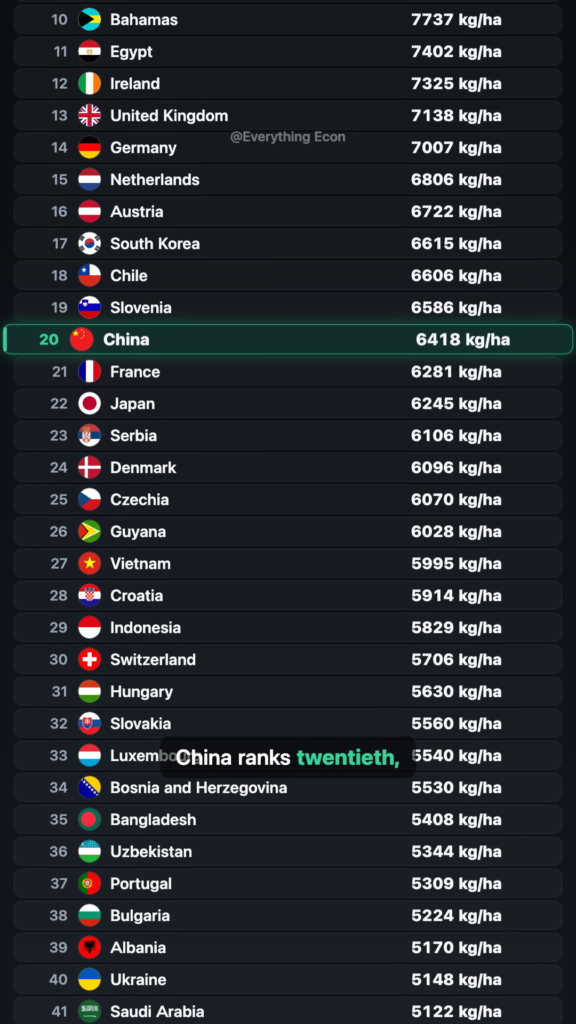
Egypt tells a related but distinct story. At 7,402 kg/ha, it ranks 11th globally thanks to near-total irrigation from the Nile, which delivers reliable water across almost every farmed hectare. Yet that high yield doesn't mean self-sufficiency — Egypt still imports roughly half the wheat it consumes, a reminder that yield per hectare and food security aren't the same thing.
The non-desert leaders
Strip out the desert states and tiny islands, and a different leaderboard emerges. New Zealand tops it at 9,102 kg/ha, ahead of the United States at 8,414 kg/ha, which relies on hybrid corn genetics and GPS-guided precision farming across its Corn Belt. Belgium (8,486 kg/ha) sits between the two, part of a broader cluster of high-yield farming across northwestern Europe that also includes Ireland (7,325 kg/ha), the United Kingdom (7,138 kg/ha), Germany (7,007 kg/ha) and the Netherlands (6,806 kg/ha). None of these countries has abundant open land or a desert's incentive to farm indoors — instead, they combine mild, wet climates with decades of investment in seed science, soil management and machinery.
What separates the top from the bottom
At the other end of the table, the lowest yields belong to Sudan (580 kg/ha), Niger (577 kg/ha), Somalia (504 kg/ha) and Namibia (451 kg/ha), with Cabo Verde last of all at just 40 kg/ha. These are mostly places where farming depends on unpredictable rainfall rather than irrigation, where fertiliser and modern seed varieties are scarce, and where drought and arid soils limit what any hectare can produce. The contrast with the Gulf states is almost paradoxical: the driest countries in the ranking are split between the very best yields, achieved through heavy technological investment, and some of the worst, where farmers have neither the water nor the capital to farm the same way.
Oman leads the world
That contrast is clearest at the very top. Oman posts the highest cereal yield on Earth, at 29,147 kilograms per hectare — more than seven hundred times the figure recorded in Cabo Verde. Oman receives an average of just 60 millimetres of rain a year, barely enough to sustain traditional farming at all. Its yield comes almost entirely from greenhouse and hydroponic systems that grow crops in a controlled environment, detached from the weather outside. It's less a story about fertile land than about engineering a substitute for it.
Data from the World Bank.
Get a new data story like this every week — join the newsletter.
Browse every visualisation on the visualisations page.