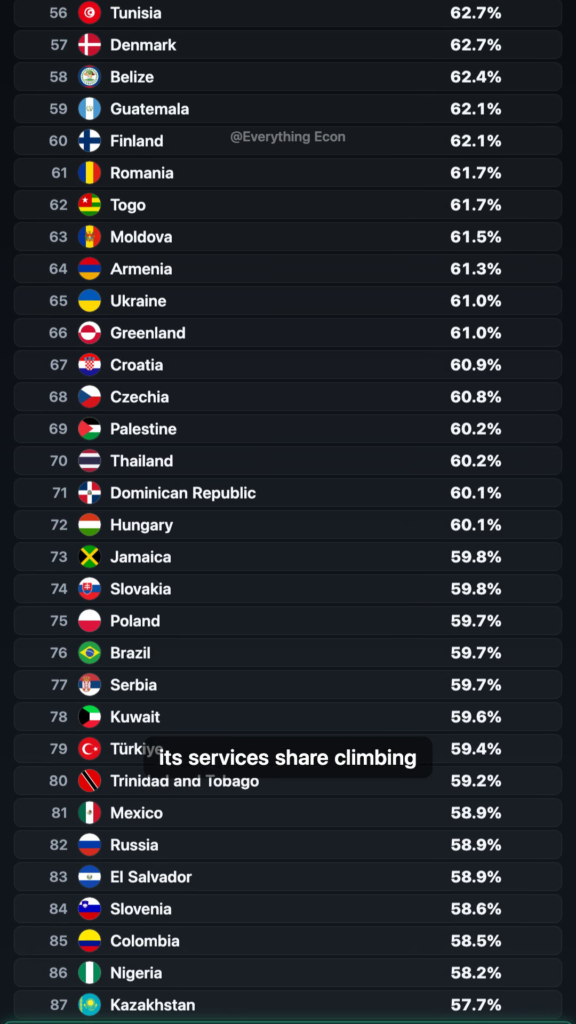
Services now make up the biggest slice of economic output almost everywhere on Earth — everything from banking and retail to tourism, healthcare and software, as opposed to farming or factory production. The World Bank tracks this figure as a share of each country's GDP, and the global pattern tells a clear story: the richer and more specialised an economy becomes, the more it tends to run on services rather than growing crops or making goods. But a handful of countries sit at the bottom for reasons that have nothing to do with being poor or underdeveloped — they're simply built around one enormous resource instead.
Small places, outsized service economies
Several of the countries at the very top aren't large economies at all — they're small, specialised ones that have built their entire output around a single service industry. Macao, which tops the ranking, generates over 90% of its economy from services, almost entirely through casino gaming and tourism. Monaco (87.2%) and Luxembourg (81.4%) run on similar logic, leaning on tourism, banking and finance respectively. Hong Kong, in second place at 91.5%, got there differently: in the mid-1980s it was still a manufacturing and export base, but it transformed into a financial and trade services hub, moving its factories elsewhere while keeping the money and the deal-making at home.
The United Kingdom, at 15th with 73.1%, tells a slower version of the same story. Deindustrialisation shrank British manufacturing from 33% of GDP in 1970 to just 12% by 2010, with financial services filling much of the gap — the sector alone now contributes roughly 12% of UK output and over £100bn a year in tax revenue, making London the largest financial centre outside the United States.
The two giants, and India's shortcut
The gap between the world's two largest economies is striking. The United States sits at 79.7% services, while China is at 56.7% — a 23-point difference that reflects how far China's economy still leans on industry and manufacturing. China has moved fast, though: its services share has climbed from just 44% of GDP in 2010 to 56.7% today, a sign of a major pivot that's still only partway done.
India followed a different route entirely. Its services share rose from 38.8% in 1960 to 49.9% in 2024, while agriculture collapsed from 41.7% to 16.3% over the same period — a near-total reversal. Rather than building a large manufacturing base first, as Britain, the US and China all did, India moved more directly from farming to a services-led economy, driven by IT, finance and travel.
One oil discovery, one upside-down economy
At the bottom of the ranking sits Guyana, at just 14.8% — the lowest services share in the world by a wide margin, trailing even Libya (26.9%) and Tanzania (28.8%). This isn't a story of underdevelopment; it's the opposite. The discovery of offshore oil sent Guyana's petroleum sector from 0.2% of GDP in 2015 to 57.3% by 2022, on the back of 11 billion barrels of reserves. The growth was so rapid that Guyana joined the ranks of high-income countries in 2023 — yet its economy remains almost entirely built around extraction, with services barely developed at all. It's a reminder that a low services share can mean a country has leapt ahead on one resource just as easily as it can mean a country hasn't yet developed.
Back at the top, Macao's 92.0% stands alone: a city-sized economy where gambling and tourism have crowded out almost every other form of output, leaving it the most service-dependent place on the planet.
Source: World Bank.
Get a new data story like this every week — join the newsletter.
Browse every visualisation on the visualisations page.