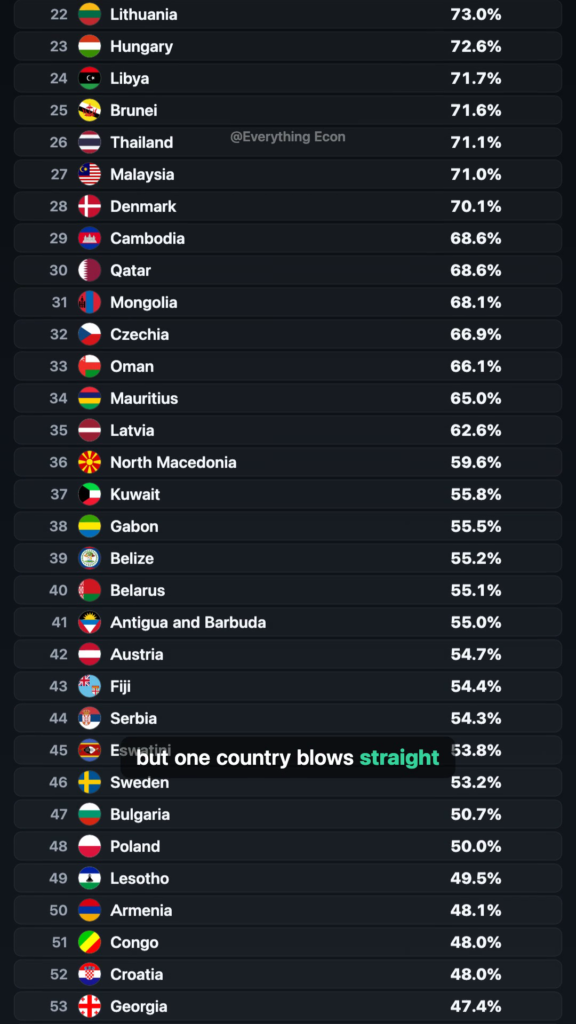
"Living off exports" measures how much a country sells abroad compared with the total size of its economy — exports as a share of GDP. A country scoring 50% earns the equivalent of half its entire yearly output just from selling goods and services overseas. Most large economies sit well below 100%, because exports are only one slice of what they produce. But a striking group of places score well over 100%, meaning their exports are worth more than their entire domestic economy. That isn't a trick of arithmetic — it reflects economies built around moving other people's goods, money, or manufactured parts through their borders, rather than consuming what they make at home.
The hub economies at the top
Most of the countries topping this ranking aren't manufacturing giants — they're trade and finance hubs. Singapore, at 177.9% of GDP, acts as a pass-through point for goods and capital rather than a market that consumes what it exports. Luxembourg, above 190%, gets there mainly through cross-border financial services, with its total trade activity reaching roughly 394% of GDP when imports are included too. The United Arab Emirates, at 106.8%, has deliberately built this role, shifting away from oil and into logistics and free-zone re-export hubs like Jebel Ali, where goods arrive, change hands, and leave again. Djibouti reaches 110.5% for a similar reason: its ports handle over 90% of landlocked Ethiopia's trade, earning the country around $400 million a year in fees for goods that aren't even its own.
Ireland's position at 140.1% tells a different but related story. Multinationals route roughly €140 billion a year through Irish subsidiaries largely for tax purposes, inflating the export figures far beyond what Ireland's domestic economy actually produces or consumes.
Vietnam's genuine manufacturing story
Not every high scorer is a pass-through economy. Vietnam, at 98.2% of GDP, has climbed this ranking through real industrial growth. Samsung alone runs six manufacturing plants in the country, which together generated $54.4 billion in exports in 2024. This is manufacturing that employs people and builds supply chains inside Vietnam, a genuinely different pattern from the re-export and financial-hub stories above it.
Why the bottom looks so different
At the other end of the ranking, countries like Sudan (1.1%), Haiti (1.6%), the Syrian Arab Republic (6.8%), Nepal (8.8%) and Comoros (9.3%) show the opposite pattern: economies that run largely on domestic consumption, remittances sent home by workers abroad, or activity disrupted by conflict, rather than selling to the rest of the world. Size matters too: China, with about 15% of all global merchandise exports, still doesn't rank near the top of this list because its vast domestic economy dwarfs even that huge trading volume — exports are a smaller share of a very large GDP. The same logic applies to Japan, whose $707 billion in exports in 2024 looks modest as a share of GDP next to the hub economies above.
The country living most off exports
Topping the ranking is Hong Kong, at 199.8% of GDP — exports worth almost double the size of its own economy. But the detail behind that number matters: of Hong Kong's export total, $574.9 billion is re-exports, goods passing through on their way elsewhere, against just $7.4 billion in exports that actually originate there. Hong Kong's economy isn't twice the size its GDP suggests; it's a port and financial gateway where enormous volumes of other countries' trade simply pass through its books.
Source: World Bank, most recent available year.
Get a new data story like this every week — join the newsletter.
Browse every visualisation on the visualisations page.