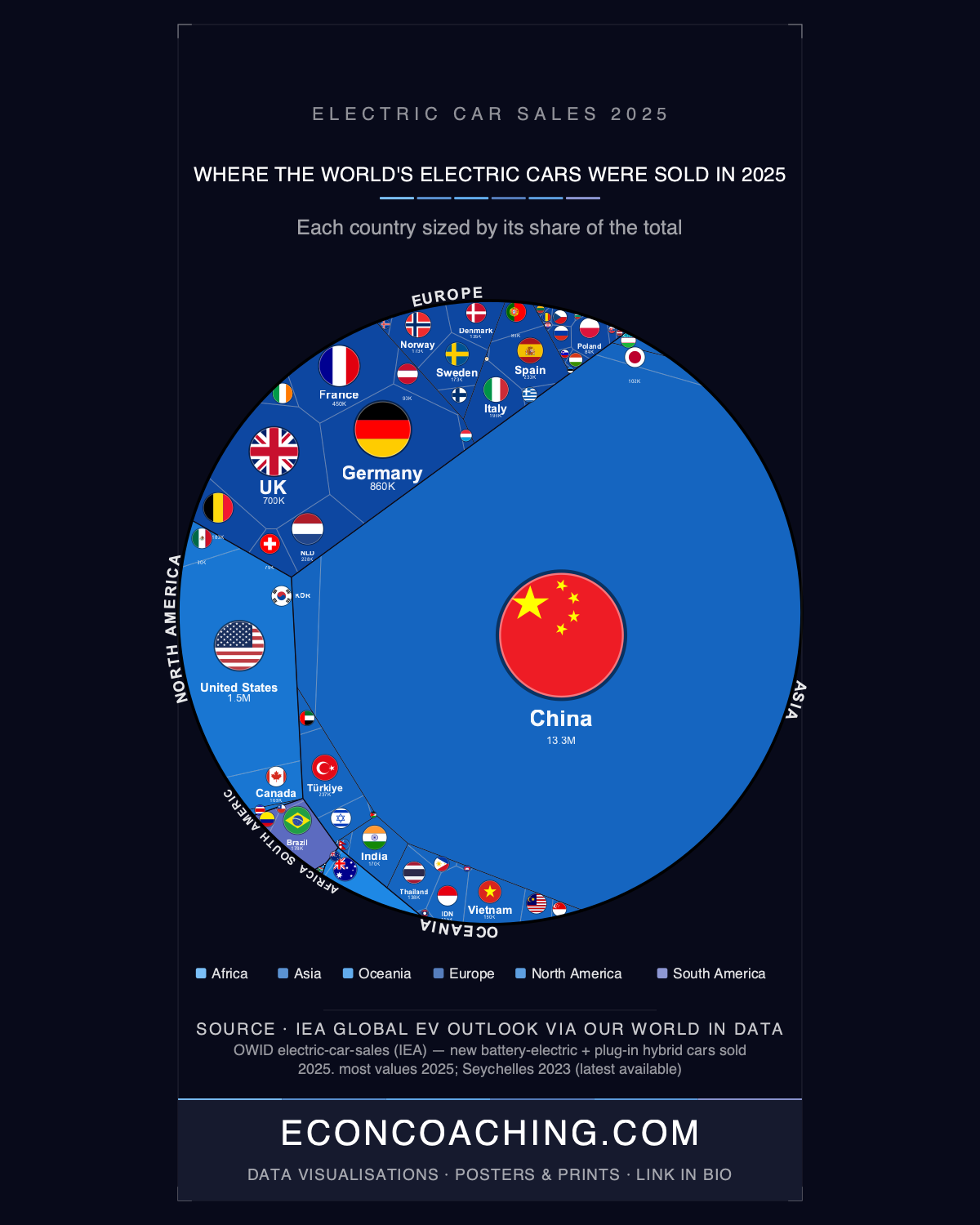
In the treemap accompanying this article, where cell size reflects battery-electric vehicle sales rather than geography, China's rectangle is larger than the other 59 countries in the dataset put together. China sold roughly 13.3 million battery-electric vehicles in 2025, 63.88% of the global total of 20,821,221 units. The United States, ranked second, sold 1.53 million, a fraction visually swallowed by China's block. That single comparison sets the terms for every other story in the 2025 EV data: adoption is accelerating worldwide, but one country is absorbing most of the growth.
China's Pace Makes Norway's Entire Year Look Like a Rounding Error
At China's 2025 selling rate of about 36,400 battery-electric vehicles a day, the country needed under five days to sell as many EVs as Norway, the world's most EV-saturated market, sold across all of 2025: 172,800 cars. A decade earlier, in 2015, electric vehicles made up less than 1% of new car sales in China; by 2025, more than half of China's new cars sold are electric. That shift did not happen organically. China's volume lead rests on sustained domestic subsidies and a homegrown brand ecosystem built around BYD and its domestic peers, a policy-driven structure that other markets, where incentives are now being scaled back, may struggle to replicate.
BYD Dethrones Tesla as the World's Top-Selling EV Brand
2025 marked the first year a Chinese manufacturer outsold Tesla globally. BYD delivered about 2.26 million battery-electric vehicles worldwide, a title Tesla had held since the EV era began. That figure alone exceeds the combined national EV markets of the UK (700,000), France (450,000), and Norway (172,800). In Brazil, BYD alone commands roughly 74% of the country's battery-electric vehicle market, meaning Brazil's EV boom is, almost entirely, a single Chinese brand's expansion rather than a broad-based market shift. Australia's market shows the same pattern on a smaller scale: BYD briefly overtook Tesla in monthly deliveries during 2025, as the country's EV share crossed roughly 11-13% of new car sales for the first time.
Adoption Rate and Sales Volume Are Different Stories
Norway's 172,800 EVs account for just 0.83% of the global total, yet 95.9% of new cars sold in Norway in 2025 were electric, up from 88.9% in 2024. Norway's near-complete EV transition is the product of roughly three decades of policy, dating to 1990s-era exemptions from import tax and VAT on electric cars, layered with purchase incentives ever since. Ranking countries by raw volume, as the chart does, rewards large or wealthy markets like the United States and Germany over countries that have gone furthest on adoption, like Norway and Vietnam. Vietnam sold 180,077 battery-electric vehicles in 2025, more than Norway's total despite ranking well below the chart's top ten, and overtook Thailand to become Southeast Asia's largest EV market as sales more than doubled versus 2024. India's EV sales grew roughly fivefold between 2024 and 2025, yet its total of 170,100 units still trails Vietnam, a country with about one-fourteenth of India's population, showing how far adoption has to run even in large markets such as India, where Tata Motors and Mahindra compete domestically against the Chinese brands reshaping other developing markets.
The United States Breaks the Growth Narrative
The US is the one market in the global top five where EV sales fell year-on-year in 2025, dipping slightly to about 1.53 million units even as worldwide EV sales rose by double digits. That decline, in the world's second-largest EV market, shows that global growth in electric vehicle sales is not a guaranteed one-way trend. Germany moved in the opposite direction, with EV sales jumping roughly 50% year-on-year to about 860,000 cars, re-establishing it as Europe's largest national EV market ahead of the UK (700,000) and France (450,000). Türkiye (237,000), Spain (230,000), the Netherlands (228,000), South Korea (217,000), and Italy (193,000) round out the top ten, each a small fraction of China's total but still larger than most of the remaining 50 countries in the dataset. Africa's entire EV market, about 3,900 cars across the whole continent in 2025, is smaller than the number of EVs sold in Denmark alone, a country of six million people with 134,700 EV sales.
What the 20.8 Million Figure Does and Doesn't Capture
Global battery-electric vehicle sales reached over 20.8 million in 2025, up roughly sevenfold from around 3 million in 2020. A separate, broader measure sometimes quoted alongside this data, the IEA's figure that electrified vehicles make up roughly 25% of new car sales globally, includes plug-in hybrids alongside battery-electric vehicles, so it should not be read as describing the same 20.8 million battery-electric total. The two numbers measure overlapping but distinct categories of vehicle, and the distinction matters for forecasting: a market can report a rising "electrified" share even where pure battery-electric adoption, the category in which China holds a 63.88% global lead, is growing more slowly.
China's position at nearly two-thirds of global battery-electric vehicle sales depends on a subsidy and domestic-brand structure specific to China's market, while the US decline and Vietnam's rapid rise suggest the next few years will be decided less by whether EV adoption continues and more by which countries build competitive EV markets that don't depend on China's subsidy model.
For more data-driven analysis of global economics and the trends reshaping the world economy, visit econcoaching.com.
Take one home
Every country drawn to scale, as an instant printable download or a museum-quality matte poster printed to order.
← Back to all visualisations & articles
Follow Everything Econ: YouTube · TikTok · X · Instagram · Facebook