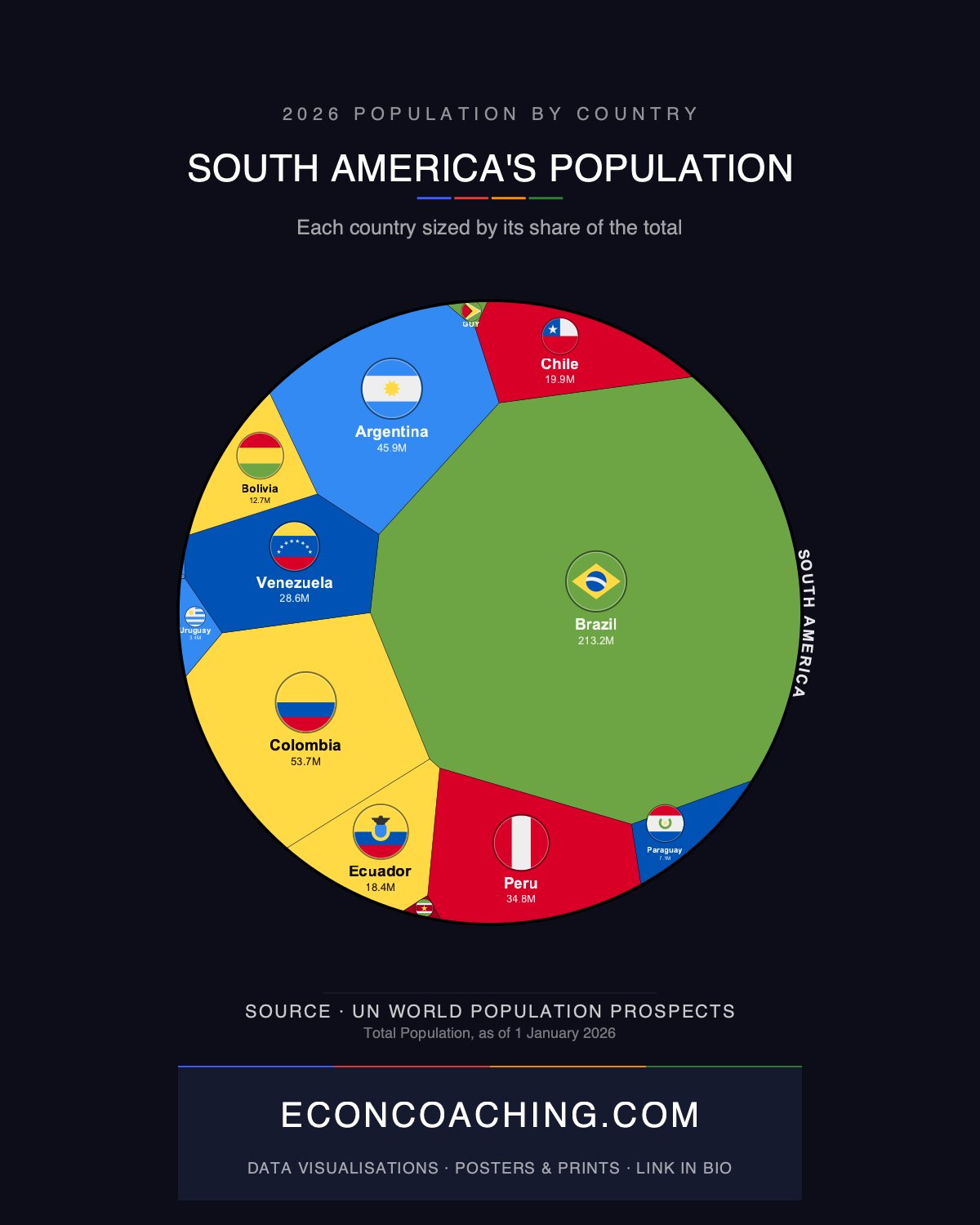
The treemap accompanying this article assigns Brazil a cell nearly as large as all its neighbours combined — and that is not a distortion. Brazil holds 213.2 million of South America's 439.1 million people, exactly 48.55% of the continent's total. It is the only South American country above 100 million, and its nearest rival, Colombia, sits at 53.7 million — a quarter of Brazil's size. The visual surprise of the chart is simply an accurate representation of a continent with one dominant demographic centre and eleven countries sharing the remainder.
One Country, Half a Continent
Brazil's share of South America's population is not purely a function of political boundaries. The country covers over 48% of the continent's land area as well, so population density per square kilometre is not dramatically out of step with regional neighbours. What is striking is the absolute scale of the gap. The top five countries — Brazil, Colombia, Argentina, Peru, and Venezuela — account for 85.64% of the continental total, leaving the remaining eight nations to divide just 14.36% between them. Bolivia, Paraguay, and Uruguay together represent barely 5.3% of South America's population. In the treemap, their cells are marginal; in economic and political terms, they carry correspondingly limited continental weight.
Brazil's dominance also extends to growth dynamics. Its Instituto Brasileiro de Geografia e Estatística (IBGE) confirmed in 2024, following the post-2022 census review, that the country's population will stop growing by 2041. Brazil's fertility rate has collapsed from 6.05 children per woman in 1960 to approximately 1.52–1.60 in 2025, well below the replacement level of 2.1. A country that once drove continental population expansion is now coasting toward demographic stagnation, and because it represents nearly half the continent, its trajectory largely determines South America's aggregate direction.
Colombia's Ascent and Argentina's Slow Fade
In 1950, Argentina was South America's second most populous country. Colombia has since overtaken it and now leads by nearly 7.8 million people — 53.7 million against Argentina's 45.9 million. Colombia's population has grown 27.8% since 2005, compared with Argentina's 17.2% over the same period. The shift reflects sustained differences in fertility and migration patterns across several decades, not a single inflection point.
Colombia's growth rate is itself decelerating, however. It averaged around 1.25% annually over the past decade, and both Colombia and Argentina are projected to reach their own population peaks around 2050. Colombia and Peru, whose working-age populations are still expanding relative to dependents, retain an active demographic dividend through the 2030s and into the 2040s — a genuine economic opportunity, provided labour markets and public institutions can absorb it.
Venezuela's Numbers Hide a Deeper Collapse
Venezuela ranks fifth on this chart with 28.6 million people, a figure that understates the scale of its demographic crisis. Since 2015, approximately 7.9 million Venezuelans have left the country — close to 23% of the pre-crisis population — in what Population and Development Review and the broader academic literature, including work by Garcia Arias (2024), identify as the largest displacement crisis in Latin American recorded history. UNHCR confirmed the 7.9 million displaced milestone in December 2025, with emigrants continuing to leave at roughly 2,000 people per day.
The demographic arithmetic is severe. Venezuela records approximately 1,305 births and 570 deaths daily, which would normally produce net growth. Net emigration of around 1,739 people per day more than offsets that natural increase, producing a net daily population decline of roughly 1,000 people. The country has lost an estimated 18% of its working-age population aged 15–64 and 20% of women of reproductive age — distortions that will take decades to correct even if emigration slows. The 28.6 million figure in the ranking represents those who remain, not the 34–36 million who would be present absent the crisis driven by economic collapse under Nicolás Maduro and compounded by the contested 2024 elections.
A Continent Approaching Its Peak
South America's population growth rate of approximately 0.56% in 2025 is the second lowest of any continent globally, just above Europe. The UN World Population Prospects 2024 Revision projects the continent's population will peak around 2049 at roughly 468–491 million before declining toward approximately 419 million by 2100. South America's global population share peaked at 5.64% in 2001 and is projected to fall to 3.72% by 2100 as Africa and Asia continue to expand.
Uruguay is already past that inflection point. With a growth rate of -0.12% in 2025, it is the only sovereign South American country currently losing population outright — demographically closer to Southern Europe than to its continental neighbours. That trajectory foreshadows what the broader continent faces on a 25-year horizon.
The historical contrast is sharp. South America held the world's highest continental population growth rate between 1951 and 1962, peaking at 2.76% annually in 1959. The continent has completed one of the fastest demographic transitions on record, dropping from that peak to 0.56% in roughly 65 years. The 88.7% urban share and median age of 33.5 years reflect a continent that has urbanised rapidly and is now ageing at an accelerating pace.
The countries best positioned within this trajectory are those — primarily Colombia and Peru — that still have several decades of favourable age structure ahead. Whether that window produces sustained economic growth depends on investment in education, infrastructure, and formal employment. South America's demographic story is not over, but its growth phase effectively is.
One chart like this in your inbox each week, explained in plain English — join the Everything Econ newsletter. Always free, and you can unsubscribe any time.
Take this one home
Get this visualisation as a download, wallpaper, or printed poster.
← Back to all visualisations & articles
Follow Everything Econ: YouTube · TikTok · X · Instagram · Facebook