
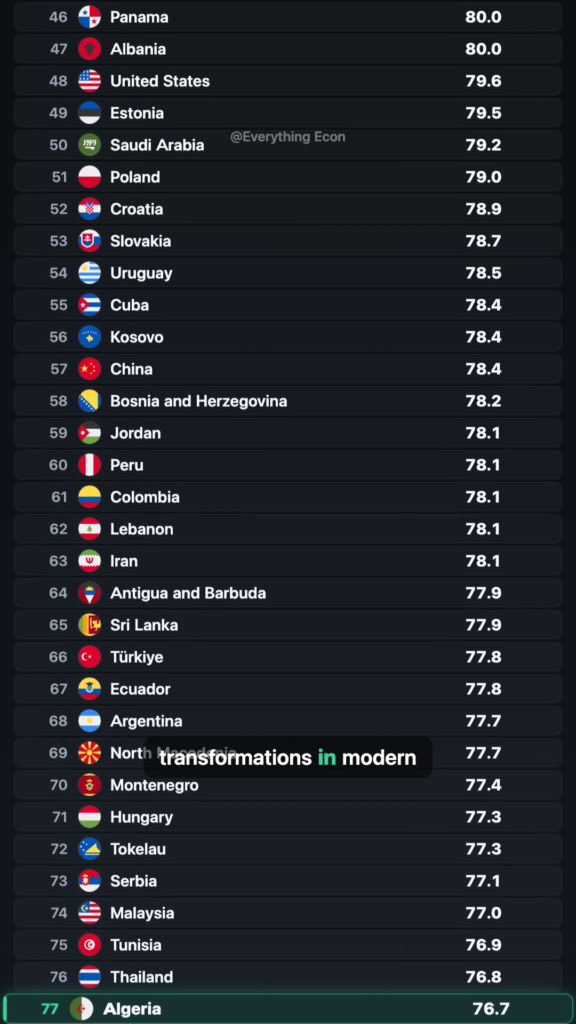
Life expectancy tells you how long a baby born today could expect to live if current health and mortality patterns held steady throughout their life. It's one of the simplest ways to sum up a country's overall wellbeing, because it quietly reflects dozens of other things at once — how good the hospitals are, how clean the air is, how much violence or poverty people face, and how well a government looks after its citizens from birth to old age. The range across the world is staggering: the gap between the longest-living and shortest-living populations is over 31 years, roughly the difference between watching your grandchildren grow up and never meeting them at all.
The high achievers
Small, wealthy places dominate the top of the table. San Marino sits at #2 with 85.9 years, a figure often put down to a Mediterranean way of life — plenty of olive oil, plant-based meals, and an unhurried pace that keeps stress low. Hong Kong (85.8) and Japan (85.0) follow close behind, and Japan's position is particularly remarkable: as recently as the 1960s, it had the shortest life expectancy of any G7 country. That turnaround wasn't an accident. It came from deliberate policy — affordable national health insurance, widespread health screenings, a law targeting non-communicable diseases as far back as 1956, and food education built into the school curriculum. Japanese women, specifically, have topped the global rankings for 40 years running, now reaching 87.13 years.
Notably absent from the top tier is the United States, which recently reached a record 79.0 years. That sounds like progress, but other wealthy nations average 82.7 years — a gap of nearly four years that has persisted despite America's wealth and medical spending. One projection suggests the US could slide from 49th place globally today to 66th by 2050, as other countries improve life expectancy faster than it does.
Regional patterns and what drives the bottom
The bottom of the ranking is dominated by one region: Sub-Saharan Africa accounts for 22 of the world's 25 lowest life-expectancy countries. Nigeria sits last at 54.8 years, with Chad (55.4), South Sudan and Central African Republic (both 57.9) close behind. These figures reflect a combination of factors that compound each other — weaker healthcare infrastructure, higher rates of infectious disease, conflict, and poverty, all of which cut lives short before old age becomes a factor at all.
The COVID-19 pandemic also left an uneven scar. The Americas and South-East Asia were hit hardest, losing around three years of life expectancy between 2019 and 2021 — a reminder that these figures aren't fixed, and can move sharply within a very short period when a shock hits.
The country on top
At the very top sits Monaco, at 86.6 years — nearly a year and a half ahead of second-placed San Marino. Monaco's position is easier to explain once you know who lives there: roughly one in three residents is a millionaire. That wealth buys world-class preventive healthcare, easy access to a Mediterranean diet, and very low air pollution in a tiny, tightly managed city-state. It's a useful illustration of how life expectancy, more than almost any other statistic, tracks the resources a population has to protect itself — from the food on the table to the doctor down the street.
Taken together, the ranking is really a map of advantage and disadvantage. At one end, small, rich places turn money and policy into extra years of life; at the other, poverty and conflict take years away.
Source: UN World Population Prospects 2024.
Get a new data story like this every week — join the newsletter.
Browse every visualisation on the visualisations page.