Every year, economists tally up what a country sells to the rest of the world against what it buys — exports of goods and services minus imports, plus a few other cross-border flows like investment income. The result is the "current account balance," usually expressed as a percentage of the country's total economic output (GDP). A positive number means a country is a net seller to the world; a negative number means it's a net buyer, relying on money flowing in from elsewhere to cover the gap. This ranking, drawn from the IMF's World Economic Outlook, spans over 180 economies — and the spread between the biggest sellers and the biggest buyers is enormous, from +35% of GDP at the top to -44.8% at the bottom.
At a glance · Top 5
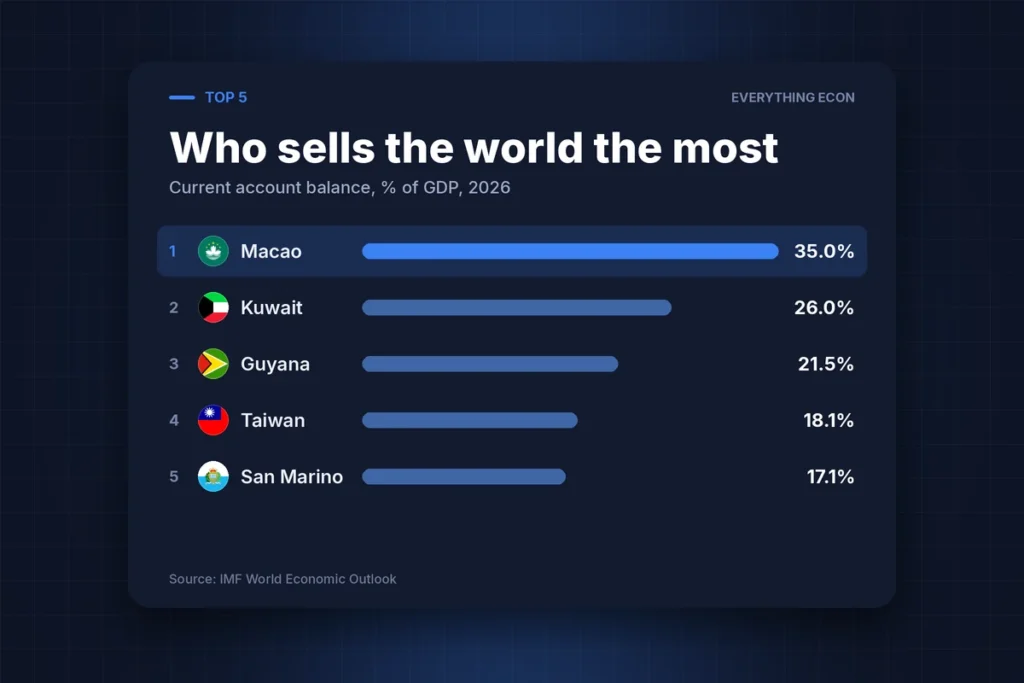
Current account balance, % of GDP, 2026
- 1Macao35.0%
- 2Kuwait26.0%
- 3Guyana21.5%
- 4Taiwan18.1%
- 5San Marino17.1%
Source: IMF World Economic Outlook
Small places, outsized surpluses
The top of the table is dominated by places most people couldn't fit on a map — and that's not a coincidence. Kuwait (26.0%), Guyana (21.5%), San Marino (17.1%), Singapore (16.6%) and Andorra (16.0%) are all small economies where one or two industries generate far more income than the domestic population could ever spend at home. Guyana is the standout mover: it went from a record $2.8 billion deficit in 2019 to a $4.1 billion surplus in 2024, after offshore oil turned it into Latin America's fifth-largest crude exporter and delivered 43.6% growth in a single year — a fifth straight year of double-digit expansion. Taiwan, at 18.1%, tells a similar story built on silicon rather than oil: exports rose 32% year-on-year through October 2025 on demand for AI chips, and its Q4 2025 quarterly surplus of $69.93 billion was the largest since records began in 1981.
Oil, gas and the exception that proves the rule
Several names near the top — Norway (14.3%), Brunei (14.5%), the UAE (11.4%) and Qatar (11.0%) — sell energy to the rest of the world and bank the proceeds. Norway's surplus widened to NOK 286.5 billion in the first quarter of 2025 alone on oil and gas revenue. Denmark (12.3%) breaks the pattern: it has no oil wealth to speak of, and its surplus instead comes from businesses saving and exporting more than the country consumes — a reminder that steady industry, not just resources beneath the ground, can produce the same result.
Why the bottom of the table looks so different
At the other end, Suriname (-44.8%), Mozambique (-43.0%), Dominica (-33.2%), Timor-Leste (-32.0%) and Moldova (-21.9%) are buying far more from abroad than they sell. Mozambique's deficit is largely self-inflicted in a productive sense: it's importing vast quantities of equipment to build huge liquefied natural gas (LNG) projects, spending heavily now in the hope of selling gas later. Others on this list are simply small, import-dependent economies without a comparable export engine to offset their needs.
Macao's casino economy tops the world
The country selling the most to the world, relative to its size, is Macao, at 35% of GDP — nearly ten points clear of second-placed Kuwait. Almost all of it comes from casino gambling and tourism: in the first half of 2024, service exports (chiefly visitors' spending) hit 81.8% of GDP, the highest share since early 2019. That dependence cuts both ways — when COVID-19 stopped tourists from arriving in 2020, Macao's current account didn't just shrink, it collapsed to -54% of GDP, one of the sharpest reversals of any economy on record.
Source: IMF World Economic Outlook.
Get a new data story like this every week — join the newsletter.
Browse every visualisation on the visualisations page.
Take one home
Every country drawn to scale, as an instant printable download or a museum-quality matte poster printed to order.