Debt-to-GDP measures how much a country owes compared with everything its economy produces in a year. It's the standard yardstick for judging whether a government's borrowing is manageable or spiralling — though, as this ranking shows, a high number doesn't always mean a country is in trouble, and a low one doesn't always mean it's safe.
At a glance · Top 5
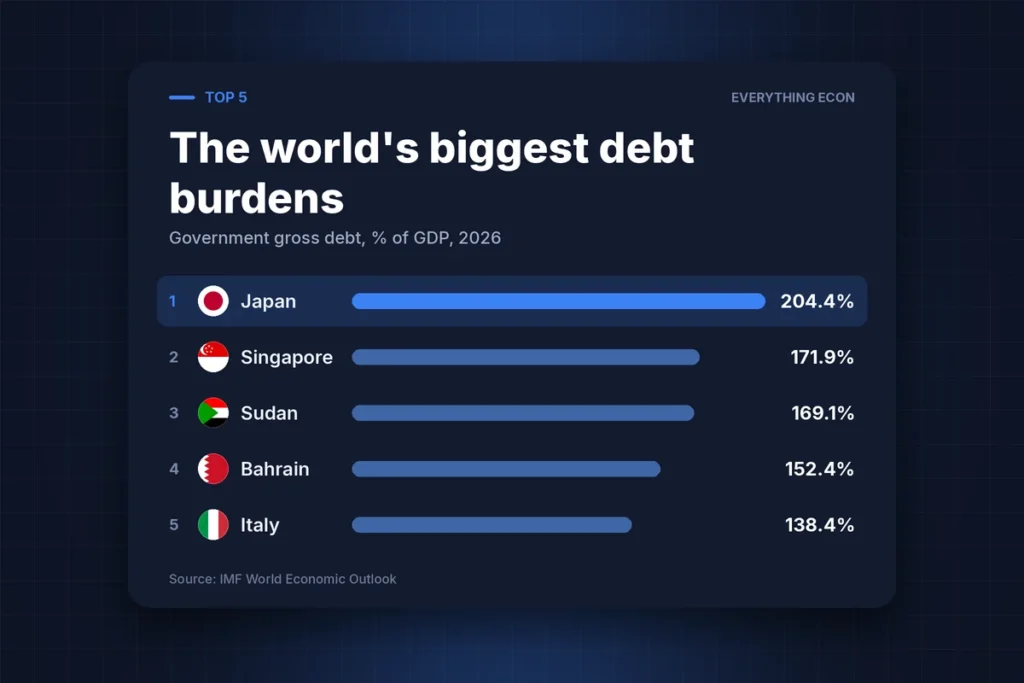
Government gross debt, % of GDP, 2026
- 1Japan204.4%
- 2Singapore171.9%
- 3Sudan169.1%
- 4Bahrain152.4%
- 5Italy138.4%
Source: IMF World Economic Outlook
The usual suspects, and one surprise
Rich, ageing economies dominate the top of the list. Italy (138.4%), Greece (136.9%), the United States (125.8%), France (118.4%), Canada (110.7%) and Belgium (109.2%) have all borrowed heavily for decades to fund pensions, healthcare and public services, and their growth has been too slow to shrink the debt relative to the size of their economies.
But the most striking entry near the top isn't rich at all. Sudan, at 169.1%, overtook every advanced economy except Japan in 2023 — the same year civil war broke out. War destroys the economy that debt is measured against while doing nothing to reduce what's owed, so the ratio explodes. It's a reminder that this number can reflect a collapsing economy just as easily as an over-borrowed one.
Bahrain (152.4%) tells a different story again: its debt roughly tripled between 2012 and 2023, largely because the 2014–2016 oil price crash wiped out the government revenue it had relied on.
Not every high number means danger
Singapore sits second on the list at 171.9%, higher than Greece, Italy, the US or France — yet it holds a top-tier triple-A credit rating. The reason is that most of this debt is owed to Singapore's own pension fund, essentially money the government owes its own citizens, while state-owned investment funds GIC and Temasek hold far more in assets than the government owes. High debt, in this case, is not the same as financial weakness.
Contrast that with Greece, which has made real progress: its ratio has fallen from a peak of 207% in 2020 to 136.9% now, driven by growth in tourism, real estate and shipping. Italy has moved in the same direction, cutting its budget deficit from 7.2% of GDP in 2023 to 3.4% in 2024 on the back of strong tax revenue, with debt now trending down.
At the other end of the ranking, countries like Turkmenistan (3.7%), Tuvalu (3.2%), Brunei (1.5%), Liechtenstein (0.5%) and Macao (0.0%) owe next to nothing. That's less a badge of prudence than a reflection of small, resource-rich or wealth-fund-backed economies that simply haven't needed to borrow at scale.
The country at the very top
Topping the entire ranking is Japan, at 204.4% — more than double the size of its economy. This is the product of decades of government spending to prop up growth in the face of a shrinking, ageing population, combined with interest rates so low that borrowing has rarely felt like a burden. The scale of the demographic shift is stark: the share of Japan's population aged 65 and over rose from 18.4% in 2001 to 30.2% in 2024, pushing pension and healthcare costs relentlessly higher while the working-age tax base shrinks.
Watching closely behind is the United States, which the IMF projects to climb from 126% in 2026 to 142% by 2031 — the steepest rise of any G7 economy. Whether that follows Japan's path, or forces a course correction, is one of the defining economic questions of the coming decade.
Source: IMF World Economic Outlook.
Get a new data story like this every week — join the newsletter.
Browse every visualisation on the visualisations page.
Take one home
Every country drawn to scale, as an instant printable download or a museum-quality matte poster printed to order.