Every year, the United Nations tries to answer a deceptively simple question: which countries are actually the best places to live? Not just the richest, but the ones where people live the longest, healthiest lives and get the best access to education. The result is the Human Development Index, a single score between 0 and 1 that blends life expectancy, years of schooling, and average income into one number. It is, in effect, a report card for how well a country turns its wealth into genuine wellbeing. The gap between the best and worst performers is stark: the top of the table scores above 0.97, while the bottom sits below 0.42 — a difference that reflects decades apart in life expectancy and educational opportunity.
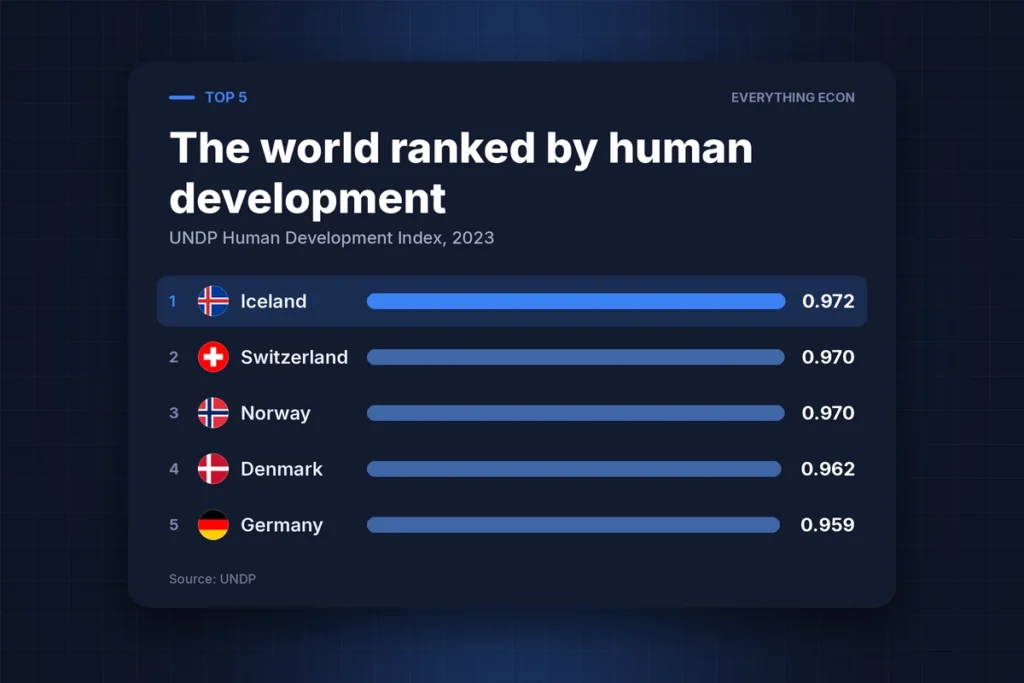
At a glance · Top 5
UNDP Human Development Index, 2023
- 1Iceland0.972
- 2Switzerland0.970
- 3Norway0.970
- 4Denmark0.962
- 5Germany0.959
Source: UNDP
Some of the biggest climbers — and one standstill
A handful of countries show just how quickly fortunes can change. The United Arab Emirates has posted one of the most dramatic rises on record, climbing from 0.710 in 1990 to 0.940 in 2023 — a gain of 0.230 points that now puts it 15th in the world, ahead of France, Japan and South Korea, and the highest-ranked country in the Arab world. China's progress has been even steeper in relative terms: its score rose 64.7%, from 0.484 in 1990 (then classed as a "low" development country) to 0.797 in 2023 (now "high"), lifting it from 104th to 77th. Bangladesh went further still, posting the largest percentage gain of any country on Earth, up 72.5% from 0.397 to 0.685. Turkey climbed 29 ranking places, more than any other nation, moving from 79th to 50th, while Ireland rose 20 places to become one of Western Europe's wealthiest nations after once being among its poorest.
Not every country has shared in this progress. Syria's score was 0.562 in 1990 and stands at just 0.564 today — essentially no improvement in over three decades, a period that includes years of civil war. That stagnation has cost Syria dearly in relative terms, dragging it down 70 places in the world rankings even though its raw score barely moved.
Wealth doesn't guarantee health
The United States illustrates an interesting wrinkle in the data. It scores 0.927, comfortably ahead of the United Kingdom (0.889) and Japan (0.878), even though both of those countries have healthcare systems that cover their entire population, something the US does not have. This is a reminder that the index rewards high income and long average schooling just as much as good health outcomes, so a country can outscore healthier peers on the back of its higher earnings alone.
The bottom of the table
The lowest scores are concentrated in Africa. Niger, Chad, the Central African Republic, Somalia and South Sudan fill the bottom five places, with South Sudan last of all 187 countries at 0.388. There, roughly 99 in every 1,000 children do not live to see their fifth birthday, a stark illustration of how far basic health provision still has to go in the world's most fragile states. These countries share a common story of weak infrastructure, conflict, and limited access to schooling that keeps both incomes and life expectancy low.
And the country that comes out on top
After all the climbing and stalling elsewhere, it's Iceland that tops the entire ranking, with a score of 0.972. It narrowly edges out Switzerland and Norway, both on 0.970 — the three occupy the top spots within just 0.013 points of each other, making the contest for first place remarkably tight. Denmark, Germany and Sweden round out the rest of the top six, underlining just how strongly Nordic and Western European countries dominate the upper end of the table.
Source: UNDP Human Development Report, via Our World in Data. Figures are for 2023 unless otherwise stated.
Get a new data story like this every week — join the newsletter.
Browse every visualisation on the visualisations page.
Take one home
Every country drawn to scale, as an instant printable download or a museum-quality matte poster printed to order.