Life expectancy for women measures the average number of years a girl born today could expect to live, based on current death rates. It's one of the clearest single signals of a country's health system, diet, wealth, and stability, because it captures everything from infant survival to how well a place cares for its elderly. The World Bank's global ranking of female life expectancy shows a gap of more than 33 years between the top and bottom of the table, a reminder that where a woman is born still shapes how long she is likely to live.
At a glance · Top 5
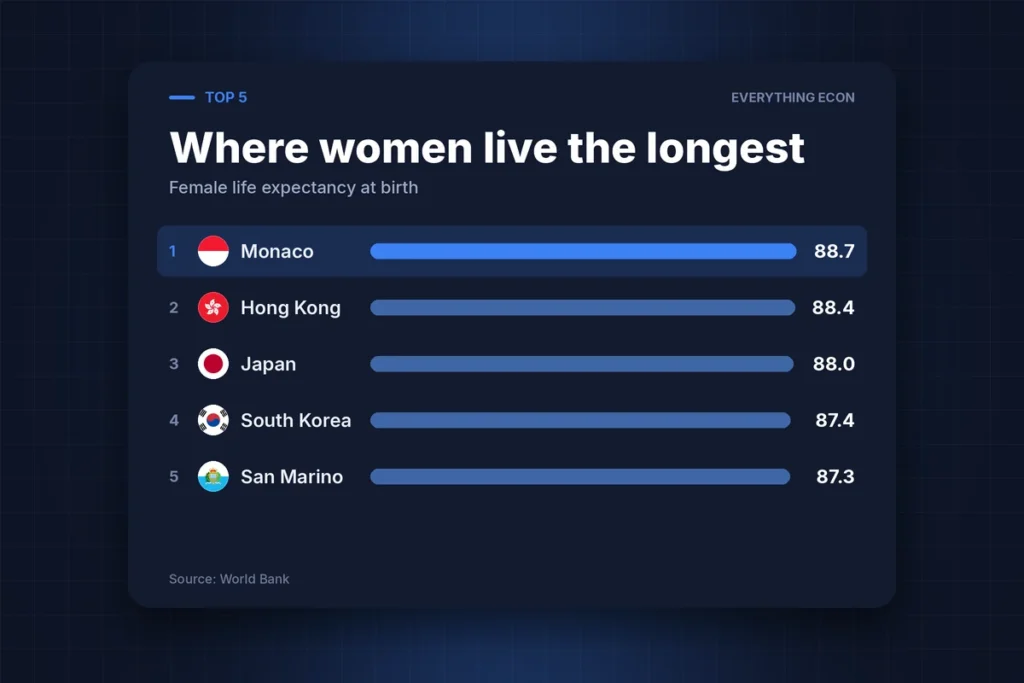
Female life expectancy at birth
- 1Monaco88.7
- 2Hong Kong88.4
- 3Japan88.0
- 4South Korea87.4
- 5San Marino87.3
Source: World Bank
Asia's remarkable rise
Some of the most striking stories are in East Asia. Japan sits at 88.0 years, third in the world, and the number is more remarkable given where the country started. In the 1960s, Japan trailed near the bottom of the G7 industrialised nations for life expectancy. A shift toward a diet built around fish, soy, and green tea, alongside low obesity rates, helped Japanese women's lifespans overtake almost every other country on earth.
South Korea, in fourth place at 87.4 years, is climbing even faster. It already has the highest rate of increase in female lifespan among industrialised nations, and researchers put the odds at 57% that South Korea will become the first country ever to see average female life expectancy pass 90 years, potentially by 2030.
Europe's steady lead, America's decline
Europe dominates the upper half of the ranking, with Spain (86.6), France (86.3), Switzerland (86.1), and Italy (86.0) all inside the top eleven. Spain stands out for a different reason: Spanish women who reach age 65 can expect to live another 23.5 years on average, longer than women aged 65 in any other country tracked by the OECD. That points to strong healthcare for older people, not just fewer early deaths.
The United States, by contrast, does not appear near the top of this list at all, and its recent trajectory explains why. Between 2019 and 2021, US life expectancy fell by 2.41 years, the steepest drop since 1943. Countries including Australia, New Zealand, Norway, and South Korea gained life expectancy over that same period, moving in the opposite direction. Nearly 100,000 opioid overdose deaths a year in the US are a major driver, making it an outlier even compared with Eastern European countries that face similar economic pressures.
What separates the bottom of the table
At the other end of the ranking, the picture is dominated by disease burden rather than lifestyle. Lesotho, in 192nd place at 60.9 years, has the second-highest rate of HIV infection in the world, which weighs heavily on female mortality. Nigeria sits last of all the countries ranked, at 55.1 years, and carries a disproportionate share of the world's malaria burden: 24.3% of global malaria cases and 30.3% of malaria deaths occur there. Chad (57.4) and the Central African Republic (59.8) complete the bottom five, both shaped by limited healthcare infrastructure and ongoing instability.
The country at the very top
Topping the entire ranking is Monaco, where female life expectancy reaches 88.7 years, the highest recorded anywhere. Monaco is a tiny, wealthy city-state, and its number reflects a familiar pattern among the leaders: small population, high income, and excellent access to healthcare. Hong Kong follows close behind at 88.4 years, with Japan completing the top three.
Together, the top of the table tells a consistent story: wealth, strong healthcare systems, and diets low in processed food tend to buy extra years for women. The bottom tells an equally consistent one, where infectious disease and weak health infrastructure still shorten lives dramatically.
Source: World Bank.
Get a new data story like this every week — join the newsletter.
Browse every visualisation on the visualisations page.
Take one home
Every country drawn to scale, as an instant printable download or a museum-quality matte poster printed to order.