Infant mortality counts how many babies out of every 1,000 born alive die before their first birthday. It's one of the starkest measures of how a country treats its most vulnerable citizens, because it captures the combined effect of nutrition, clean water, healthcare access, and the presence — or absence — of conflict. The World Bank's figures show a gap between the best and worst-performing countries that is hard to overstate: a baby born in the worst-affected country is over 50 times more likely to die in infancy than one born in the safest.
At a glance · Top 5
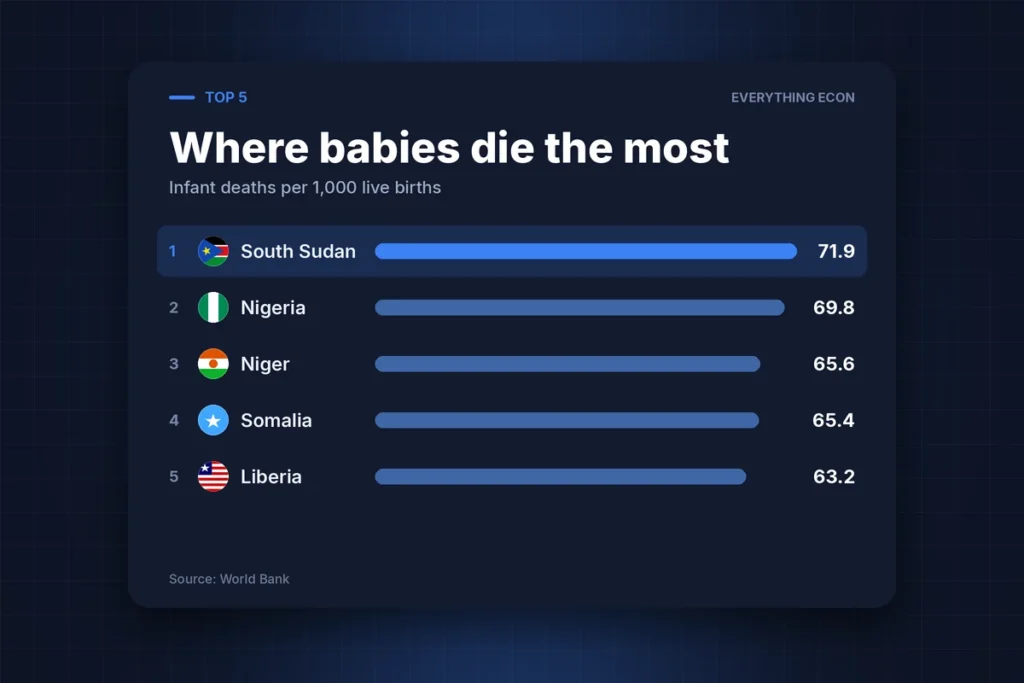
Infant deaths per 1,000 live births
- 1South Sudan71.9
- 2Nigeria69.8
- 3Niger65.6
- 4Somalia65.4
- 5Liberia63.2
Source: World Bank
A death rate shaped by conflict and disease
The countries at the very top of this ranking share a grim set of circumstances. South Sudan, Somalia, and Afghanistan — ranking 1st, 4th, and 13th — are all conflict-affected states, where war disrupts healthcare systems, displaces families, and makes basic maternal care hard to reach. Elsewhere, disease plays the driving role: Zimbabwe (6th, at 62.4 per 1,000) and Lesotho (10th, at 56.3 per 1,000) both carry high rates of HIV, which can pass from mother to child during pregnancy or breastfeeding without proper treatment. Nigeria, in 2nd place at 69.8, tells a different story again — only 38% of births there are attended by a trained health worker, and malnutrition is a factor in half of all child deaths in the country. These aren't separate problems so much as compounding ones: a mother without HIV treatment, in a country without enough trained midwives, in a region where malnutrition is already common, faces a stack of risks that a country like San Marino simply doesn't.
A regional pattern, not a scattering of unlucky countries
What's striking about this ranking is how concentrated it is. Sub-Saharan Africa holds 13 of the 15 worst-placed countries, and the region's overall rate was 44 deaths per 1,000 live births in 2023 — roughly ten times higher than North America's. This isn't a handful of isolated crises; it's a regional pattern rooted in weaker health infrastructure, lower rates of skilled birth attendance, and, in several cases, ongoing conflict or disease burden. At the other end of the table, the safest places to be born are almost all wealthy, stable nations: Belarus, Japan, and Slovenia are tied at 1.8 deaths per 1,000, with Estonia just behind at 1.5. Interestingly, safety doesn't map neatly onto wealth alone — the United States, despite spending more on healthcare than any other country in the OECD, ranks only 32nd out of 38 OECD members, at 5.1 deaths per 1,000. That's a reminder that money spent on healthcare doesn't automatically translate into outcomes for infants; how and where that money reaches mothers and babies matters just as much.
South Sudan: the worst place to be born
At the very top of the ranking sits South Sudan, with 71.9 deaths per 1,000 live births according to this dataset — and by other World Bank measures, its rate runs even higher, at 72.6 per 1,000, the highest in the world. Compare that to San Marino, the safest country in the world at just 1.4 per 1,000, and the gap is roughly 52-fold. South Sudan has endured years of civil conflict since gaining independence in 2011, which has devastated its health system, displaced millions of people, and left large parts of the country without reliable access to hospitals, clean water, or trained medical staff. For a newborn there, the first year of life carries a level of risk that is almost unimaginable in the countries at the bottom of this table.
Source: World Bank.
Get a new data story like this every week — join the newsletter.
Browse every visualisation on the visualisations page.
Take one home
Every country drawn to scale, as an instant printable download or a museum-quality matte poster printed to order.