
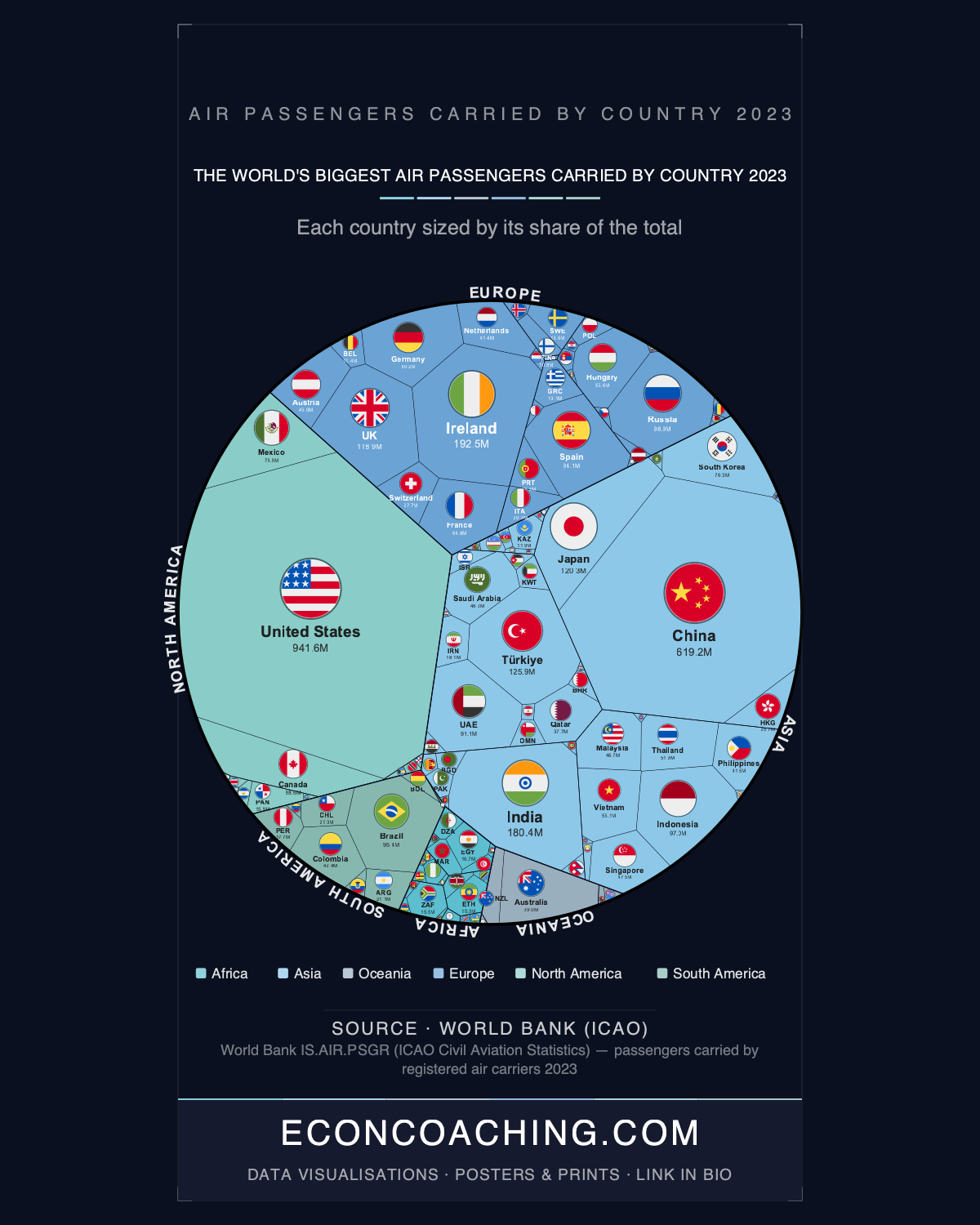
Ireland carried 192.5 million air passengers in 2023, more than India (180.4M) and Japan (120.3M), despite having a population of roughly 5 million against India's 1.4 billion and Japan's 125 million. The treemap accompanying this article sizes each country by that passenger figure rather than land area or population, and Ireland's block sits third largest in the world, wedged between China and India. The distortion is not a data error. It reflects how the underlying metric is defined, and understanding that definition changes how the rest of the ranking should be read.
Why Ireland Outranks India and Japan
The World Bank and ICAO measure "air transport, passengers carried" by the country where the carrying airline is registered, not by the country where passengers depart or land. Ryanair and Aer Lingus are both registered in Ireland, and their combined passenger volumes across Europe get attributed entirely to Irish totals. Ireland's actual airport throughput in 2023 was around 39 million passengers, a fraction of the 192.5 million figure driving its global rank. Germany and France operate far larger physical airport systems than Ireland but rank lower on this metric, at #14 (80.2M) and #18 (64.6M) respectively, because their flag carriers do not dominate European short-haul traffic the way Ryanair does. The same registration effect explains Panama's #41 ranking with 15.75 million passengers, ahead of Nigeria's #58 and 5.3 million despite Nigeria's population of over 220 million against Panama's 4.4 million. Copa Airlines is registered in Panama and operates as a hub carrier for the wider hemisphere, inflating the country's total well beyond what its own population would generate. The United Arab Emirates (#12, 91.1M) and Qatar (#29, 37.7M) follow the identical pattern, together carrying 128.8 million passengers on combined populations under 12 million, almost entirely through Emirates, Etihad, and Qatar Airways functioning as global transit hubs rather than serving domestic demand.
The United States and China Still Set the Scale
Despite the registration distortions further down the list, the top two positions reflect genuine scale. The United States carried 941.6 million passengers in 2023, 22.06% of the global total and more than all of Europe combined, where Russia and every other European country together reached 956.8 million only when the entire continent is summed. China carried 619.2 million, putting it second globally but still well behind the US in absolute terms. That gap is smaller than raw population would suggest, given China's size, and it partly reflects that Chinese carriers were still rebuilding international routes after zero-COVID restrictions lifted in early 2023, with Asia-Pacific international travel recovery lagging domestic recovery through the year.
Asia's Dominant Share Masks an Uneven Recovery
Asia carried 41.7% of all global air passengers in 2023, 1.78 billion, making it the largest aviation region on earth by a wide margin. China's reopening from zero-COVID policy was the primary driver of that regional total, generating one of the largest single-country demand surges the industry has recorded. Yet the region's dominance in passenger count does not mean uniform recovery. Global full-year 2023 traffic, measured in revenue passenger kilometres, reached only 94.1% of pre-pandemic 2019 levels, though the fourth quarter alone reached 98.2%, indicating the industry was closing that gap fast by year end. Business travel lagged the leisure recovery throughout 2023, with agency bookings tied to corporate travel still trailing 2019 levels by around 30% even as total passenger counts approached pre-pandemic benchmarks.
Africa's 2.2% Share Hides a Recovery Story
Africa accounted for just 2.2% of global air passengers in 2023, 95.3 million, despite holding roughly 18% of the world's population. That low share coexists with a genuine recovery milestone: African air traffic had already reached 108% of pre-pandemic 2019 levels by 2023, ahead of the global average. Ethiopia leads the continent at #43 globally with 15.3 million passengers, carried largely by Ethiopian Airlines, Africa's largest carrier, which is planning a $4 billion airport in Bishoftu with capacity for 100 million passengers to handle continued double-digit growth. IATA projects African passenger numbers could double to 341 million by 2043. The continent's total is also uneven internally: Nigeria, Africa's most populous country at over 220 million people, ranked only #58 with 5.3 million passengers, far behind Ethiopia and Egypt, underscoring that population size alone does not predict aviation volume without the carrier infrastructure to match it.
Geography and Growth: Australia, Brazil, and Hungary
Australia carried 69.0 million passengers in 2023, ranking #17, ahead of France's 64.6 million and close to Germany's 80.2 million, despite a population of just 26 million. Its geographic isolation makes aviation the default mode for both domestic and international travel in a way few other countries require. Brazil is the only South American country in the global top 10, carrying 95.4 million passengers, 2.23% of the world total, and South America as a whole reached 210.4 million, more than Africa's 95.3 million despite a smaller population base. Hungary carried 55.6 million passengers in 2023, ranking #19 and outpacing several larger Western European economies on this metric, a position built on carrier registration dynamics similar to Ireland's rather than domestic travel demand alone.
What the 2023 Numbers Signal for Aviation's Recovery
The 2023 dataset marks the first full year in which nearly every major market had dropped COVID-era travel restrictions, making it the clearest baseline yet for judging which countries and regions actually drive global air travel. The countries at the top of the treemap are not simply the largest by population or GDP. They are the countries whose registered carriers, whether Ryanair in Ireland, Copa in Panama, or Emirates in the UAE, have built hub networks that capture passenger volume far beyond their home markets, a structural feature of the industry that will keep shaping these rankings as Africa's growth accelerates and Asia's international routes continue reopening.
For more data-driven analysis of global economics and the trends reshaping the world economy, visit econcoaching.com.
Take this one home
Get this visualisation as a download, wallpaper, or printed poster.
← Back to all visualisations & articles
Follow Everything Econ: YouTube · TikTok · X · Instagram · Facebook