
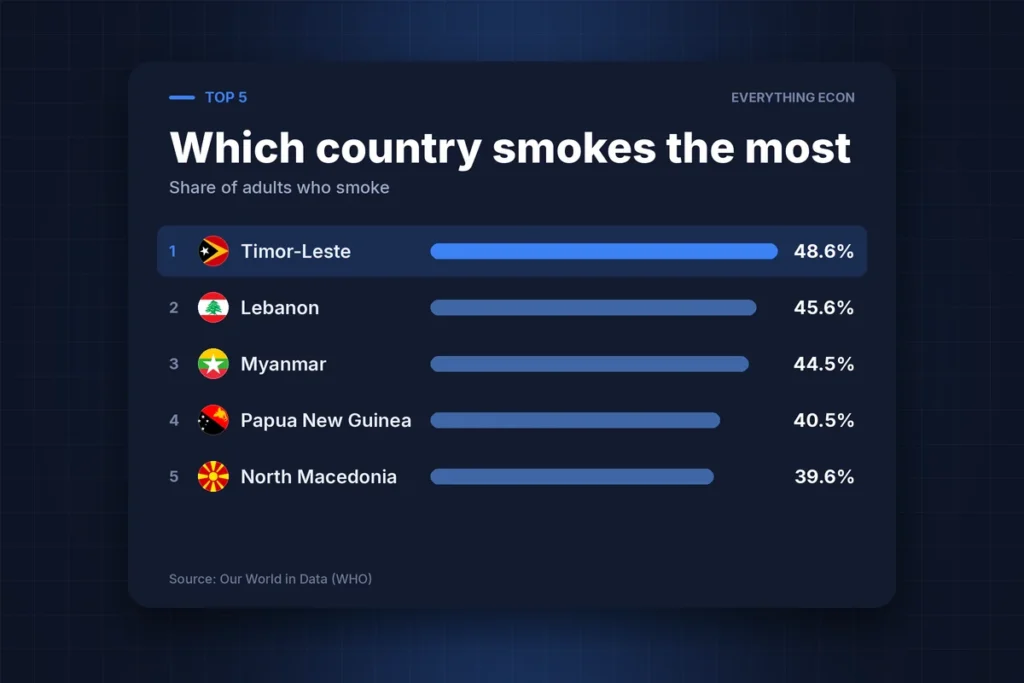
Smoking rates have been falling almost everywhere for decades, driven down by taxes, advertising bans and public health campaigns. But that global decline hides huge gaps between countries. Some nations have pushed adult smoking rates down into single digits, while others still have close to half their adult population lighting up regularly. This ranking, covering 161 countries, measures the share of adults who smoke tobacco, and the spread between the top and bottom is enormous — more than forty percentage points separate the highest and lowest.
At a glance · Top 5
Share of adults who smoke
- 1Timor-Leste48.6%
- 2Lebanon45.6%
- 3Myanmar44.5%
- 4Papua New Guinea40.5%
- 5North Macedonia39.6%
Source: Our World in Data (WHO)
A Balkan cluster near the top
Look past the very top of the list and a clear regional pattern emerges: the Balkans dominate. North Macedonia and Serbia are tied at 39.6%, Bulgaria sits close behind at 39.1%, and Bosnia and Herzegovina (37.6%) and Montenegro (37.1%) round out a tight cluster of Balkan nations. This isn't a coincidence. Tobacco advertising and marketing rules across much of the region have historically been looser than in Western Europe, and cigarettes remain cheap and socially normal. It's a reminder that high smoking rates aren't only found in poorer countries — Andorra (35.4%) and Latvia (35.3%), both comfortably wealthy, also crack the global top 15.
What sets the extremes apart
At the bottom of the table, the pattern looks different. Nigeria has the lowest recorded rate in this ranking at just 3.3%, followed closely by Ghana at 3.5%. Panama and Ethiopia are both at 5.3%, and Turkmenistan at 5.8%. Several of these countries have cultures where cigarette smoking has never taken hold in the way it has elsewhere, alongside strict tobacco controls or import restrictions in some cases.
It's worth separating two different questions the data can answer: which country has the highest rate of smoking, and which has the most smokers in absolute numbers. China wins the second question by a landslide — about 288 million adults smoke there, almost entirely men, more than the entire population of most countries on this list. But because China's overall population is so large, its rate doesn't crack the top ranks. A useful comparison is Indonesia, which doesn't top the general rate but has long had the highest male smoking rate in the world, historically as high as 72.8% and still around 59.7% in 2024 — smoking there is overwhelmingly a male habit, with far lower rates among women pulling the national average down.
The country that tops them all
At the very top of the ranking is Timor-Leste, where 48.6% of adults smoke — the highest rate of any of the 161 countries measured. That means nearly one in two adults in the country smokes tobacco, a rate roughly four times higher than the United States, which has fallen to around 11-12% today after sitting above 40% in the 1960s.
Not far behind is Lebanon at 45.6%, in second place globally. Lebanon's figure is pushed up by something beyond ordinary cigarettes: widespread use of the waterpipe, or shisha, which is deeply embedded in social life there and is counted alongside cigarette smoking in these statistics. Myanmar (44.5%) and Papua New Guinea (40.5%) complete the top four, showing that the very highest smoking rates in the world are spread across Southeast Asia, the Middle East and the Pacific, not concentrated in any single region.
Together, these figures show that smoking's decline in wealthy Western countries is only part of the global story — in dozens of other nations, tobacco use remains as common as it was generations ago.
Source: Our World in Data (WHO), 2024 data.
Get a new data story like this every week — join the newsletter.
Browse every visualisation on the visualisations page.
Keep exploring
 Economy · GraphicWho Holds America’s Debt? The $9.25tn Owned Abroad407K views3 min read
 Economy · RankingThe Countries Where an Extra Three Decades of Life Comes as Standard293K views3 min read
 Economy · RankingThe Countries Where Money Is Growing Fastest — and Where It’s Vanishing279K views3 min read