Every country elects or appoints a parliament, but who sits in those seats varies enormously. The "women in parliament" measure simply tracks the share of seats held by women in each country's national legislature, based on World Bank and Inter-Parliamentary Union data. Some countries have pushed that figure past the halfway mark, while others still have no women in parliament at all — a reminder that formal democracy and equal representation are not the same thing.
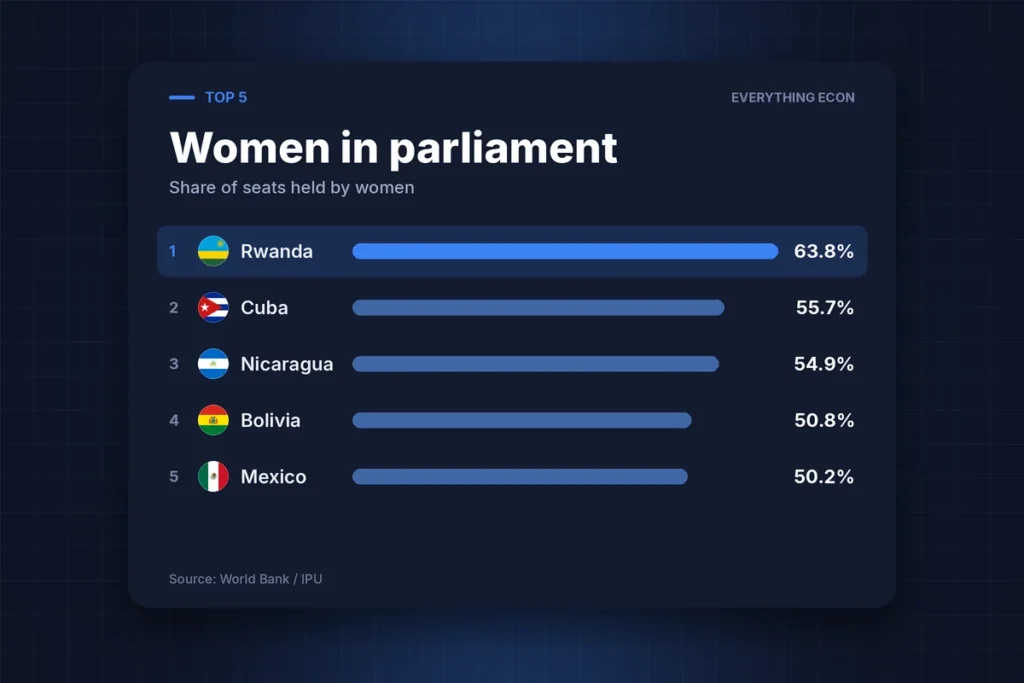
At a glance · Top 5
Share of seats held by women
- 1Rwanda63.8%
- 2Cuba55.7%
- 3Nicaragua54.9%
- 4Bolivia50.8%
- 5Mexico50.2%
Source: World Bank / IPU
The power of a quota
The clearest pattern at the top of the ranking is that the highest-ranking countries mostly got there by design, not by accident. Nicaragua sits at 54.9% thanks to legally binding gender-parity rules for election candidates — parties are simply required to run equal numbers of men and women. The United Arab Emirates offers an even sharper example: after a 2019 royal decree mandated gender parity in its appointed council seats, the country's share of women MPs jumped by 50 percentage points compared with 1995, pushing it to a tied 50.0% today alongside Andorra. Andorra itself gained 46.4 points over the same 30 years, one of the three largest rises anywhere in the world. Kyrgyzstan shows the same forces can move fast even without three decades to work with — a single election in 2025 lifted its women's share by 12.9 points, the biggest one-election jump of the year.
A Latin American cluster, and a very different bottom
Look down the top 15 and the Americas dominate: Cuba (55.7%), Nicaragua (54.9%), Bolivia (50.8%) and Mexico (50.2%) all clear the halfway mark, with Ecuador close behind at 45%, a national high reached after its 2025 election. Cuba's 55.7% makes it the leader across the whole region. Nordic and small European states round out the top group too — Iceland, Sweden and Finland all sit at 45–46%, continuing a longer tradition of high female representation in that part of the world.
The bottom of the ranking looks completely different, and notably absent from it is any single dominant region — instead it's a handful of small or conservative-leaning states. Papua New Guinea (2.7%) and Vanuatu (1.9%) have only a token handful of women MPs, while Oman, Tuvalu and Yemen report 0.0% — no women in their national parliaments at all. In these cases there's usually no legal barrier to women running for office; the gap instead reflects a mix of cultural norms, small legislatures where a handful of seats can swing the percentage sharply, and an absence of the quota systems that have driven change elsewhere.
Rwanda's constitutional bet
Topping the entire ranking, well clear of every other country, is Rwanda at 63.8%. The story behind that number is specific: after the 1994 genocide, Rwanda rebuilt its political system from scratch and wrote a 30% quota for women into its new constitution. That floor turned out to be just the starting point — women's representation has since climbed to nearly two-thirds of parliament, a rise of 59.5 percentage points since 1995, the largest increase of any country in the world over that period. No other nation comes close to that combination of scale and speed.
Taken together, the countries at the top show that high female representation is rarely a side effect of general development — it tends to follow a specific legal or constitutional decision. The countries at the bottom show what happens in the absence of one.
Source: World Bank / IPU, 2026.
Get a new data story like this every week — join the newsletter.
Browse every visualisation on the visualisations page.