
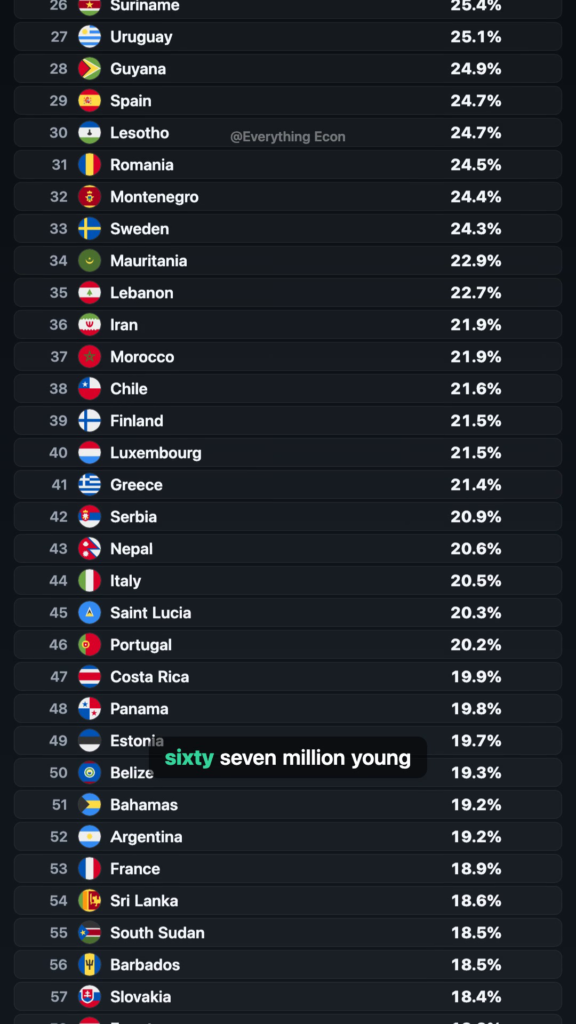
Youth unemployment measures the share of people aged roughly 15 to 24 who want a job and are actively looking for one, but can't find it. It's a different number from overall unemployment, and often a much starker one, because young people are usually the first to be squeezed out when economies stagnate, conflicts disrupt daily life, or public sectors stop hiring. The gap between countries at the top and bottom of this ranking is enormous: from Djibouti, where more than three in four young jobseekers come up empty, to Niger, where the figure is under 1%. That gap says less about which country is "doing better" and more about how differently economies function — and how differently unemployment itself gets measured — across the world.
The Southern African cluster
The most striking pattern in this data is a tight cluster of Southern African nations near the very top. South Africa sits at 59.9%, with youth unemployment having climbed even further to 62.4% by early 2025 — meaning most of the country's 4.8 million unemployed young people have never held a job at all. Eswatini follows close behind at 54.3%, Botswana at 46.0%, and Namibia at 38.0%. This isn't coincidence: these economies share structural issues, including capital-intensive industries (mining, in particular) that don't generate many entry-level jobs, education systems that don't line up with what employers need, and labour markets too small to absorb each year's new graduates. Botswana's case is particularly telling — it has one of the higher average incomes in the region, proof that a reasonably wealthy economy can still fail badly at employing its youngest workers.
Conflict, collapse and cronyism
A second driver running through the top of the list is instability. Libya's 50.1% reflects over a decade of conflict and a fractured, dysfunctional state. Haiti's 37.5% and Palestine's 36.1% tell similar stories of economic collapse under crisis conditions, while Syria, at 33.1%, reflects a country still rebuilding from war. Elsewhere, the cause is less dramatic but just as damaging: Tunisia's 38.1% is widely attributed to low investment, favouritism in hiring, and a public sector that has stopped growing, while Jordan's 38.9% reflects long-standing strains in the wider Middle East and North Africa region, where formal job creation has failed to keep pace with a young, growing population.
The bottom of the table — and what it really means
At the other end, countries like Niger (0.5%), Qatar (0.6%) and Cambodia (0.7%) report youth unemployment close to zero. This isn't necessarily a sign of thriving job markets. In low-income countries with large informal or agricultural sectors, most young people work out of necessity — on family farms or in informal trade — rather than being formally "unemployed" in the way the statistic captures. In Qatar's case, a small citizen population alongside a huge migrant workforce filling most jobs skews the number differently. Low youth unemployment in these places often reflects a different economic structure entirely, not an absence of hardship.
Djibouti tops the table
At the very top sits Djibouti, where 76.8% of young jobseekers cannot find work — by far the highest rate anywhere in the world. The country's small economy is strained by its geography and policy choices: an open-door approach to refugees has swelled the population seeking work, while a sharp divide between its urban centre and underdeveloped rural areas leaves few opportunities outside the capital. It's an extreme case, but one that echoes the same theme found across the top of this ranking — narrow economies, limited job creation, and a young population growing faster than opportunities can keep up.
Source: World Bank (ILO), data referenced from 2024–2025.
Get a new data story like this every week — join the newsletter.
Browse every visualisation on the visualisations page.
Keep exploring
 Economy · GraphicWho Holds America’s Debt? The $9.25tn Owned Abroad407K views3 min read
 Economy · RankingThe Countries Where an Extra Three Decades of Life Comes as Standard293K views3 min read
 Economy · RankingThe Countries Where Money Is Growing Fastest — and Where It’s Vanishing279K views3 min read