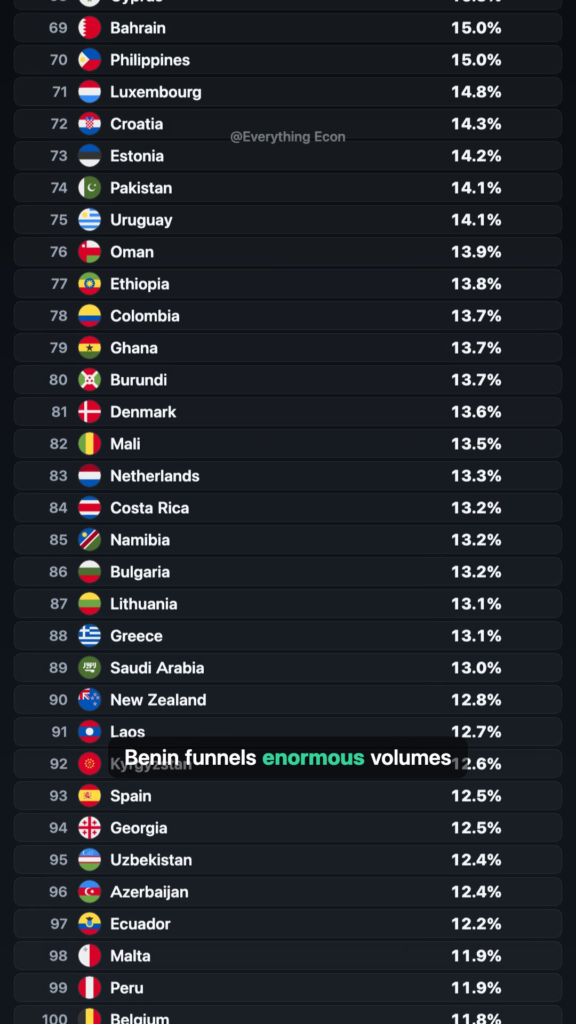
Food is the most basic of necessities, yet for many countries, a striking share of it arrives from abroad. This ranking, compiled by the World Bank, measures food imports as a percentage of a country's total merchandise imports — in other words, of everything a nation buys from other countries, how much of it is food? The higher the figure, the more a country's import budget is consumed by simply feeding its people.
Small Islands, Landlocked Deserts, and Geopolitical Quirks
The top of the ranking is dominated by two very different kinds of vulnerability: geography and politics.
Small island nations appear repeatedly near the top because they have little arable land and no choice but to ship in much of what they eat. Cabo Verde, Aruba, Antigua and Barbuda, Tonga, the Seychelles, and Saint Vincent and the Grenadines all sit between 26% and 33%. For these places, food dependence is simply a fact of island life.
Then there are countries where politics distorts the picture. Iran ranks ninth at 29.5%, but not because Iranians eat unusually large amounts of imported food. Decades of Western sanctions have so thoroughly dismantled Iran's ability to import goods of all kinds that food now makes up an outsized share of whatever trickles through. It is a metric shaped as much by what a country cannot buy as by what it actually needs.
Benin offers a different kind of distortion. It ranks fourth at 33.3%, but researchers estimate that around 90% of the rice and frozen poultry arriving through its Port of Cotonou is quickly re-exported to landlocked Niger or western Nigeria. Benin's high figure reflects its role as a regional trading hub rather than genuine domestic food dependency.
Africa's Structural Problem
Africa stands out as the world's most food-import-dependent region, with an average food-import share of 19.2%. Staple food prices across sub-Saharan Africa surged 23.9% between 2020 and 2022 — the sharpest rise since 2008 — and the continent's agricultural import bill is forecast to balloon from $114 billion in 2019 to $510 billion by 2043, with import volumes rising from 174 million to 754 million metric tons. That is an enormous financial burden for some of the world's poorest nations.
Niger, ranked third at 37.9%, illustrates why. The country loses nearly 100,000 hectares of productive farmland every year to desertification. Growing food at home is becoming physically harder with each passing decade.
The Most Dependent Nation on Earth
That brings us to number one: Comoros, a small archipelago in the Indian Ocean, where food accounts for 42.1% of all imports. The government itself estimates that 90% of everything consumed in the country is imported. Comoros produces very little domestically and relies heavily on cereals and oilseeds — much of it sourced from Ukraine and Russia. When the war in Ukraine began in 2022, the ripple effects were felt immediately in one of the world's smallest and most overlooked nations.
Djibouti sits just behind in second place at 38.6%, facing a near-identical challenge. Its landscape is so arid that agriculture is virtually impossible, leaving it dependent on imports for roughly 90% of its food needs.
The Bottom of the Table
Low figures at the bottom do not always signal strength. Singapore and Hong Kong, ranked 159th and 160th at 3.7% and 3.3% respectively, import food heavily but also import vast quantities of everything else, diluting food's share. The Democratic Republic of Congo ranks 157th at just 4.8% — not because it grows enough food, but because its collapsed economy imports almost nothing at all. Brazil, by contrast, earns its low 5.5% share honestly, with a food self-sufficiency ratio of 185%, producing nearly twice what it consumes.
Data: World Bank.
Get a new data story like this every week — join the newsletter.
Browse every visualisation on the visualisations page.