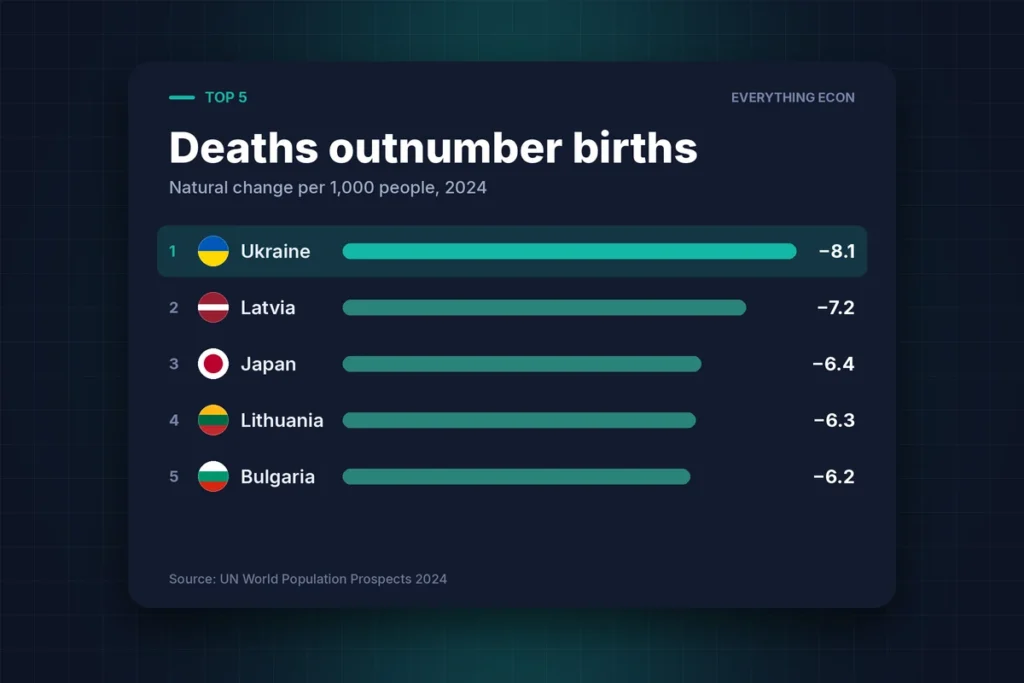
In 2024, 55 of the 237 countries and areas in the United Nations population database recorded more deaths than births, and Ukraine’s natural change was the steepest at −8.1 per 1,000 people. The measure is the rate of natural change: the crude birth rate minus the crude death rate, before migration is counted. When it is negative, a population can only hold steady if enough people move in. The deepest declines cluster in a band running from the Baltic to the Balkans.
At a glance · Top 5
Natural change per 1,000 people, 2024
- 1Ukraine−8.1
- 2Latvia−7.2
- 3Japan−6.4
- 4Lithuania−6.3
- 5Bulgaria−6.2
Source: UN World Population Prospects 2024
Eastern Europe and the Balkans set the pace
Four of the five steepest natural declines among countries with more than 100,000 people are in this region: Ukraine (−8.1 per 1,000), Latvia (−7.2), Lithuania (−6.3) and Bulgaria (−6.2). Japan, at −6.4, is the only outsider in the top five. Belarus (−6.1), Croatia (−5.9), Bosnia and Herzegovina (−5.8), Greece (−5.4) and Serbia (−5.4) follow. Latvia records almost two deaths for every birth (27,400 against 14,000), and Bulgaria about 103,000 deaths against 61,000 births.
Two forces stack on top of each other. Fertility is low, at between about 1.0 and 1.7 children per woman across these countries, well under the 2.1 needed to replace a generation. And since the 1990s many younger adults have left to work in Western Europe, which removes potential parents and leaves an older population that produces more deaths each year. On the UN’s figures Latvia’s population is about 30% smaller than in 1990, and Bulgaria’s about 23% smaller. Ukraine is a special case: its 2024 figure reflects a very low birth rate of 5.5 per 1,000 alongside wartime conditions, and the UN’s estimates for it carry more uncertainty than for most countries.
East Asia: fewer births, older populations
Japan has recorded natural decrease every year since 2005 in the UN series. In 2024 it had an estimated 751,000 births against 1.54 million deaths, a gap of about 790,000 people, in a country with a median age of 49. South Korea is earlier in the same story: a fertility rate of 0.73 produced 241,000 births against 358,000 deaths, a natural change of −2.3 per 1,000. Korea’s rate looks mild beside Japan’s, but with so few births each year, deaths will only pull further ahead as larger older cohorts age.
China is the largest single case. The UN estimates that deaths first exceeded births in 2021, by only about 300,000, and that the gap had grown to roughly 2.9 million by 2024 (8.8 million births, 11.7 million deaths). That is a rate of −2.0 per 1,000 – shallow compared with Japan’s, but applied to 1.4 billion people. Taken together, the 41 countries and areas of over 100,000 people with natural decrease hold a little over a quarter of the world’s population, and China accounts for a large part of that.
Italy, Germany and what migration can offset
Italy (−4.7 per 1,000) and Germany (−3.8) show the difference between a natural decrease and a shrinking population. Italy had about 385,000 births and 664,000 deaths in 2024, a natural change of roughly −280,000. Net migration of around 95,000 offset a third of that, but the population still fell by an estimated 185,000. Germany’s natural change was about −324,000, but in 2023 net inward migration of about 610,000 more than covered the gap and the population grew by around 295,000.
Migration is powerful but volatile, and it rarely closes the gap. Of the 41 larger countries and areas with natural decrease in 2024, only six still had growing populations. In Finland and Belgium that was because arrivals outweighed a natural change of −2.9 and −1.2 per 1,000 respectively; Ukraine’s estimate is highly uncertain. The other 35 shrank.
What changes next
The UN’s medium projection has the count rising to 56 in 2025. Natural decrease is hard to reverse because it is built into age structure: a country with few women of childbearing age will have fewer births even if fertility recovers, while deaths rise as large older cohorts age. For governments, the lever that moves fastest is migration, and that is a political choice rather than a demographic one.
Source: United Nations, World Population Prospects 2024 (Department of Economic and Social Affairs, Population Division), medium variant, demographic indicators for 2024, with 2025 projection noted. Figures for 2024 are projections from a series whose estimates run to 2023.
Get a new data story like this every week — join the newsletter.
Browse every visualisation on the visualisations page.