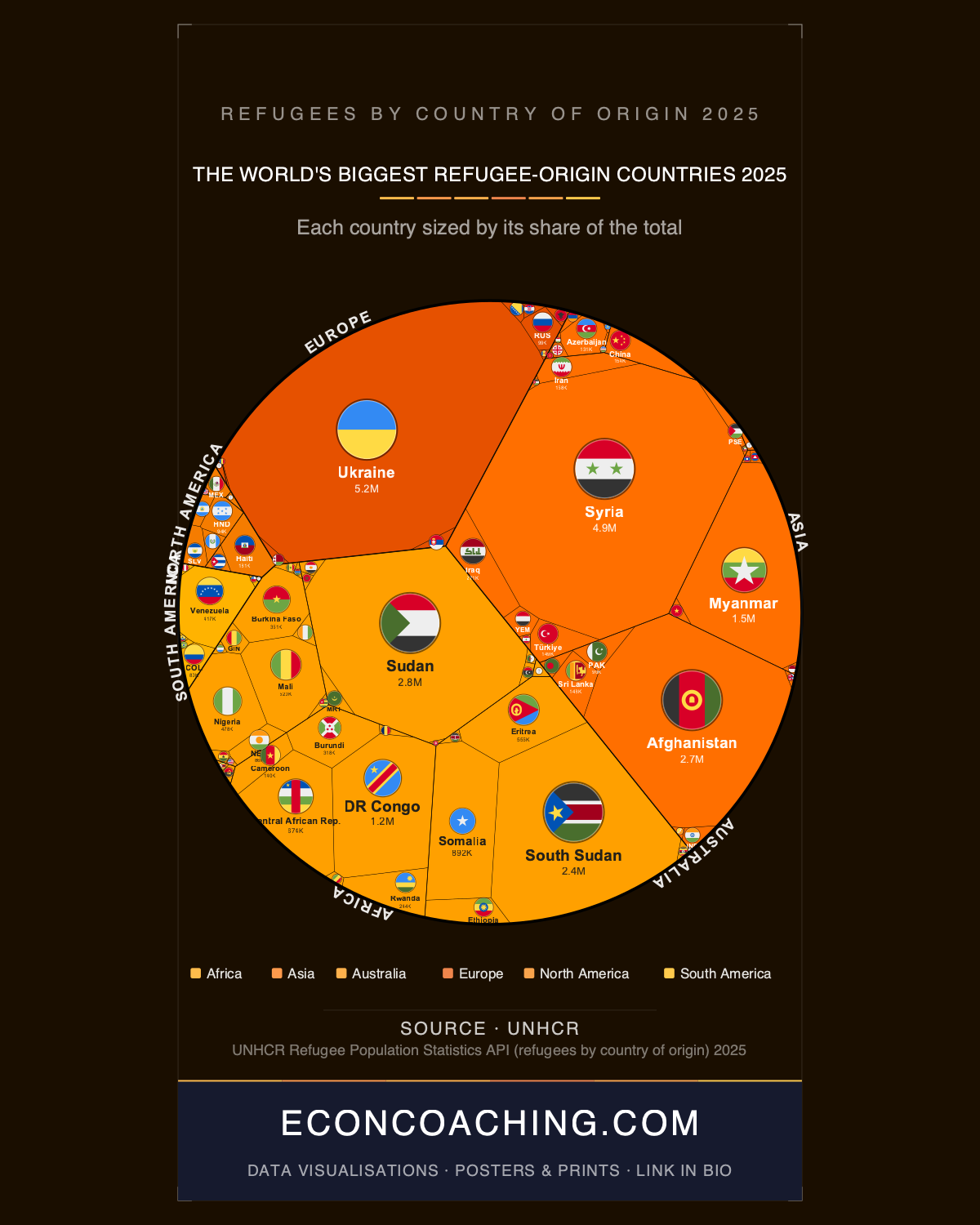
Ukraine now produces more refugees than Syria, a country whose civil war has run for over a decade. The treemap accompanying this article sizes each country by its refugee count rather than its land mass, and Ukraine's cell, at 5.22 million people, 18.6% of the global 28.1 million total, is now the largest rectangle on the chart. Syria, which held that position through most of the 2010s and into the 2020s, has slipped to second place. The shift happened inside a single year, and it says as much about Syria's changing circumstances as it does about Ukraine's war.
Ukraine Passes Syria as the World's Top Refugee-Origin Country
Syria's refugee population fell from roughly 6 million to 4.87 million in 2025, a drop of about 1.3 million people who returned home after the fall of Bashar al-Assad's government in December 2024. That collapse ended the political condition that had kept millions of Syrians from returning since the Syrian civil war began in 2011. Ukraine's count kept climbing over the same period, driven by the continuing Russian invasion of Ukraine that started in 2022. The result is a genuine rank change rather than a rounding artefact: one country's refugee population is shrinking through repatriation while the other's has grown large enough to overtake it. Rankings like this move with the underlying conflicts, and a falling count is not automatically good news, since Afghanistan's decline this year illustrates the opposite case.
Sudan's Refugee Total Hides a Much Larger Displacement Crisis
Sudan ranks third with 2.82 million refugees, behind Ukraine and Syria, but that figure understates the scale of what has happened there since fighting broke out between the Sudanese Armed Forces and the Rapid Support Forces in April 2023. Refugee counts only capture people who crossed an international border. Sudan's total displaced population, refugees plus people displaced inside the country, is around 14 million, making it the world's largest overall displacement crisis despite ranking third here. The same distortion applies to the Democratic Republic of the Congo, which sits at 1.18 million refugees, rank seven, while its internal displacement is far higher. Any comparison built solely on this chart will understate Sudan's and DRC's true humanitarian scale relative to Ukraine and Syria.
Afghanistan's Falling Count Reflects Deportation, Not Peace
Afghanistan ranks fourth at 2.67 million refugees, a figure that has dropped sharply after Pakistan and Iran deported at least 2.8 million Afghans in 2025 alone, roughly 1.8 million from Iran and 930,000 from Pakistan. The UN classified 67% of these returns as forced. A shrinking refugee count for Afghanistan therefore reflects host-country expulsion policy rather than an improving security or economic situation at home, a pattern that stands in contrast to Syria's returns, which followed a change in the political situation Syrians were fleeing.
Africa Produces More Refugees Than Any Other Continent
Africa accounts for 39.7% of the world's refugees, 11.1 million people, more than Asia's 37.3% and close to double Europe's 19.4%. South Sudan (2.39 million, rank five), Sudan (2.82 million, rank three), Somalia (892,000, rank eight), the Central African Republic (674,000, rank nine) and Eritrea (555,000, rank ten) all sit inside the global top ten. The Democratic Republic of the Congo's 1.18 million refugees are rising as M23 Movement forces, backed by Rwandan troops, seized Goma and Bukavu in early 2025, pushing over 1.1 million Congolese into Burundi, Uganda and Tanzania. By contrast, the whole of Australia and Oceania accounts for just 1,264 refugees, 0.00% of the global total, a gap of several orders of magnitude against Africa's 11.1 million.
Venezuela and Haiti Show How Classification Shapes the Numbers
Venezuela ranks only 13th globally with 417,010 formally recognised refugees, despite roughly 7.6 million Venezuelans displaced worldwide overall. Most fled under temporary protection or visa arrangements coordinated through R4V rather than applying for formal refugee status, so its position on this chart is smaller than the underlying crisis. Haiti is North America's largest refugee-origin country at 180,702 people, rank 18, reflecting gang violence and state collapse rather than the interstate wars driving most of the top ten. Together, Afghanistan, South Sudan, Sudan, Syria, Ukraine and Venezuela account for seven in ten refugees and people needing international protection worldwide. The 28.1 million counted here also sit inside a much larger movement of people: 14.7 million displaced people returned to their areas or countries of origin in 2025, up 49% from 2024, with 92% of returns concentrated in DRC, Sudan, Syria, Afghanistan, Ukraine and Myanmar. Most refugees are also not hosted by wealthy countries: low- and middle-income countries host over 73% of the world's refugees, with Colombia, Germany, Türkiye, Uganda, Iran, Chad and Pakistan among the top hosts.
The countries at the top of this list next year will depend on decisions made in the coming months, in Kyiv and Moscow, in Khartoum, and in Islamabad and Tehran's deportation policies, more than on any change in the underlying number of people displaced worldwide. For more data-driven analysis of global economics and the trends reshaping the world economy, visit econcoaching.com.
Take this one home
Get this visualisation as a download, wallpaper, or printed poster.
← Back to all visualisations & articles
Follow Everything Econ: YouTube · TikTok · X · Instagram · Facebook